Storytelling in Games: Does Music Have To Be Poetry?
I want to follow up on my thoughts earlier this week about storytelling in games. I may have implied that all games need to have stories, or that the quality of the stories is definitely a factor in judging how good the game is. That’s not exactly true. It’s helpful to think of this in the same way we think of using words with music. Yes, some songs include wonderful poetry or tell stories, but that’s not a requirement. There are good songs with simple, inane lyrics, or even with no lyrics at all. While a person could argue that songs should just be used to deliver poetry, they would need to use a very expansive definition of the word “poetry” and also ignore many qualities that music can offer.
This isn’t a perfect metaphor, but I think it’s instructive. Music can be focused on poetry, but it doesn’t have to be. And even when it is, we often look for different qualities in poetry that is sung than poetry that is written or spoken. Similarly, stories in games are going to be different than stories in books. When it’s a linear narrative, the point of the story is to give meaning and context to the player’s actions rather than to enjoy the story for its own sake. And when the player can influence the story, that changes everything. How do you discuss or review a story that became unique to you?
This isn’t an entirely new idea. Role-playing games and other shared storytelling experiences have been around for a while. And judging from them, the answer to “how do you discuss them?” may be “you don’t”. There are few things more annoying than a person trying to tell you all about their RPG campaign. On the other hand, the fact that people keep trying to do that is a testament to how powerful the story was to them. It just shows that stripping away the interactivity completely changes the value of the story, just as some effective song lyrics are weak when stripped of the music and written down.
My hope right now is to see games defined by stories that are worth coming back to. Do you know anyone who still plays Diablo instead of Diablo 2? Maybe they play Diablo 2 instead of Diablo 3, but that’s because they have quibbles with the copy protection or skill trees of the third one. Even with Diablo-esque games outside the series, such as Torchlight, the general consensus is that one new, better game can completely replace another. Old games are usually just replayed for nostalgia, or because they offered a unique gameplay element that hasn’t yet been made obsolete by the sequels.
On the other hand, people still read Lord of the Rings and The Great Gatsby. I do frequently argue that old works eventually get supplanted by new ones, but certainly not in the sudden way that games replace each other. I couldn’t imagine a new Terry Brooks series suddenly making Tolkien obsolete. Similarly, old songs become less popular as styles change, but their poetry and stories still stand on their own. Even the games that were revered for their stories ten to fifteen years ago (like Marathon and Planescape: Torment) are pretty much completely ignored today.
Maybe technological advances will always make video games fade faster than books or music. I like to think that this is at least partly because we’re still learning how to use the tools of the genre, though. I hope that someday, it will be common for people to play ten-year-old games because even if their mechanics and engine have been improved upon, the stories they tell are unique.

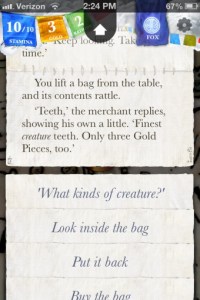 The app does a great job of updating an old game system that had been heavily dependent on a specific technology. I was a little more frustrated with the plot they chose, though. You play a promising young hero sent off on a mission of great import to your people, but it’s possible to play through the whole thing without getting a clear description of what that mission is or what this world is like. Yes, an opening dream sequence mentions a magical crown, but it wasn’t clear to me until halfway through my first game that that was my real goal. And even then, I had no good understanding of why it was urgent to find this item that was lost to the ages, what kind of culture my people had (aside from a few undeveloped hints), or even why I was chosen to seek the crown alone. I spent the first half of my first game feeling absolutely no connection to the events in front of me, even less than I’d expect from a physical gamebook. Though the whole thing plays through in a matter of hours, it still took me a few weeks to find the motivation to get through it.


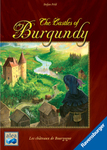 Castles of Burgundy really surprised me with further plays, though. In some senses, it does feel generic – You play a bunch of tiles that score in different ways, like a parody of Euro games circa 2012. It’s a perfect implementation of that “generic Euro”, though, with everything still feeling balanced after a couple dozen games. I’ve seen every major strategy succeed and fail, always for fair reasons. While Trajan has a limited number of ways to score big points, Burgundy always provides multiple opportunities. The trick is to recognize which ones will pay off the best, as well as figuring out how many different directions you can afford to go in at one time.
 Cult of the New