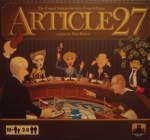
Article 27
Good negotiation games are rare. They always end up dragging on while two people bargain, or being decided by one especially significant deal, or maybe it’s just too easy to calculate everything’s relative value so the game becomes more about the math than the deal-making. Given all that, Article 27: The United Nations Security Council Game by little-known designer Dan Baden is a rare accomplishment, and I’m surprised it hasn’t become more popular. It has some flaws, but it’s still an excellent approach to a negotiation game.
The first flaw may be that the theme just wasn’t attractive enough. It’s named after the part of the United Nations charter that describes how any member of the Security Council can veto a bill. It sounds dry, but it’s a good foundation for a game.
In short, on each round one player will be the “Secretary General”. Five tiles are drawn, each with a color and symbol on it, and everyone has five minutes to negotiate over how they will be voted on. The Secretary General chooses which of these “issues” will actually make it to the table, and then everyone casts a single vote on the group of chosen issues. Any one “veto” vote will kill it, but that costs the player reputation points. Alternately, you can abstain from the voting, because if a majority don’t vote yes, the bill quietly dies without costing you points. If the chosen issues do pass, then everyone gets points. Each round, players secretly draw tiles from a bag to tell them how many points they gain or lose for a specific color tile being passed, and everyone also has a long-term goal to pass as many issues as possible with a specific symbol. Also, the Secretary General gets bonus points as long as something passes, so there is motivation to put issues to vote only if enough players like them.
There is also a system of “bribes”. If you want the current bill to pass (or fail), you can give some of your points to another player if they agree to vote the way you want. The Secretary General can be bribed to include or exclude certain items. Everyone has a play area where bribes are placed, with a token marking what player supplied it, so that it can be returned at the end of the round if you failed to live up to your end of the bargain.
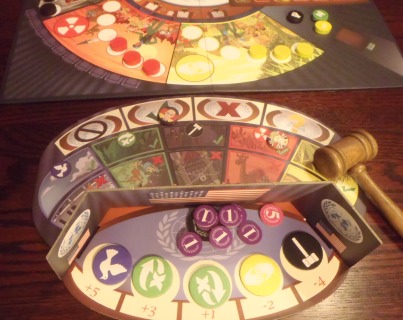
One player’s mat with a bit of the central board beyond. There are two bribes in front of the player’s shield.
And remember, all of this happens in five minutes’ time! It’s a lot of fun, with people negotiating how to vote at the same time they are figuring out what to vote on. At any point in the countdown, someone’s veto threat might convince the Secretary General to add or remove an issue from the bill, and then suddenly other peoples’ opinions about it change as well. Bribes are rescinded, new ones offered, and the people who were in favor of it might suddenly be arguing against it. If you don’t have much chance to get points from the issues, you might still be able to get points if other people bribe you to support them. But be careful, because someone might be pretending not to like something just to collect extra bribes, or they might be quietly planning to sink the bill that everyone else is agreeing on.
It’s fun because, with both the bribes and items up for vote always changing, everyone will always have something they can do to try to earn more points. Also, you have a bunch of people with different secret goals negotiating about multiple things at once, and one change may set off a domino effect. At about five minutes per player (with everyone being Secretary General once), it’s quick as well as fun.
The biggest flaw is probably that the game works much better with some groups of people than others. I’ve played sessions that were chaotic and active the whole time, but also sessions where everyone just quickly came to agreements that everyone could live with, and then they quietly stopped the voting. The latter isn’t very fun with this game. Also, though it claims to work with three to six players, I think that six players is the only good option. With less than that, you have fewer rounds, you exclude a random assortment of the symbols that people are looking for, and you also simply have fewer players. Six people talking something out is a lot more chaotic (in a good way) than four people.
So, Article 27 is a good game that requires exactly six players with the right attitude. That’s unfortunately a lot more limiting than “good games” usually are. But I can say that if you do find that mix, it’s an excellent experience.
Grade: B

 Cult of the New