Archive for the ‘ Books ’ Category

The Man Who Mistook His Wife for a Hat (Book Review)

The Man Who Mistook His Wife For A Hat

The Man Who Mistook His Wife For A Hat

The more one learns about the human brain, the more fascinating – and puzzling – it becomes. For those who want a hint of the depths we have yet to explore, The Man Who Mistook His Wife for a Hat contains twenty-four case studies of people with a wide variety of neurological ailments. All of these non-fiction stories were witnessed firsthand by author Oliver Sacks, leaving the reader acutely aware of how many more strange cases there must be beyond this single person’s experience. Though it’s a little dated now, having been written between the years of 1970 and 1985, it is still considered a classic in certain circles.

The people and conditions described here are definitely interesting, and Dr. Sacks comes across as the kind of cultured, empathetic man who is perfect to the role of helping damaged people get the most out of life. His writing style can be frustrating at times, though. I’m not sure who his target audience was, or if he even had one in mind. Most of the time, Sacks takes a high-level approach that will be comfortable to people with no knowledge of the science that drives his discipline. (It’s often easy to forget that his focus is on the neurological side of things, and not just general psychology.) But when he does bring up the physiology of the brain, it’s in passing references without much explanation. Apparently, the reader is expected to understand the significance of a lesion on this or that area of the brain. Similarly, Sacks frequently drops references to other doctors and their work. Again, there is often little context given, and the reader doesn’t always know why that particular case study is relevant at this time.

It also doesn’t help that most of these stories were first published independently in various places. The book simply takes the original articles and adds postscripts where necessary to tie them together or to update old information. The chapters range from a few pages long to nearly twenty, while some postscripts can be longer than the shorter chapters. Many of the articles would be greatly improved if they had been re-written to incorporate their postscripts’ information more naturally. This is especially frustrating when Sacks wants to compare different cases to each other. He is as likely to refer to a story that appears later in the book as he is to refer to an earlier one, meaning that (on a first read, at least), these comparisons mean as little to the reader as do the references to other doctors’ work. This is a shame, because there are a lot of interesting discussions to be had from these stories, and Sacks’ chapter-by-chapter approach does not do justice to these overarching questions.

That isn’t to say that the stories aren’t interesting in themselves. Some create interesting and memorable characters, such as the aging man perpetually trapped in his past as a nineteen-year-old sailor. Others raise intriguing questions, such as the man whose head trauma made him regain suppressed memories of a violent murder. Does that imply that the mechanism of suppression had been tied to a physical element of the brain? There are clever factoids that armchair philosophers like myself can take away in lieu of real medical training, such as the fact that phantom limbs are necessary in order for a person to use prosthetics. But the real gems of the book are when Sacks takes a quirky condition that is half-understood by the general public and gives us some appreciation for how their internal lives actually are. The case studies of a man who relied on his Tourette’s and the idiots savants who could do little but perform amazing calculations will stay with me and even inform my impressions of other people in the future.

Alternately incomplete, dry, and disorganized, The Man Who Mistook His Wife for a Hat can be difficult to appreciate at times. I had a few false starts before I got into it. I am glad that I did read it in the end, though. Despite its flaws, the book’s highlights will stick with me for a long time.

Grade: B-

Noise (Book Review)

Noise Cover

Noise

Darin Bradley’s Noise tells of the chaos that follows a complete social and economic collapse in the near future. It is the story of a young man named Hiram who follows a movement called “Salvage”, which was dedicated to preparing for just such a collapse. Specifically, Salvage advocates forming a tight-knit tribe (Group) of people to take what they need and kill anyone in their way.

On the surface, Noise appears to be a ridiculous wish-fulfillment fantasy: The main characters encounter little serious resistance in their amoral path, and just happen to have all the training and luck they need to succeed. The “Event” that precipitated this new anarchy is never explained, but seems suspiciously convenient as an excuse for “one day I woke up and had to start killing people”. And the conceit behind Salvage is hard to believe, as well: This community communicates in nothing but obscure broadcasts over unused television frequencies. It has so many rabid followers that the small town of the novel has at least ten warring Groups, and yet it never became mainstream enough to move to the Internet or attract government intervention.

Despite these problems, the novel works. Part of it is the dense, chaotic prose, which can jump without warning between the present and the past, or even multiple events that are occurring simultaneously. Hiram’s backstory is filled out piecemeal as he draws parallels between his childhood and his present, as if he’s trying to justify all his violent actions as pre-ordained or generate a creation myth for his new Group. The writing style provides a glimpse into the narrator’s damaged psyche and ensures that the reader is always questioning him. If this violent story is someone’s wish-fulfillment fantasy, it’s obviously not the author’s.

The other thing that makes this story succeed is the system of rituals and psychological tools that inform Hiram’s interpretation of Salvage. Some are simple (“Hiram” is a new name that he chooses for his post-Event life), but others are complex and surprising. When possible, murders are performed by one member of the Group ordering another to do it, and they provide absolution for the act afterwards by making eye contact and announcing “What you did was right”. The dynamics of the Group have a control that borders on the fascist, but with a shifting, communal leadership that emphasizes the common good over any one person’s. And the fervor with which these people quote the “Book” they’ve created and hunger for new broadcasts from their favorite sources makes it clear that this is more a religion than a survival plan.

Most of all, Noise works because the author doesn’t stoop to any simple answers or feel the need to explain where he disagrees with Hiram. The plot may be straightforward once you’ve pierced the schizophrenic ramblings of Hiram’s narration, but there are only glimpses of a “true story” behind it. Hiram doesn’t realize how selectively his actions pick from the plan in his Book, and doesn’t seem to think about how the Group dynamics will work (or not) once they have settled down and started a new community. The obvious, Fight Club-like hunger for identity through this violence belies the idea that this is simply for survival. Given the choice, Hiram wants attempts to restore law and order to fail. Though the novel never says this, I strongly suspect that the “Event” which led to this post-apocalyptic situation was nothing more than a self-fulfilling prophecy by a critical mass of Salvage participants who had decided that the end was nigh.

Noise is not for everyone. It espouses a gruesome morality, but comes from a literate, deconstructionist source that will turn off people looking for a visceral thrill. It asks plenty of questions, but never raises them explicitly. Yet for all that, it clearly positions itself as a “low art” thriller that doesn’t have to mean anything, rather than aiming for weighty significance. If you can stomach that combination, you’ll find a novel that is sometimes exciting, sometimes disturbing, and always thought-provoking.

Grade: B+

Other Lands (Book Review)

“Elenet, the first man… learned enough of the Giver’s tongue that he became vain. He tried to make his own creations, but because he was not the Giver, nothing he tried came out right. It was always twisted… To warm himself, he made fire, not noticing until later that fire consumes all it touches. To put out the fire, he lifted water from the rivers and created storms. To quell the storms, he blew the sky clean and found he had created deserts.”

Other Lands cover

Other Lands

The second book in David Anthony Durham’s Acacia trilogy continues its exploration of the gray areas of morality and the way that even well-intentioned people will propagate evil. This isn’t always subtle: The opening scene in Other Lands features Princess Mena Akaran hunting down magic-spawned beasts that were a side effect of the wars in the first book. Durham doesn’t let his point bog down the story, though. A strength of his writing is that he can feature a huge number of point-of-view characters, some directly opposed to each other, but almost all with sympathetic motivations.

This novel picks up nine years after the end of Acacia, but the plot follows smoothly from the last page. With the cultures and history of the “Known World” now fleshed out, the scope expands to include the “Other Lands” across the sea. The great sin of the protagonists’ empire is a long-standing slave trade with that land, but no one knows what happens to the “quota children” once they are sent there. Without giving too much away about the status quo after the first book, it’s safe to say that new threats challenge the empire in both lands.

Looking back at my review of Acacia, I see that my chief complaint was “the plodding pace that derails so much epic fantasy”. This is thankfully gone in the new novel. Durham shaves 150 pages from the first book’s 750-page length (measuring by the mass market paperback), and narrows the timescale from a full generation to a few action-packed months. But some of the first novel’s strengths are also lost. Most notably, while Acacia presented major actors on every side with good intentions and a conflicted morality, Other Lands shows us some important people who are easy to dismiss as simply evil. The moral conflicts still do add rich layers to the story, but it’s much easier to root for a winner this time around.

Other Lands also focuses much more on magic and other fantastic elements. This is not a surprise, as the stakes steadily climb throughout the trilogy, but one notable feature of Acacia was how firmly rooted the book was on the mundane and human. Most people, even royalty, knew of no magic beyond their ancient legends, and this was a refreshing approach for an epic fantasy. The fantastic elements in Other Lands are interesting and appropriate to the story, but it doesn’t feel as unique on my bookshelf as Acacia did.

The plot itself is well done, though. As well as being interesting, it does an excellent job of keeping its various elements balanced and moving. Unlike many epic fantasies, every indication is that Durham will be able to deliver a satisfying, timely ending without needing to stretch the series out into additional books. However, it should be noted that while Acacia worked as a satisfying, standalone story, Other Lands is obviously all set-up for the final book. That doesn’t make it bad, but it is always preferable when a book can work both on its own and as part of a larger story. (Also, while Acacia sent the world through major upheavals and could kill off main characters at any time, Other Lands seems to tread more carefully. The status quo evolves slowly, and characters that survived from the first novel seem to be under the author’s protection now. I suspect that this is mainly because the story is building up towards the next climactic chapter, and not because Durham is softening.)

In short, Other Lands continues a fantasy series that is more notable for its unique moral and humanistic concerns than for an especially thrilling story. However, the solid writing and thoughtful build-up make it clear that the next book will be timely and at least as good as the first two. These days, not many fantasy authors can give their fans confidence of that.

Grade: B-

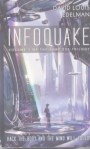
Infoquake (Book Review)

Infoquake cover

Infoquake

David Louis Edelman’s Infoquake is about cutting-edge programmers in a far-future world dominated by “bio/logics”, or programs that extend the human body. This being the future, of course, many things are different: Our Internet has been replaced by the “Data Sea”, modern corporations have turned into “fiefcorps” while religions are replaced with single-issue groups called “Creeds”, and people can use “multi projections” to virtually travel around the world, indistinguishable from flesh-and-blood people except for being intangible.

Infoquake is a fun, fast read that makes a perfect airplane book, but it never reaches the depths that it is aiming for. A culture with generations of experiences so different than ours should be fundamentally changed in some ways. (For books I’ve read recently that explored differences like this, see the shockingly different culture in The City And The City, or to a lesser extent the magic society of the Young Wizards series.) The people in this novel are easy to understand through the lens of our own culture, though. The powerful programs circulating through everyone’s bodies don’t fundamentally change their capabilities, but instead are just used to add flavor to the prose. (For example, it may say that someone “switched on PokerFace” in a place where a present-day novel would say they “struggled to keep their surprise from showing.) Fifty years ago, Isaac Asimov was writing about how the ability to visit people virtually would change our perceptions of self and human interaction. But in Infoquake, the decisions about whether to physically travel or project oneself virtually are entirely based on narrative convenience.

A lot of thought did go into the world-building. The book closes with 50 pages of appendices that actually feel relevant and interesting. It’s just too bad that the result is so shallow, without any of the exploration into human nature that science fiction can provide.

The “fiefcorp” system is another frustratingly-vague element of the book. Most companies in this book are small teams of 10 or so people that only last for a few years. The employees (“apprentices”) pledge to a master for a period of years, earning only subsistence wages with the promise of a big bonus when the contract ends. This system keeps the main characters in the employ of their obsessive, narcissistic leader Natch throughout the story, but it raises many unanswered questions about how such a structure could succeed and continue for generations.

In the novel’s case, the fiefcorp works because the characters are equally vague and defined only by their work. They regularly put in 16-hour days for Natch (with the help of a bio/logics program that keeps them awake, of course), and never mention any hobbies or friends outside of this work. They remain single-mindedly focused on driving the book’s plot forwards.

As for that plot, it is fairly interesting. Natch is a borderline-sociopathic genius driven to succeed in order to quiet an existential emptiness. His fiefcorp’s battles to fight to the top of the bio/logics food chain are redirected when he is given a head start on a mysterious new science initially known only as “The Phoenix Project”, which promises to redefine humanity as much as bio/logics did centuries ago.

Programming marathons and corporate battles are not normally the ingredients for a page-turning novel, but Edelman manages the light touch necessary to keep these moving along for the reader. By the end of the book, a complex status quo has been built up, along with several moving pieces that guarantee this status quo will not remain in place for much more of the trilogy. It is slightly frustrating that so many unresolved elements are introduced late in the story, but it’s obvious that the three books are meant to be read as a whole.

Will the rest of the trilogy address the frustrations I had with the first book? It’s hard to say. This story seemed pretty content to play with the pieces of a distant civilization without actually exploring the consequences of making them so distant. On the other hand, it’s hard to believe that so much world-building couldn’t be setting up something more complex. One scene in the book provides the sort of experience I’m looking for: A sheltered character named Horvil meets “an Islander”, a person who we have been led to believe is less technologically advanced than the rest of the world. To Horvil’s shock, the Islander shows that he is still quite sophisticated and even uses bio/logics, but explains that his people avoid the dangers of all the uncontrolled code that floats around “civilized people’s” bodies. This scene works so well because, two-thirds of the way into the book, the reader has also had time to build up expectations that are now being subverted. A different way of life is being shown, and it mirrors tensions in today’s world without copying them directly. It is possible that the later novels intend to continue correcting the reader’s misunderstandings as the world of the characters changes.

Whatever the future volumes hold, Infoquake is a light, readable science fiction story. It provides escapism, but no deep ideas.

Grade: C+


A Theory of Fun For Game Design (Book Review)

A Theory of Fun For Game Design

A Theory of Fun For Game Design

Have you ever wondered what makes games fun? Sure, you can talk about how you enjoy the challenge or the novelty, but what makes those things fun? What does “fun” mean, anyway? In A Theory of Fun For Game Design, Raph Koster tries to answer the fundamental question of how games work by defining “fun” itself. Though his background is in video games, he finds common ground with everything from sports to role-playing.

According to Koster, games appeal to us because our brain rewards us for learning new things. Games present a structured, learnable system, in effect providing us a lesson that can later be applied to our more complex reality. In fact, Koster takes this to its logical extreme, saying that games are part of the same medium as training drills and school. “Fun is just another word for learning”, and if we don’t normally perceive learning as fun, that is more a failure of school lessons than with the medium itself. After all, our brains are wired to want to learn.

It’s a compelling theory, as figuring out new challenges is a fundamental part of games and it explains why a game will not be fun for someone if it is too simple or too complex for them. Koster builds up this point with a breezy description of cognitive theory, throwing around terms like chunking and explaining levels of consciousness to quickly lay a foundation for the way he sees our relationship to games. This simple style is complemented by the cartoons that are found on every even page. They help the book fly by, partly because those pages read so quickly, and partly because they make it so easy for the reader to peak ahead and suddenly become committed to the next page. They also are effective at driving home Koster’s points; Whether it’s his game design experience or understanding of cognitive theory, he knows that using a second source to repeat a point to a reader will make it much easier to accept.

Continue reading

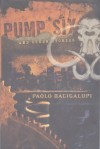
Pump Six And Other Stories (Book Review)


Pump Six And Other Stories cover

Pump Six And Other Stories


Pump Six And Other Stories establishes its themes on the opening page: A massive new skyscraper is being built in the city of Chengdu, using new organic technology that will actually let it grow until it covers the entire city. The description is fascinating enough that readers of this fiction will feel some exhilaration at the future that technology promises. But then, the focus shifts to the main character of the story, a starving beggar boy who lives in the filth under the shadow of this skyscraper. Technology may offer a lot of potential, but what does it matter if it only helps an elite few, while the rest of humanity is used or discarded at the whim of the powerful?

These characters are actually lucky, compared to those who populate the other short stories in this collection. At least here, some people are gaining a better world. In most of Paolo Bacigalupi’s tales, the state of the world has become so horrible that even the abusive rich people would envy our standard of living today. Most of these futures are dominated by environmental disasters, but other evils are more directly man-made: Brutal Intellectual Property police are apparently the only law in “The Calorie Man”, while “The Fluted Girl” creates a culture of slavery by applying a system of stocks and investment to individual people. One of the great features of short stories is that they don’t have to end happily. Since readers don’t invest as much emotion and time into them as they do to novels, the author doesn’t feel obligated to provide a reassuring ending. Bacigalupi takes full advantage of this: Maybe half of the stories end on a note of hope for the protagonist, if you look at them right, but the overarching feeling is one of doom. Whether or not the damage is permanent, the reader will still despair at the path that humanity is taking.

And despair they will. Bacigalupi may be called a science fiction author, but these works are better described as horror. A true horror story doesn’t need shadowy monsters of fountains of blood, but should rather unsettle the reader’s comfortable life. The disasters shown in Pump Six And Other Stories feel extrapolated from the real world, and their “day after tomorrow” nature hits in a more visceral way than present-day Inconvenient Truths can.

Continue reading

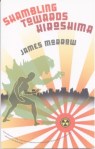
Shambling Towards Hiroshima (Book Review)

Shambling Towards Hiroshima cover

Shambling Towards Hiroshima

Shambling Towards Hiroshima has a hell of a high concept: In the final days of World War II, B-movie actor Syms Thorley discovers that the U.S. has been developing a terrifying new weapon: Monstrous, fire-breathing lizards strong enough to destroy entire cities. Horrified at the thought of the civilian casualties this will cause, Thorley agrees to help the army in a last-ditch effort to end the war without super-weapons. Thorley will wear a rubber suit and pose as a dwarf version of these monsters, so the U.S. can demonstrate their destructive potential to Japanese emissaries. If Thorley is convincing enough as a miniature monster, he just might convince them to surrender before millions of people are killed. Thus begins the highest-stakes monster movie of all time.


Continue reading

Young Wizards Books 1-5


Every now and then, I find myself trying to explain to someone why I’m not a big fan of the Harry Potter series. I still haven’t gotten good at this explanation, probably because I usually change the subject before the other person decides I’m an elitist snob who is trying to over-think their simple pleasures. When I do go into details, I try to explain that it feels like Harry Potter just throws in world-building elements because they are amusing or useful at the time, with no thought for how they fit in to the greater series. It’s not that I’m intentionally nitpicking it, but if I really like a series, the world will keep living on in my head. And it breaks the spell when I repeatedly realize that a conflict from one book could have been resolved easily if the characters had just remembered to use a spell or character from a previous book.

Sometimes, instead of just walking away, the person asks me what alternative I’d recommend to Harry Potter. Usually, I tell them about Diane Duane’s Young Wizards series. Unlike Harry Potter, these books kept kept a foothold in my imagination for years after I read them.

When I discovered the series, there were only three books, and the final one seemed meant as the end of a trilogy. I was happy to discover recently that the series continued after all, and is now up to nine books. I got the first five for Christmas a year ago, and I began re-reading them. It was exciting, but also a little worrisome. Would these live up to the standards that had been set by almost two decades of nostalgia? Short answer: they did sometimes, but disappointed me at other times. They probably aren’t the Harry Potter killers I remembered, but I can definitely recommend them as good young adult fantasy books.

Continue reading

The Year In Books (Part 2)

Continuing from Part 1 a couple days ago, here are capsule reviews of the rest of the books I read in 2010.

Continue reading

The Year In Books (Part 1)

For the past several years, I’ve read a lot fewer books than I used to. Most people blame this on a lack of time, but my undoing was comic books. Comics come out on a weekly schedule, each one updating something from the last month. The system is set up to make sure that you keep up on them, while it’s easy to put off a novel for a while, since it will still be on the shelves months, if not years, later.

I realized how bad this had gotten a year ago, when my birthday and Christmas presents included almost 20 books, but I’d only read about 5 all year. I decided to make more of an effort on novels for the year.

In the end, I read 19 books in 2010. It’s not an incredible number, especially since several of them were novellas or children’s books. Considering that I did it without dropping back on my comics reading, though, I’m happy. This year I’m planning on 25-30.

Rather than going back and doing full articles on things I read in the past, here are capsule reviews. It’s still pretty long, so I’ve split it into two parts. The books I read in the first half of the year are below, and I’ll follow up with part two in a couple days. Continue reading