Archive for the ‘ Games ’ Category

Play By Email Week: Diplomacy

Before last year, the only Play By Email game I’d tried was Diplomacy. Following this blog’s standard practice of only reviewing things that are “new to me”, I won’t be officially grading this. However, it would earn an A or A- if I did, and I still want to talk about it because I think it’s the gold standard for how a PBEM game should work.

For those that don’t know, Diplomacy is a classic board game in which seven players fight over territory in pre-World War Europe. Every army is fairly weak on its own, so it’s important for players to make alliances to help each other. But the constantly-shifting strategic positions, as well as the zero-sum nature of the game, means that you’ll eventually have to break your promises and change alliances. Most of the game is spent with players simply talking to each other, and then they secretly write down orders that everyone turns in simultaneously. People either love or hate this game, as it’s long, intense, and gets players emotionally invested enough to take betrayal personally. Regardless of whether you like the game or not, anyone interested in email gaming should look at how online Diplomacy was implemented. There are two big reasons why I call this the standout for PBEM.

First of all, it’s amazing to see how much this changes when it’s played online instead of face-to-face. I said in my previous article that I’m not interested in email games that simply reproduce tabletop experiences, but I don’t think that’s the case here at all. For one thing, Diplomacy is complex enough that you could easily spend hours planning moves and negotiating with everyone, but typical games only allow fifteen minutes between turns to keep the game down to a single evening. It feels like a sprint that repeats itself every few minutes for hours. Over email, though, there are usually two or more days between turns. That’s enough time to plan and discuss extensively, even while going about your life. Even more importantly, though, face-to-face Diplomacy allows everyone to see who is talking to each other. You may not hear what they say, but you’ll know who may be planning to work together. Online, this is all hidden from others’ views, so you can talk to someone for as long as you want without making your current ally suspicious. In short, tabletop Diplomacy turns both time and conversations into a resource to manage, while email games take those out of the equation to let you focus on the core game. Neither is necessarily better or worse, but it’s fun to experience it both ways.

The second notable thing about PBEM Diplomacy is its implementation. This is written and hosted free of charge by fans, but it’s more reliable and feature-rich than commercial PBEM games. It may be because of its free nature that it’s so robust, because the hobbyists who run the servers don’t have time to handle anything manually. Everything, from requesting lists of open games or rules, to submitting your orders, can be handled with automated email codes. Even better, you’ll get an email back within seconds that tells you what you requested and whether or not you had typed in any errors. It even spells out details that the terse order codes don’t include, so it’s immediately obvious if you typed something wrong. Orders can be changed and errors corrected at any time before the turn deadline. Also, messages can be sent to other players through the system. This keeps the game anonymous if desired (since Diplomacy players try to avoid personal grudges), and lets you clearly identify players as “Italy” or “Russia” instead of “John” and “Dave”. When the game is anonymous, cheating is virtually impossible, because no one knows how to lie or spoof emails when they don’t know any other players’ addresses. These are all little things, but the make the system work very smoothly.
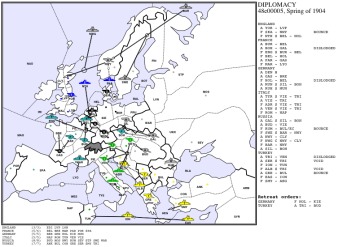
An example from a game I played, using an online mapping utility that helps visualize the game.

An example from a game I played, using an online mapping utility that helps visualize games on dozens of Diplomacy servers.

As fun as this is, though, I can only play every year or two. These games are too time-consuming and intense for me to stick with it more regularly. The standard two-day turnaround time forces you to put in significant effort every day. In addition to that, the game gives late players a grace period, so unexpected delays of hours or days will happen from time to time. Eventually, a late player will be kicked out, and the game will go on hold until someone new volunteers to take over the abandoned position. (And since it was probably abandoned because the player was losing, it usually takes a while before someone is willing to do so.) I think every game I’ve played has had a couple multi-week breaks because of this. This makes planning to play Diplomacy very difficult, because I don’t know what days over the next several months might be focused and busy and which days will have no gaming at all.

A great experience every couple years is still worth noting, though. Diplomacy’s email implementation is not only well-designed, but a fascinating study in the way environment changes a game’s mechanics.

Play By Email Week: Introduction

I’ve had a vague interest in Play By Email (PBEM) Games for a long time, but it wasn’t until last year that I finally made an effort to try them out. Now that I’m ready to discuss them on my blog, my plan is to devote my four articles this week to various PBEM games, starting with a general introduction today.

I haven’t talked about them much, because people usually get confused when I bring the topic up. They assume that I’m either talking about standard games like Chess, or free-form role-playing games with lots of flowery in-character emails. Those options do exist, but they never interested me, probably because they don’t offer anything that an in-person Chess game or RPG couldn’t provide. Instead of Chess, I’d want my email game to provide extra complexity and communication to take advantage of the long delays between turns. And I prefer things more structured than the RPG story-telling people think of, more World of Warcraft than Dungeons & Dragons. In short, these are games where people submit moves (in some pre-defined code) to a server, so a central computer can process them and send out results. The fun does come from talking and strategizing with players between turns, but the heart is a strict rule-based system.

So why am I looking at these games now, when there are so many other options available in 2013? Well, admittedly, the initial impulse was just scratching an itch from 20 years ago, when I heard about games like “Monster Island” through a friend of a friend of a friend, but the internet was so young (as was I) that there was no good way for me to find them. But even with my initial curiosity satisfied, they’re still interesting. As with gamebooks and text adventures, I’m fascinated by the story and game possibilities in niche hobbies that continue to evolve long after technology has passed them by. Besides, I love the tension that comes from games that let all players make simultaneous choices, and those are common when everyone submits secret orders in PBEM. Finally, from a practical standpoint, I don’t have a lot of time these days for long, drawn-out games that require me to schedule hours of time with a group. With email, I can catch up when I have time, but the game slowly builds (and sticks in my head) for months at a time.

The main drawback is that the PBEM community isn’t very robust. While gamebooks are enjoying a comeback due largely to nostalgia, and text adventures have flourished in a community dedicated to exploring their artistic possibilities, Play By Email has mainly continued on as a hobby for people who liked Play By Mail in the past. The audience tends to be older, conservative, and surprisingly unsavvy about technology, as well as (from what I’ve seen) universally male. The games are pretty much the same ones that you could find decades ago, and their prices often reflect a past era in which someone had to painstakingly copy all your snail-mailed orders into a computer . In fact, I’m surprised by how many things that could be done automatically are still handled manually by the person running them, because there was never any drive to evolve.

Still, I’ve enjoyed experimenting with these, and I plan to continue on with some of them. I don’t know how quickly I’ll get around to trying the other games that sounded interesting, so expect it to be a while before I post any follow-ups after this week. (PBEM games tend to move slowly. I started this experiment about a year ago, and I wasn’t ready to write up these impressions until maybe a few months back. So even if I sign up for new things now, It would probably be near the end of this year before I report back.) On the other hand, it’s interesting to note that each of the three topics in my upcoming articles had their own community, with almost no awareness of the other PBEM groups out there. I choose to interpret that optimistically, and say that the next game I try could be completely different from any one I’ve seen before. That possibility is always going to drive me on.

Deck-Building Game Reviews: Core Worlds, For the Crown, and Puzzle Strike

I talk about deck-building games fairly often, usually to complain that they copy Dominion while missing the point. There have been some clever twists, but only one real success so far. However, these days Dominion is a well-established part of the board gaming scene, and we’re seeing more and more innovation.

Here are reviews of a few other games I’ve been trying out. Admittedly, each one is at least a year old, so they prove that this innovation has been growing for a while. However, I’m heartened by both the successes and failures here. Even when these have problems, it’s not that they misunderstand the game they’re copying. I think that the most exciting times for the deck-building mechanic may be just ahead. Continue reading

Astronut and Pangolin: Two iPhone Aiming Games

For today, here are two quick reviews of iPhone arcade games. I wouldn’t quite call them puzzle games, but both are based more around timing and aim than standard arcade elements. Both are also available for free, with in-app purchases used to purchase the whole game if you like the early demo levels.


AstronutAstronut

Astronut is a few years old; I remember it being one of the first games to use that in-app purchasing model. In it, you play a sort of base-jumping spaceman who leaps from one rotating planet to the next. Instead of directly moving him, you have to wait for the planet to rotate to the right position and jump at the right moment. This makes the Jump button about the only control in the game, though there is also a “Boost” ability that lets you shoot straight ahead for a time, passing through planets and destroying enemies.

As it was made by the design experts at the Iconfactory, you’d expect Astronut to handle this simplicity well. It does, to an extent. The game is quick to learn, and the different kinds of monsters are planets you encounter are all easily recognizable. It’s enjoyably cute, without being busy or distracting. However, the controls aren’t as elegant. In a game in which one basic action is used 95% of the time, I’d expect to be able to just tap the screen to use it. Instead, both Jump and Boost are accessed with little buttons in the bottom corners, and the rest of the screen is a giant pause button. It’s easy to pause this by accident, which is really frustrating in a timing-based game.

The goal of the game is simply to dash forward to the end of each level, and it’s fun when everything goes right. But sometimes it’s annoying how easy it can be, as most enemies only hurt you when you’re in space, and most planets in the early levels let you hang out on them harmlessly as long as you want. Your Boost power takes time to recharge after each use, but that’s not actually a problem. On the other hand, it can feel difficult sometimes, because timing your jump can be difficult. But failing in that just feels arbitrary, rather than a punishment for a mistake.

This arbitrariness is largely because, if you jump farther than a short hop, your character starts to drift in space, spinning wildly but attracted by the gravity of nearby planets. The game encourages this (long hang times are even worth points), but whether you land safely or not is completely left up to chance. Especially when later levels add barriers to bounce off of and planets that push you away, sometimes it just feels like watching a pinball bounce around.

Grade: C


PangolinPangolin

A pangolin is a scaly tropical anteater, but you don’t need to understand that to play Pangolin any more than you need to recognize a hedgehog to play Sonic. The animal’s one relevant feature is that it rolls up into a ball when threatened. Here, your character spends the whole time in ball form, trusting you to bat it through an obstacle course. You have a limited number of shots to make in each level, but because the pangolin is almost always flying through the air, it’s much more hectic than golf. Also, you’re rewarded for finishing with shots remaining and for picking up the coins and gems on each level. That gives each course multiple levels of difficulty: First you can try to make it to the end at all, and then you can try to redo it better. Thanks to this, even the free teaching levels offer a good deal of challenge and replay value.

To bat the pangolin around, you tap two fingers on the screen to make a platform it can bounce off of. The position and angle matter a lot, of course, and even the distance between your fingers determines how much force the bounce will have. As you can imagine, this is easy to mess up, especially since the pangolin’s constant movement means that the view you’re trying to tap on is always scrolling by. However, the difficult aiming never becomes as annoying as Astronut. Most importantly, it’s because levels take under a minute each to complete. Retrying a shot that happens ten seconds into a level is hardly frustrating at all. Also, Pangolin lets you restart the current level by swiping your finger to the right. I was suspicious of this non-standard UI control at first, but it really works. Before long, restarting after a mistake becomes so reflexive that the action never stops at all. It’s actually easy to retry than it is to leave the game, which makes this dangerously addictive.

Once I do stop, though, Pangolin’s addictive hold fades. It’s simple and repetitive enough that I can go days without thinking about it again. The next time I do try it, though, I’m always surprised by how immersive and fun it is. It has a unique cartoony appearance (I especially like the textured look of the backgrounds), a physics model that feels very natural (among other things, it lets the pangolin hug the insides of curves, which is necessary for a lot of the moves in the game), and challenges for different skill levels. I’m looking forward to having more level packs to buy in the future.

Grade: B


Agricola: All Creatures Big and Small (Game Review)

Agricola: All Creatures Big and Small box

Agricola: All Creatures Big and Small

Although Uwe Rosenberg’s Agricola is a great game, I wasn’t at all interested in trying Agricola: All Creatures Big and Small. Two-player versions of games don’t seem very exciting when the original is already perfectly fine with two players. As for the idea that All Creatures is simpler, Agricola already comes with “Family” if that’s needed. I was wrong, though: It turns out that instead of calling All Creatures “simpler”, it would be more accurate to describe it as “streamlined”. In only twenty minutes, it captures the essence of a two-hour game.

All Creatures is still a worker placement game about building your 17th Century farm, but it strips out most of the thematic elements that seem vital to the original. You don’t expand your house or add family members, there are no fields and crops, and it doesn’t even have the “Harvest” phases that provide the main tension in the original. Now, you get some points for filling up space and adding new buildings (each with a cost and special power), but most of the points come from the number of animals you can obtain. Your enclosures and buildings can only hold so many creatures each, and two or more  of the same type will breed a new animal after every round of the game.

A player board at game's end

A player board at game’s end

In principle, the game feels a little friendlier: The punishing deadlines of the Harvest are gone, along with most of the sources of negative points in Agricola. But now you are constantly one or two steps away from running out of space to hold all your animals, and if you don’t want those points to just wander away, you need to constantly rush to add on to your domain. At three moves per round and only eight rounds, it’s significantly shorter than Agricola’s fifteen rounds (and up to five moves each by the end). However, it drops you right into the point where time is slipping by, and every type of animal that doesn’t reproduce at the end of each round feels like a missed opportunity. In other words, the seven rounds of Agricola that are dropped from All Creatures are those initial ones that start the game out so slowly.

Agricola: More Buildings Big and Small box

Agricola: More Buildings Big and Small

All Creatures’ great flaw is its repetition, though. Players have no hidden cards or agendas, and every game is set up the same. Much like the original’s Family game, you deal with the same situation every time. On its own, it would feel pretty limited after a few plays. Fortunately, there’s an expansion called More Buildings Big and Small that adds several new building tiles, each one with a different ability. Only a few random ones are to be used every game, so each game becomes unique. It’s far from perfect: These buildings play a much smaller role than the cards did in Agricola, and when the price of this is added on to All Creatures’, they cost almost as much as that original game. It’s fun, and feels very meaty for a filler, but it still seems like it should be priced a little closer to the filler side of things.

Those caveats aside, though, the Agricola: All Creatures Big and Small family is a great idea. Agricola is just a little too long and polarizing to make it to the table very often. A fast, two-player alternative that actually fills that same niche is much easier to get to.

Agricola: All Creatures Big and Small: C+

Base Game with Agricola: More Buildings Big and Small: B

(Images above from Board Game Geek. Follow the links for the original and photographer credit.)

Dungeon Petz (Game Review)

Dungeon Petz box

Dungeon Petz

Vlaada Chvátil’s Dungeon Lords has become one of my favorite games. Admittedly, it’s a long game that puts lots of emphasis on two short battle rounds, so a brief mistake can be devastating. But it’s still very fun, with a hilarious theme, choices that have lots of ramifications, and an action-selection system that stays interesting even after it has become familiar. Now Chvátil has created a new game, Dungeon Petz, set in the same fantasy world. Where Dungeon Lords centered around evil beings building underground lairs, this is about the hard-working imps creating pet shops that raise various monsters.

The art, humorous rulebook (with very clear explanations), and playing time will all be familiar to a Dungeon Lords fan. Both games are also built around worker placement, with a twist that comes from players making simultaneous choices. But that’s where the similarities end. In Dungeon Petz, the choice is in how to group your imp workers at the start of the round. When they’re all sent out to market, the bigger groups will have more “buying power”, and thus get to go first. This lets you decide whether you want to take a few actions before everyone else, or many actions after the other players have taken the good spots, or some mix in between. The goal is to buy baby monsters, set up cages suited to their unique needs, and then earn points by showing or selling them.

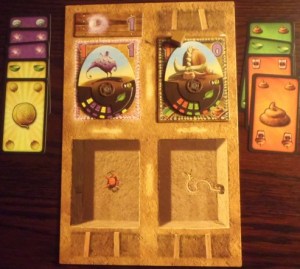
A view of two pets and their needs (with one poop cube in play!)

A view of two pets and their needs (with one poop cube in play!)

Of course, there are a lot of different factors to track in the game. The most important is in meeting the needs for each animal. Each one has multiple dots of different colors, with an elegant wheel increasing the total number of dots as the animals “grow” from round to round. After actions are chosen, you must draw cards of matching colors, and assign them to your pets so that each one has the same number and types of “needs” as its figure shows. Those needs, which include eating, playing, pooping, and unstable magical energies, must be met by paying certain resources or having a cage designed for them. (The cards are random, but each color has a different focus, so you can make educated guesses ahead of time.) If needs can’t be met, that pet will be less appealing to customers. Also, there are cubes to mark the amount of poop each pet makes. As with Dungeon Lords, this is a funny game, despite its complex, balanced rules.

In fact, I would say that Dungeon Petz is arguably the better-designed game, as it features scoring opportunities on almost every round (exhibitions and potential customers). Points accumulate gradually, and a single bad round won’t determine everything as it can in Dungeon Lords. I still say that Dungeon Lords is the more fun one, though. It may be difficult to control, but it has the personality to make up for it. And the simultaneous selection in that game is pure genius. Outguessing your opponents can lead to them taking actions that don’t help because they didn’t get other actions they needed. In contrast, Dungeon Petz feels like a much more traditional worker placement game. The initial choices just determine how many actions each player will have, and in what order. After that, everyone takes turns choosing actions, so if you didn’t get everything you wanted, you can immediately readjust your strategy. There’s nothing wrong with that, but the actions don’t feel that interesting. It’s the pet management on your personal board that feels fun, and that is only a portion of the game. Also, each round of Dungeon Petz involves several phases, which are difficult to remember even when looking at the reference card. This can make the game confusing, especially since planning ahead is vital.

It works best with three players. With four, everyone plays fewer rounds to keep the playtime down, which means that the endgame planning has started by the time the game really gets going. This makes a nice alternative to Dungeon Lords (which plays best with four people), but the three-player game does add extra rules to account for a “dummy” player blocking certain actions.

Dungeon Petz isn’t a great game, and it depends a lot on the goodwill generated by Dungeon Lords’ rich, amusing theme. But it still adds to that world, and it is fun if less distinctive. Very importantly, the two games feel related but are still different enough that one person can justify owning both.

Grade: B-


Might & Magic: Clash of Heroes (iPhone Game Review)

Might & Magic battleThe first thing you’ll see when starting Might & Magic: Clash of Heroes is a warning that quitting the game at the wrong time will corrupt all saved game data. That’s just not an acceptable flaw for an iPhone game to have, and it’s the first sign that this Nintendo DS port may not have been planned very carefully.

I bought Clash of Heroes because, after trying 10000000 and DungeonRaid, I was curious to see another cross between an RPG and a Match 3 puzzler. This game also rewards planning and puzzle solving, but it’s much more of a traditional turn-based RPG than those other two. Not only does it include normal JRPG elements (including exploration, a verbose but half-hearted story, and unnecessary mini-puzzles), but higher-level characters will crush weaker ones no matter how well or poorly each side plays the Match 3 game.

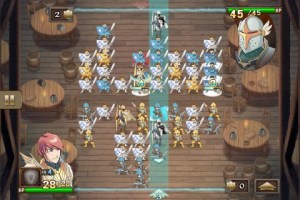
Judged by RPG terms, the battle system is very clever. Your hero leads units of three different colors that go in a grid formation. If you create three matching ones in a column, they will attack up that column, destroying opposing units and hopefully reaching the far end to damage their leader. If you match three in a row, they turn into a defensive wall to block attacks. Combos give you extra actions, and proper positioning can “fuse” and “link” attacks to make them stronger. There are also larger “Elite” and “Champion” units, which become especially powerful if normal units are lined up behind them.

A boss battle

A boss battle

It’s fun, especially since the campaign comes up with a lot of clever twists on the basic system. Some battles require you to attack targets in specific columns, maybe also in a certain order, or planning ahead as they move around. Bosses have unique patterns and attacks, and you can plan ahead by swapping around the units and magical artifact you’ll take into battle. Plus, as this is a Might & Magic game, you know that there will be several different factions, each with units that have their own special ability. If you take the time to get familiar with all of them, you’ll find a lot of depth behind the simple, logical battle system.

Will you take that time, though? Probably not. This game just doesn’t feel designed for an iPhone screen. Everything on the battlefield is very tiny, and it’s easy to make uncorrectable mistakes. (It’s sort of a mixed blessing that the opponent AI is so bad, because they messed up even more often than I did.) When not in a battle, I had more trouble tapping hotspots than I ever have in any game before. Perhaps this would be more playable on an iPad, but it was sold as one usable on iPhones, and that’s how I’m considering it.

Might & Magic dialogEven with a bigger screen, there would be other problems. The fights don’t become interesting until you gain a few levels and earn enough units to fill the battlefield. You need to wait for frequent load screens. Worst of all, the gameplay is slow, with the “minutes played” counter on the save screen feeling less like an interesting fact and more like a note about how much time you’ve wasted. Once your units are ready to attack, they take a certain number of rounds to charge up. This is important to the strategy, since you may use that time to set up combos, and your opponent may try to prepare with walls or by setting up a faster attack in the same column. However, it means that you may still have a few rounds left to play after the outcome of the battle becomes obvious. And the rounds play slowly. With the animations of each unit charging up or fighting and the slow-paced opponent moves, you’ll often need to tap your screen to keep it from falling asleep between the time you end one round and begin the next! That feels way too passive. By the higher levels (which you get to quickly, since the game is a series of campaigns), the no-risk battles against minions can easily take eight to ten minutes, and a battle featuring defense and healing abilities could feasibly take half an hour! They never feel meaty enough to justify that time.
The pick-up battles outside the campaign can be more fun, with evenly-matched high-level fighters and no distracting plot. It still suffers from a too-small screen that will guarantee mistakes, though, and you need to play through the campaign to unlock everything. After more than thirteen hours, I’m apparently halfway through, but I have no motivation to keep going. There are a lot of great ideas that make me want to like Clash of Heroes, but the flaws usually dominate.

Grade: C-


Board Game Capsule Reviews: Fillers

My board game reviews have rarely looked at any “fillers”. These are the simple ten-to-twenty minute games you might play as friends start to trickle in for game night, or when you’ve finished your longer game and are waiting for another group to finish theirs. Almost by definition, fillers are rarely as satisfying and replayable as the longer, more complex games. Even so, there is an art to making good ones. Here are reviews of four fillers I’ve gotten in the past couple years.

Continue reading

Two Feld Games: Trajan and The Castles of Burgundy

Trajan box

Trajan

Castles of Burgundy

The Castles of Burgundy

Stefan Feld is a prolific game designer, with at least three new releases scheduled for this year. As two of his recent designs show, though, he manages to keep the quality high. The Castles of Burgundy and Trajan may obviously come from the same design approach, but they feel very distinct from each other.

What is the same? Well, both offer a unique way for players to choose among several available actions each turn. The actions generally involve taking items from a common pool or racing to a goal, which provide the player interaction for the game. Additionally, many actions involve giving you another action of a different type. This isn’t over-powered, as spending an action to gain an action doesn’t automatically give you much, but a well-planned combination will provide big rewards. And while these two games have little of the engine- or empire-building common today, they instead have an open-ended nature that overwhelms the players with choice. The actions provide points or new abilities in different ways, and the game’s internal clock moves too fast to let players take advantage of every opportunity. The different paths are well-balanced, with no one strategy being dominant every time, so each game becomes a matter of finding the best opportunities in the current set-up.

The Trajan player board.

The Trajan player board.

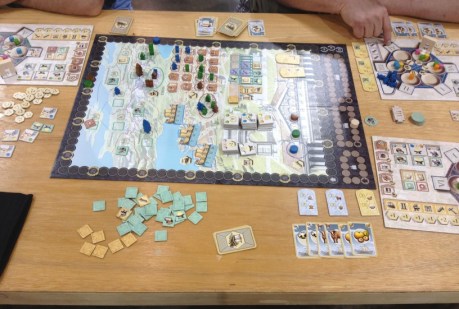
When comparing the action-selection mechanisms, Trajan definitely comes out ahead. Each player has a personal board with twelve markers spread over a ring of six spaces, and they move these pieces around as in a game of Mancala. Each space represents a different action, and the one that you end in determines the action you can take. Further, those markers in the Mancala board come in six colors. Sometimes, you’ll get to place a special tile by one space. If you later trigger that space’s action while two markers of specific colors are present, then you earn a bonus. This means that you’ll need to plan ahead a few turns to make sure you can do the needed actions in the needed order, but you have some ability to shift suddenly if the situation on the board changes. As a simple example, perhaps you planned to use the “Shipping” action next turn, and that would set thing up for you to next take the “Senate” action. If an opponent first plays cards to claim the Shipping points that you wanted, then you may want to wait until that bonus is available again later. But do you have a different way to lead up to the “Senate” action you still really want to play?

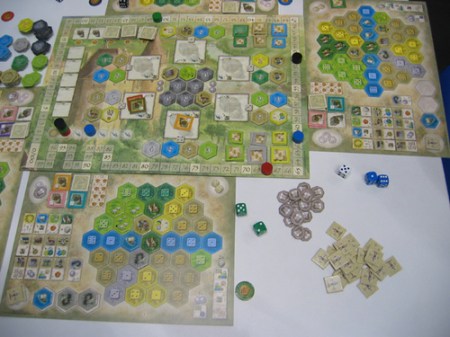
In contrast, The Castles of Burgundy’s action-selection is simply done by rolling two dice. Most of the game involves claiming tiles from a central area in one action and then adding them to your “princedom” on a later action. Specific numbers are required in each case, and not always the same for each of the two actions. (For example, you may want to claim the City tile that’s in the “4” area, but the space you’ll later play it to is marked “1”.) Despite some ways for players to tweak dice, this feels more arbitrary than Trajan’s deterministic system, and dice just usually aren’t that interesting. More troublesome, this game can have a surprising amount of downtime as players consider the different options they have for their two actions each turn. (Trajan also takes some thinking, but it’s usually more interesting to watch, and you have more to plan yourself while waiting.)

Two player boards and the central area of Burgundy visible.

Two player boards and the central area of Burgundy visible.

The defense of Burgundy would be that it has the more interesting actions. Though neither has a strong sense of empire-building, Trajan has none at all. That game’s actions are just sources of points with a pasted-on theme. Burgundy at least has the feel of putting together an abstract fiefdom. The board has a pre-determined plan for what types of buildings can go where (with many different boards to choose from, and a typical game filling up at least two-thirds of the spaces), with rewards for completing areas or being the first player to finish off a tile type. Of course, the tiles give different types of bonuses when played, from points to the chance to perform another specific action (not limited by numbers). One tile type provides new “technologies” that give players different abilities or ways to score.

I find Trajan’s actions interesting in a different way, though. Despite the lack of theme, there is an interesting interaction between them. Many resources can be gained from more than one action, and some actions provide benefits to others. Because the Mancala movement lets you skip over actions, it’s possible to play an entire game without using all six action types, and realistically, your strategy will lead to using one or two of them very rarely.

The full Trajan board

The full Trajan board

Regardless of the differences, both games are put together excellently. If you want a balanced game of moderate player-interaction, rewarding the most efficient tactical choice out of many possibilities, then you will enjoy either. I give the edge to Trajan, which most perfectly fits the “default” Feld style explained at the start of this article. It features interesting decisions in which your current move determines what choices will be available in the next one. Even so, it definitely doesn’t make The Castles of Burgundy obsolete. These are both different enough to be worth playing.

Trajan: B+

Castles of Burgundy: B A (I have updated my opinion)

(Trajan images taken by me, while the (better) pictures of The Castles of Burgundy are from Board Game Geek. Follow the links for the originals and photographer credits.)

Juggernaut: Revenge of Sovering (iPhone Game Review)

JuggernautJuggernaut: Revenge of Sovering is an attempt to translate the feel of a big-budget video game to handheld devices. They found a lot of interesting ways to make the combination work, but main effect was to make me think about how the line between hardcore and casual gaming is a lot finer than most people think.

Juggernaut has many of the hallmarks of a hardcore RPG, from the good (3D graphics largely unparalleled on the iPhone) to the bad (atrocious voice acting and a haphazard story). But the game initially feels like a casual time-waster: You move on rails from one enemy to the next, and attack by choosing one of three directions, avoiding the direction of your opponent’s “gaze”. It’s simple, and at the end of each battle you get a reward by choosing a chest, an extra interactive step that really isn’t different than the game randomly choosing for you.

But then, after you clear an area, you can keep returning to it (while the next enemy waits patiently) in order to tap around and collect “tribute” from the people there. Every now and then, wandering monsters appear there, and you take a break from the pre-planned battles to protect the village that’s giving you money. This made me wonder: Is the time-consuming click-fest to collect coins a remnant of casual games and their easy rewards, or is it really any different from the level-grinding of a classic RPG? The offhanded treatment of civilians as nothing more than a way to get resources could, honestly, fit in either gaming culture.

An example of less-than-stellar writing. ("We have reached the desert, my brave warrior. It is so hot here that you want to peel off layers of clothing!")

An example of less-than-stellar writing. (“We have reached the desert, my brave warrior. It is so hot here that you want to peel off layers of clothing!”)

New elements and mini-games keep appearing, from the tile-matching locks on buried treasure to the magical bits of “Mana” and “Fury” that you need to tap on during fights. But as those elements keep adding up, your battles become more complex. Eventually, you are husbanding that Mana and Fury to use for special moves, making your attacks in a prescribed order to execute combo blows, and trying to use three types of purchasable artifacts as efficiently as possible to win without wasting money. Each individual piece of that is a simple matter of tapping or swiping in response to some stimulus, but isn’t that true of any game? By introducing this system gradually, Juggernaut reveals that an intricate, strategic system can be built on top of game mechanics less interesting than Fruit Ninja.

When everything comes together, Juggernaut’s battle system is a lot of fun. There are a decent amount of things to keep track of, various areas of the screen to manage, and several little tricks that I eventually figured out to make the resources go farther or to save up powerful strikes for the right time. But not every battle is like that. The fun ones are on the main path, where it’s worthwhile to burn through expensive items to progress. Fighting the wandering monsters is only fun when you need to use the system in certain ways to unlock achievements (of course) that lead to special areas. Otherwise, those side monsters are dull: You can usually win without trouble, so you shouldn’t waste special items on them, and you’ll use them as an opportunity to build up Fury and Mana rather than to unleash it. The only thing worse than those those repetitive battles is when you have to aimlessly move around collecting money and waiting for one to appear, because you need to build up more resources before you can handle the next main fight. Grinding is a time-honored part of RPGs, but it feels especially mundane and reductive here.

You could advance faster by opening ads or roping in friends via the “Store”, in an annoying freemium section of the game. I can’t complain too much, though; I completed this without ever using that, and given the game’s technical and artistic aspects, I can’t imagine that this free download has turned a profit. (I assume Mail.ru, the publisher, justifies this as marketing for their MMORPG Juggernaut. Strangely, though, the app never mentions the game it’s based on.) I only finished it because it was an easy time-waster during late nights with a newborn baby, though. The full thing easily took over one hundred hours to complete, and the majority of them were boring level-grinding or frustrating attempts to advance when the only paths available to me were too much for my character. At its best, this was addictive, rewarding, and encouraged me to squeeze the most out of a deceptively simple system. It just wasn’t at its best very often.

Juggernaut Action

Overall, it just seems like Juggernaut: Revenge of Sovering was a good RPG with too many cut corners. The battle system is cool, but every enemy fights exactly the same, whether a dumb animal, a skilled warrior, or even a group attacking together. The balance is mainly good, but the material and number of missions aren’t planned well at all for the sheer length of it. And the little bits of story they bothered to include rarely seem to go anywhere, presumably because they were referencing elements of the main game. It’s easy to like this a little bit, as a free experience that looks like a $60 console game, but don’t plan on sticking with it like I did.

Grade: B-