Archive for the ‘ Games ’ Category

Ad Astra (Game Review)
As Astra box

Ad Astra

In Ad Astra, players choose action cards that everyone at the table will use, but that give a bonus to the one who selected it. On the board, they colonize resource-producing areas in order to harvest those resources and build structures that will produce even m ore. Yes, it sounds like a cross between Settlers of Catan and Race for the Galaxy, but it actually plays very differently from either.

The most obvious immediate difference is that the players go around the table a few times laying out action cards upside-down, so that a sequence of twelve to fifteen events (depending on the player count) is determined beforehand. When they unfold, the actions you picked may work out better or worse for you than expected, depending on what you gained from the actions the other players chose.

While that is important, the key aspect that makes this game work differently is the scoring: Points are earned by certain action cards, with a bonus for whoever is leading the category being scored. That turns Ad Astra into a game of careful simultaneous choices. Does it look like another player is preparing to score spaceships? Well, maybe you can choose some actions that will let you build another one of your own first. Or maybe you can let some other players struggle over the spaceship war, and take advantage of the resource-generating actions they’ll need to play. If you time it right, you could score your resource cards after those other players have discarded theirs to build the ships!

The action board, with the first eight revealed so far.

The four-player game has twelve actions per round. The first eight have been revealed so far.

It’s a clever system, but it must have been very difficult to balance right. Fortunately, the two veteran designers behind this (Bruno Faidutti and Serge Laget) found the perfect mix of elements to make this work. In most resource-building games like this, everyone needs to build up infrastructure at the beginning so that they can churn out the most resources and points at the end. Here, playing actions to score actually slows down your empire-building, but because of the bonus points for leading during a scoring round, it’s possible to earn significant points right away. If you’re the only player positioned to build, say, a terraformer in the first round, it might make sense to do that right away and claim points for it. Others will pull ahead of you in resources, but that doesn’t matter if you win the game. The ending condition (scoring fifty points) hits the sweet spot at which either short-sighted scoring or focused engine-building could win the day. The key is really to use whatever strategies your opponents are not, and there are enough choices (increasing fleets, seeking out specific resources, or building structures that give points but no in-game benefit) that there is always something unique you could be doing.
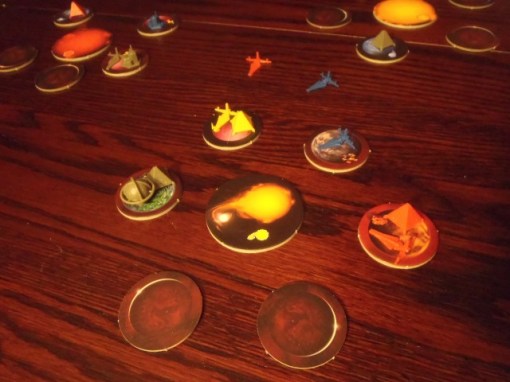
A section of the "board", which is actually disconnected systems of stars and planets, with ships sitting in "hyperspace" between them.

A section of the “board”, which is actually disconnected systems of stars and planets, with ships sitting in “hyperspace” between them.

The apparent similarities to Settlers and Race are interesting, because, unlike most of the gaming community, I’m not a big fan of either. This game doesn’t have the flaws I see in those, though. My problem with Race for the Galaxy is that your opponents quickly build up complex systems picked from a set of hundreds of different cards, and they’ll interact with yours in almost no meaningful ways. Yes, it’s important to understand their strengths and weaknesses to properly predict the actions that will help you best, but I have no motivation to pay attention. In Ad Astra, the system is much simpler and the interaction is frequent, thanks to the constant threat of scoring rounds. With that set-up, it’s fun to watch everyone and try to out-guess their action choices.

The usual complaint about Settlers is the randomness inherent in its resource-production. If you dislike that, you’ll be glad to know that Ad Astra has no dice. Instead, players must select action cards to generate resources. In fact, Ad Astra minimizes most random factors. Planets are hidden until someone lands on them, but you can look at all of them in a given “star system” at once when traveling, so you have a good deal of choice in the matter.

My main issue with Settlers is not the randomness, though. Or rather, I find it dry and too long for a game that has that much chance. There’s a high likelihood that some player will find themselves stuck without any good paths forward. In Ad Astra, on the other hand, there are no roads to block you in and so many resource types that no one will keep up production in all of them. Instead, the bank offers generous trades at a one-for-two rate, so whatever resources you do produce can get you the rest without too much efficiency loss. The best player still wins in the end, but there are options to keep everyone involved until the end.

This game is a few years old now, and it never got the attention it deserved. If you get a chance, though, try it out. It finds the perfect balance of elements to make a medium-length game of simultaneous choices interesting until the end.

Grade: B+


Hundreds (iPhone Game Review)

HundredsThe most notable thing about the iPhone game Hundreds is its design sense. Simple but visually arresting, it just features black and gray circles on a white background, with the occasional burst of red. Items fade in or roll onto the screen after you win or lose a level, and the level select menu punctuates its whitespace with circular symbols that are labeled “statistics” but may as well be an artistic flair. The soundtrack, naturally, is simple looping music that always seems to mesh perfectly with whatever just happened on screen.

The gameplay has the same understated elegance, without even needing a tutorial. The first level has a single circle with a “0” in it. When you touch it, it grows and the number increases. It reaches “100”, and the level is complete. Future levels introduce multiple moving circles (generally in different shades of gray) that bounce around each other with a smooth Brownian motion. The goal is always to grow the circles until they total 100. The game continues to add new pieces with special abilities, but always with a simple internal logic. The only written instructions the game provides are “if they touch when red then you are dead”, a reference to the fact that the circles turn red as they are growing. The challenge lies in making them grow when there is space around them, and then stopping in time to let them bounce off each other safely.

HundredsThe game is at its best when it lets you enter a simple Zen-like state. With no time pressure, you can watch the circles bounce around harmlessly while waiting for the right time to increase one by a point or two. (SemiSecret Software, also the publisher of Canabalt, seems to have a thing for simple games that reward a relaxed mind.) However, most levels don’t let you do that. The game introduces other types of objects, including non-growing ones you can drag around yourself, ones that shrink down towards “0” when left alone, and ones that reset anything they touch back to “0” immediately. Some of those add a time pressure, especially the ones that stay red, forcing you to complete the level before they bump into anything. (New rules about “frozen” pieces add some exceptions, but that isn’t worth going in to here.) Suddenly that meditative gameplay goes out the window, and you need to outrace objects that will undo all your work.
The problem is that Hundreds is a very unforgiving game. Make one mistake with the dozens of items moving around the screen (while your own fingers are obscuring the view), and “you are dead”. Most levels are easy to complete – sometimes there is a trick or two to decide on, but this isn’t a “puzzle game” in the strict sense of having a precise solution. In fact, sometimes you’ll rush through several levels in just a few minutes. But others are very challenging. And those ones, with tight quarters and enemy pieces, are where the frustration appears. They demand near-perfection, and when you do finally win, the screen just fades away to an underwhelming “100”. Reaching that threshold doesn’t feel like an accomplishment in the way that crossing a finish line or clearing out enemies does. Most of the time, it wasn’t even obvious to me that I was about to win. Picture that: repeating the same actions, over and over, continually making it halfway to your goal, and then suddenly being told that you can move on. The level transitions have the same smooth, iconic design of the rest of the game, which makes it easy to keep going, but it doesn’t provide any visceral satisfaction either.

Hundreds is a well thought-out puzzle/action game that’s almost worth experiencing for its sense of style alone. However, it feels hollow beneath that. It’s also notable an an example of how a by-the-books game can fail to hold your interest.

Grade: C+


Hawaii (Game Review)

Hawaii box

Hawaii

Hawaii is an immediately attractive game, though it has more complexity than you’d expect from its colorful appearance. That’s actually a good combination, because it seems to be successful at bringing in casual players. For many people, the main barrier to learning a game’s rules is first becoming interested in it. From what I’ve seen, new players will be able to handle it, assuming a more dedicated gamer is there to handle the fiddly set-up. Even better, once the new players have tried this a few times, they’ll have learned enough advanced concepts to prepare them for other, better games. You see, Hawaii doesn’t stay interesting for long.

This is a worker placement game, though it obscures that by having you pick up tokens from spaces when you use them, rather than putting a worker figure there to mark it. This change makes sense in-game, as the tokens you take show the price of the action. In each of five rounds, when new tokens are put out, the costs of the different actions are randomized. The game tries to offer a varied setup partly with these changing prices, and partly by shuffling up the action spaces themselves at the start of each game. (Before taking an action, you pay to “move” from your last action tile to the next one, so their physical location matters.)

This variety does matter, but it’s too random to feel strategic. Turn order is also changeable, and sometimes there will be some great deals available to the first player or two. Other times, you’ll regret that you wasted resources in the previous round to let yourself go first this time. Since there are only five rounds in the game, randomly getting a good setup can be a huge factor. (Even worse, the number of times each action can be taken is also randomized. Some spaces allow two or three action tokens, others allow one or two, and a couple will have either zero or one. If an action turns out to be unavailable for the last rounds, it can derail all your plans.)

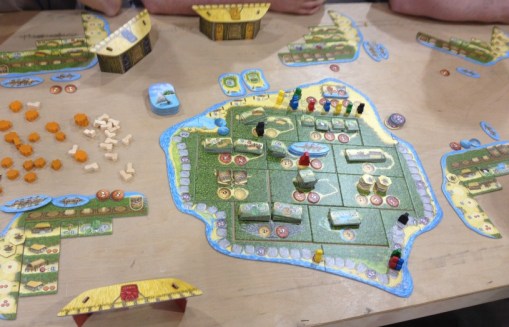
Hawaii play

The actions that you do sound interesting, and also feel thematic. Trying to put together your community on a Hawaiian island, you gather buildings and special tokens to create one or more villages. All tokens either give you abilities in-game or increase the score for their village at the end. However, villages only score if they extend past a certain marker on your gameboard. (Among other things, there is an action that moves that marker to make your job easier.) There are two currencies to keep track of, “feet” for moving around and “shells” to pay for actions. Cleverly, your base income actually drops each round (as the king sponsoring you expects you to become independent), and even with the special buildings you can add, it’s difficult to keep that income up. However, the “tribute” you want to send after each round keeps increasing.

All the pieces provide a lot of ways to score, but there aren’t that many different strategic paths to take. You have two main options in the game:  Do you focus on one huge village or try to get many past the scoring threshold, and how much effort should you put into the “boat” actions that give you resources but generally don’t build your villages? Otherwise, just take the best deals available at the moment. That is enough, barely, to build a game around, but with only five rounds of play, it feels slight.

Aesthetically appealing and offering some clever twists on worker placement rules, Hawaii is worth trying out. It loses its appeal before too long, though. I respect its potential as a “gateway game”, but I’m not very interested in playing it otherwise.

Grade: C+


Lance Armstrong and Game Theory

Lance Armstrong (from Wikipedia)

Lance Armstrong (from Wikipedia)

I play a lot of games, but don’t follow professional sports much. I’m just more interested in playing my own games than in watching others. I still think of sports as a category of gaming, though, which is why it always surprises me when the general public reacts in outrage to the participants treating it like that. The current controversy about Lance Armstrong’s doping is a perfect example.

Let’s put aside the questions about health risks and bad role models for the moment, and consider professional bicycling as a game. Because, as I point out from time to time on this blog, the flow of a game and effectiveness of various strategies is determined by the rules. If someone discovers a winning strategy that makes the game not “fun” to you, then you need to change the rules so that the aspects you want in the game become primary again. Sometimes, you need to consider not just “the rules”, but the entire system, in which “cheat but don’t get caught” can be a valid strategy to win millions of dollars.

It’s obvious that a lot of pro cyclists break the doping rules. And even before Armstrong, it was already obvious that a lot of them got away with it. Now that his seven Tour de France wins are thrown out, the only thing more shocking than the number of disqualified first-place finishers is the number that weren’t caught until after the fact. Does anyone have much faith that all the second- and third-place winners who eventually got their trophies were drug-free? Given all the evidence that people get away with it, it seems likely plenty of trophies have been taken away from one doper just to be given to another.

The popular perception is that doping in sports is a mistake made in a moment of weakness by someone who should know better. That may be accurate for teenagers trying testosterone, but it couldn’t be less true at the professional level. Consider Armstrong’s rigorous training regimen, his highly-trained support staff looking for any medical or scientific edge, and his own experience. Armstrong knew exactly what his performance was like both on and off drugs, and presumably had a better idea than we do about how his colleagues were using them and their chances of getting caught. Given all that, he (and a staff whose careers depended on his success) made the conscious decision that he was better off taking them.

Remember that. Lance Armstrong only doped up because even he wouldn’t have won otherwise. In a field like that, what chance does anyone else have? Oh, I’m sure there are entrants in the Tour de France who followed all the rules. You just haven’t heard of them. I wasn’t mad (or surprised) when the allegations against Armstrong came out, because I had assumed all along that the system was set up for dopers to win.

Professional cycling is long past the point where it’s become a joke, with so many disqualifications that it’s hard to take any victory seriously. The important thing to understand is that this is ingrained into the system. Cheating technology is way ahead of enforcement technology, and there’s no sign that this will change. The dwindling fanbase can either stick their heads in the sand and pretend that this isn’t the case, or they can look for changes that give them what they want.

Barring a new technology that catches all dopers, I can think of two options: Doping could be allowed. It’s not a magic shortcut, given that proper usage is as technical as the training and calculations that athletes make to maximize their results. And concerns about the health effects are hard to take seriously, when sports like boxing and (American) football are much more punishing to the body and brain than Armstrong’s tricks were. If you don’t like that, because you want role models and people who represent mankind’s drug-free potential, then that brings me to my second option: Stop looking for those heroes in competitions that make its winners rich. Amateur and hobbyist cyclists are the ones doing the things you care about, because they don’t have the same incentive to cheat. It all comes down to the structure of the game.

Mage Knight (Game Review)

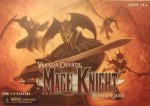
Mage Knight box

Mage Knight

I’ve explained before that I don’t generally like dungeon-crawler board games. Usually too in love with their cool setting to make the rules fun and fair, they are victims of the trade-offs between theme and mechanics. I had high hopes for Mage Knight, though. In games like Galaxy Trucker and Dungeon Lords, Vlaada Chvátil has shown that he can come up with innovative, fun ways to bring out a game’s theme. But while Mage Knight is well-designed in many ways, it just doesn’t work for me.

Each player is a morally ambiguous “Mage Knight” roaming the countryside: You kill the wandering monsters that threaten civilians, but you also sack towns and fortifications, and most scenarios require you to capture cities at the end. The board is a series of tiles which don’t offer a lot of variety from game to game, but do keep individual turns unpredictable as you explore the edges and reveal more tiles. These tiles, along with everything else in the game, are beautifully made: The oversized box is full of custom dice, hundreds of cards, a wide variety of different tokens for monsters and abilities, as well as a few painted figures.

Some of the beautiful, varied cards.

Some of the beautiful, varied cards.

Those cards are especially important. Instead of traditional stats and dice, your character’s abilities are determined mainly by a deck of cards. This mix of deck-building with role-playing is a concept that I’m starting to hear about frequently, but I doubt many games will do it as well. Mage Knight is one of the very few deck-builders with mechanics that fit the game, instead of just unsuccessfully cloning Dominion. In this case, each card has two possible abilities (with the stronger one generally powered by one of four Mana colors), and any card can be played to give a single point in one of the basic needs of a turn: Movement, Attack, Blocking, or Influence. This variety of options keeps your character’s abilities fairly balanced regardless of what you draw. Sure, you’ll sometimes find yourself with little movement on a turn, or lots of combat ability when you wanted to spend Influence peacefully in town, but it’s not nearly as arbitrary and random as other systems.

Not one deck-building element seems to be directly lifted from Dominion. Money and “Buys” are gone, and Mana powers cards when they are used. Players optionally keep or discard any unused cards at the end of their turn. And like some other games, wounds are represented by useless cards that can’t be discarded easily. The biggest innovation is in the pacing of the game: Each round ends once one player has gone through their deck, and then everyone shuffles for the next round. Decks generally grow slowly, as card Trashing is rare, and no cards (other than Wounds) are so bad that you would want to get rid of them just for the sake of deck efficiency.

With only six rounds in most games, and no guarantee that you’ll go through your full deck on a round, Mage Knight doesn’t offer a lot of time to build and modify your deck. However, you gain other improvements as well. With every level-up, your character either gains a skill (from a pool that grows throughout the game) or a slot to recruit an additional supporting unit. The units and skills offer almost as wide a variety of abilities as the cards do. Though it’s not pure deck-building, the combination of cards, skills, and units combine to make your character feel unique and powerful by the end.

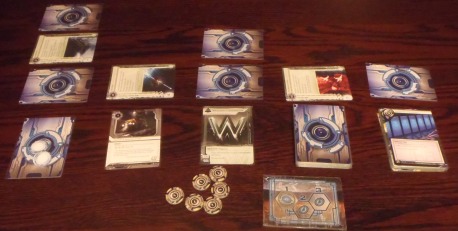
Midway through a solo game. There are a LOT of components, and a multi-player game barely fits on a large table by the end.

Midway through a solo game. There are a LOT of components, and a multi-player game barely fits on a large table by the end.

So why did I say that this game disappointed me? Everything I’ve explained so far is true: This is beautifully produced and features creative, well-balanced game design. There are two huge problems, though.

The first is the complexity of the rules. Though the rulebooks are designed with Chvátil’s typically thorough, clear explanations and even provide an introductory scenario to teach it gradually, this game is complex. It took me hours just to prepare to teach that introductory scenario, which I don’t think has ever happened before. Every rule has a logical reason, but there still too many quibbling details to remember: Gaining Artifact cards works differently than other types, because you draw an extra and then give one back. When fighting multiple enemies, you must play cards to block them individually but can group them for attack card effects. Remember that any enemy you attack in a Keep gains the “Fortified” ability, and that after killing a rampaging monster you move up in the Reputation track! The introductory scenario doesn’t even include all the rules, including the many ways that player vs. player battles differ from normal combat.

A close-up of the same game a little later, once the city figures are out.

A close-up of the same game a little later, once the city figures are out.

Also, while the range of options offered by each card makes the game structure work, it also makes it long. Each turn is basically a puzzle, trying to figure out the optimal way to move to a new location and accomplish something there. Many cards can combine with others, and spending Mana on one might make you unable to afford another, so the possibilities are incredibly broad. Add to that the fact that your units and many skills can be used only once per round, so you have to decide what to spend this turn. And of course, you may have three or four possible targets close by, so if one doesn’t seem possible, you can consider another. It’s not uncommon to see someone spend five or ten minutes figuring out what to do on their turn, and the people I play with are normally very fast.

These two issues make a bad combination: We spent hours playing that teaching game, and if we wanted to keep playing it within the group, we’d need to do it again to bring other friends up to speed. Going through it once is somewhat interesting (if full of way too much downtime), but the fact that every new player needs hours of training is the real killer. I’ve only played it once with others, and since then have just played it solitaire. The solo game does a remarkable job of maintaining the experience (Chvátil’s design skills are impeccable), but because of that I can also say that the problems never quite go away: My games continue to take a very long time, and even though I’m not waiting on anyone else, the puzzle-after-puzzle feel makes the game seem slow and draining.

Mage Knight has a lot going for it. The production quality and rules are among the best of 2012, but none of my friends are interested in playing it. I can’t say I blame them; I’m very glad to have experienced this, but after a few solitaire sessions, I have no desire to try it again myself.

Grade: C


Android: Netrunner (Game Review)

Android: Netrunner

Android: Netrunner

After creating Magic: The Gathering, Richard Garfield tried to reproduce his success with another collectable card game, Netrunner. It failed to survive long, but its cult following led Fantasy Flight Games to resurrect it two decades later. Despite all the advances in game design over that time, the new version (now branded Android: Netrunner) holds up remarkably well.

The biggest innovation of the game was the asynchronous roles for its two players. Set in a cyberpunk future, one person played a Corporation trying to protect their secrets from the Runner (hacker) played by the other. Each player uses different types of cards and has very different needs. Most of the rules flow smoothly from that concept, with the Corporation seeking to spend turns “advancing” Agenda cards before the Runner can break through the Ice protecting them. This is a big change from the direct attacks of Magic, and the resources used are different as well: Instead of recurring Mana to spend every turn, players gather up credits, potentially spending many turns’ worth in a single big move – and also potentially finding themselves strapped for cash just when the other strikes.

The Runner's play area, with a few rows for the different types of cards.

The Runner’s play area, with a few rows for the different types of cards.

Fundamentally, this is a bluffing game. The Corporation plays most of their cards face-down, so the Runner doesn’t know the types or strength of the Ice until they attack. They don’t even know if the card being protected is an Agenda or Trap. This makes for very tense games, as both sides try to build up their abilities, responding to the perceived or actual threats shown by the other. Often, the end result hinges on a single element that seems blown out of proportion, with one surprising success giving a player the card they need for victory. (Agendas are generally worth two or three points, and the first player to seven wins.) These game-ending chances (or lucky combos coming at just the right time) may seem a little disappointing to some people. They are the only potential problem with the gameplay that I see, though: My experiences have been consistently interesting, tense, and varied. Even if one player gets off to a better start, the other can still threaten to build up their abilities and take the lead later. (This is important to note, because I did play the original version of this, and I remember most games being very one-sided. Whether it was a problem with that version, or with my skills at the time, I can’t say.)

The Corporation's play area, full of face-up and face-down cards. Ice (horizontal cards) protects everything - even the draw and discard piles.

The Corporation’s play area, full of face-up and face-down cards. Ice (horizontal cards) protects everything – even the draw and discard piles.

Even the deck-building has elements of this guessing, as the game has too many aspects to account for every time. Will the Corporation be trying to run “Traces” against the Runner? Will the Runner use Viruses or straightforward Icebreakers? Will the Runner benefit from revealing their opponent’s cards, or is that a waste of resources that could be better put towards brute force? All those answers depend on what the opponent chooses before the game starts.

Fantasy Flight has left the gameplay fundamentally the same, but did make significant changes to the deck-building. For one thing, this is now a “Living Card Game” instead of a “collectible card game”. The LCG model means that instead of buying packs of random cards, people purchase a complete set at one time. Frequent updates are released, but those are also available in a single purchase. This new version also groups cards into “factions”, with decks needing to be built largely around a single one. (Cards from other factions can be added, but only up to a specific “influence” level.)

The LCG model is probably the right business decision for Netrunner. It always had a reputation for being a game based more on mixing in the right surprises than on tracking down rare cards. I appreciated that I didn’t need to spend lots of money to feel involved, but that may be why it didn’t survive as a CCG.

Psychologically, this makes it feel very different. For example, the game is easiest to play if both people have bought their own copies. That is true of both CCGs and LCGs, but since LCGs feel more like traditional board games, that seems like an extra expense. Also, you are allowed to include up to three copies of each card in your deck, and it’s usually best to do so. But it’s one thing to search through booster packs for extra copies of a card you like, and it’s another to realize that you’re paying for one large box full of duplicate cards. Worse, some cards in the base set only have one or two copies. To play with three of them, you’d need to buy multiple copies of the game! (Or make your own copies, of course.) That feels like an obnoxious limitation.

On the other hand, I now have three copies of most cards in the decks I made. I usually didn’t have extra copies available in the decks I made with the original game. I suspect that that might have added the randomness that made my old games so one-sided, while the modern ones are competitive. If so, I can’t argue with the results.

So far, the game is very fun, but also very limited. There are just enough cards to let you make a basic deck with each faction, and there aren’t a lot of changes you can make from the others. It seems that the base set is well-designed to keep you building within tight constraints that expansions will have to take away. There are too many strong combos that are limited now only by the cost of mixing cards from different factions. How long can that last as new cards are added? And what about the cards so powerful that the other side needs to treat them as a threat at all times? Bluffing games work when each side has a known set of threats to make. If new cards keep being added to the game, then the set of possible actions will be too diverse to create true bluffing tension. (The first expansion just came out. It looks very fun, but mainly skirts those issues by including very few cards.)

Judging this game by its base set only, it’s excellent. It provides a unique feel with a enough tweaks available to keep me playing for a while. I may not be sure what the future holds for Netrunner, but in the worst-case scenario, the initial cards are well worth buying on their own.

Grade: A-


Elder Sign (Game Review)

Elder Sign box cover

Elder Sign

Most horror-themed board games disappoint me for reasons similar to those for dungeon-crawlers: The cool theme takes precedence over game design, and it ends up being broken in some way. Richard Launius’ games avoid the worst of these problems, but usually feature overly complex rules and still have a few annoyances that betray the theme. Despite the complexity, they also seem to be solvable at some level: I’ve never lost one of his cooperative games. I don’t like Arkham Horror, the popular game he designed with Kevin Wilson, at all. It’s with some surprise that I found their latest effort, Elder Sign, to be fairly tolerable. It’s a clever take on themed Yahtzee, and while I think the mechanics have more potential than this game realizes, my two plays of this were enjoyable (even if I knew I was winning the whole time).

A selection of cards in the center of the table provide challenges. On your turn, you’ll choose one and roll dice to beat it. After each roll, the symbols on the dice must match one of the rows shown on the card. It’s easy at first, but gets harder as you set those symbols aside and then roll again to match the other rows. If you can’t, you must discard one, making it even harder. (You also get to “focus” one symbol to keep it without re-rolling, though.) If you can match all rows on the card, the encounter is defeated. Each one offers different rewards when defeated, as well as punishments if you fail.

Close-up of dice and cardsThere are, of course, many more quirks to the game. Some encounters have additional ways to punish players who fail rolls, and monster tokens can make encounters more difficult. Reminiscent of Arkham Horror, each player has a character with stamina, sanity, and a special ability. There are different categories of items and cards, which can be used to change symbols, add more powerful dice to the roll, and so on. But the group must draw from a deck with harmful events every few turns, and some of the encounters will also cause problems until they are defeated. Also similar to Arkham Horror, each game pits the players against one of Lovecraft’s elder gods, with different special effects depending on the particular enemy.

To win, the players need to collect a certain number of Elder Signs before a number of Doom Tokens come out. If they fail, they get one last chance to banish the evil god with dice, but it’s very difficult, unlike Arkham Horror’s embarrassingly easy “kill Cthulhu with tommy guns” end-game. Even so, this victory condition is underwhelming. Good cooperative games usually involve tension increasing as you near the conclusion. In this, beating an encounter for the final Elder Sign rarely feels any more eventful than the first one you got.

Though I think that the gameplay is better than Arkham Horror, the theme is much more arbitrary: Even if you try to take the time to read the flavor text and tell stories about it, there is little feeling that the encounters (“Don’t Fall Asleep” or “The Hedge Maze”) are anything more than an excuse to match symbols. Also, there is very little player interaction here, making this feel less like a cooperative game and more like solitaire with long delays and a sudden conclusion. I feel like the mechanics could have been used in a different way. Admittedly, I don’t have any good suggestions: In a competitive game, it would probably be too easy to fall behind due to one bad roll. It’s better to falter as part of a team. Still, it feels like the game needs more ways to affect each other.

Despite all that, the basic dice-rolling mechanic is fun.  It is interesting to decide when to spend resources to improve your odds, as well as which encounter to choose from the ones in the middle. I do wonder if there is a better way to use the system, but I still found the game interesting.

Grade: C+

(Images above from Board Game Geek. Follow the links for the original and photographer credit.)

Continue reading

10000000 and DungeonRaid: Dungeon-Crawling Puzzle Games for the iPhone

I’ve recently been playing two different iPhone games that mix casual game mechanics with a deeper dungeon-delving theme. 10000000 and DungeonRaid do very different things with this approach, but both of them manage to make something deeper and more interesting out of simple matching games.

Continue reading

Three Solo RPG Books

After trying a few (generic equivalents of) Choose Your Own Adventures last year, with mixed results, I was interested in seeing what else is out there. This time, I tried some solo RPG books, where stats and dice rolls play a part along with the branching choices.

I was surprised by how different the role-playing elements make these books. I always approached traditional CYOAs as something between a puzzle and a quantum story, where of course I’d keep placeholders at previous branches and go back and forth as necessary. The end result was a non-linear meta-story, in which I knew of all possible plot-lines at once. Once I have dice and a number of hit points, though, the book doesn’t work like that. These books were more about the adventure itself, and became a legitimate game instead of a story. I couldn’t jump around without invalidating my character, and that completely changed the experience.

However, the sudden deaths that are common in these books were very frustrating. I don’t mind them at all if I’m flipping through every path of a CYOA, but when I’m actually trying to follow a storyline, and my focus is on keeping a health stat above zero, it feels very unfair to have success ripped away by a single unpredictable choice.

Below the fold are the reviews of the three books I tried over the past several months.
Continue reading

Gauntlet of Fools (Game Review)

Gauntlet of Fools box cover

Gauntlet of Fools

Though I love the theme, most dungeon-crawling games are disappointing. The setting seems to invite not only randomness, but “screw you” cards that swing the game uncontrollably and special events that interact with each other in game-breaking ways. Given that, it’s a relief to say that Gauntlet of Fools is a fun game. Of course, there’s still a heavy amount of chance, but it feels appropriate to the theme without any of the pitfalls typical to dungeon-crawlers. That doesn’t mean it’s completely satisfying, though; Among other things, this is designed to be a 15-minute filler, so it won’t scratch that itch for an involved evening of monster-slaying.

The game is straightforward: Players each choose a Hero, and then they fight monsters from a deck of Encounters. Eventually, everyone will die, and whoever ends with the most gold wins! The key of the game, and the only real player interaction, is during the initial selection. Each Hero is paired with a random Weapon, and may receive additional “Boasts” that weaken it further. The Boasts are basically a thematic auction: If you want to use a Hero someone else has already claimed, you can announce “I can have the Barbarian run the gauntlet Blindfolded!” (That means that you’ll earn less gold each time you kill a monster and dodge their attack.) To take the Hero back from you, another player would have to add another Boast, such as Hungover (a serious attack and defense penalty that lasts until the Hero manages to kill their first monster). The first Encounter is revealed only once everyone feels that their opponents’ Heros have been weakened too much to be worth stealing.

The Armorer can improve his defense as he kills monsters, and he’ll need that with his penalty for Hopping on One Leg! The Bow has two ability tokens that let him dodge monsters, which will be perfect when his defense is low at the start.

The fun of Gauntlet of Fools comes from Donald X. Vaccarino’s design approach. The basic system for encounters is very simple, but it allows for a wide variety of ways for the Heros, Weapons, Boasts, and Encounters to interact with each other. It’s quick, clever, and manages to feel reasonably different from game to game. The dice rolls and shuffled deck of cards may do a lot to drive the game, but it also feels like you’re experiencing unique twists each time due to the simple yet varied ways cards can interact. (“The Giant Spider poisoned everyone, but my Priest’s healing ability made all the difference.” “I never should have said my Avenger could run the gauntlet without breakfast! He died first, and his ability only works after others have died.”)

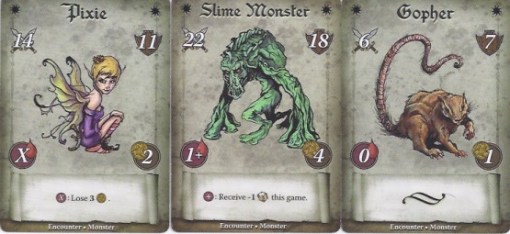
There are a wide variety of monsters. The Armorer is hoping for easy opponents like the Gopher, so he can raise his defense quickly. But the Slime Monster, which reduces the number of dice the Hero’s Weapon has, could keep the Armorer from ever getting the kills he needs.

That randomness still makes it feel arbitrary sometimes. There are real strategic choices in deciding what combination of Hero and Boasts will work best, and it will take a few games to figure this out. However, the “right” choice for a game won’t become apparent until the top cards in the Encounter deck are revealed. The Priest may be the best choice if a Spider is about to poison everyone, but you won’t find that out until after the auction is done. This works, but because it only aims to be a quick and silly game. The theme and art are fun, and the game unfolds without any of the painful events that derail other dungeon-crawlers. Make your choices, play up the theme of Boasting, and then take a few minutes to see who guessed right.

Grade: B