Archive for the ‘ Games ’ Category

Letterpress (iPhone Game Review)

Letterpress in playThe new iPhone game Letterpress was just released last weekend, but it attracted enough players so quickly that people are wondering if it’s responsible for overloading Game Center. I wouldn’t be surprised: Game Center never gets much attention, and it’s an easily-ignored option in most apps that use it, so one big push may overload it. Personally, I think the fact that Letterpress requires Game Center is a major strike against it: The system feels a little sloppy, I didn’t like agreeing to the EULA for yet another information-gathering service, and as we just saw, the game is now at the mercy of hiccups in a service it doesn’t control.

Despite all that, Letterpress is worth checking out for its clever approach to word games. Players make words from the letters of a 5×5 grid, and each tile becomes “owned” by whoever used it last. But if a player manages to own a tile and every one it touches, it cannot be captured even if their opponent uses it. The unique thing about this system is that letters can be used without being adjacent, but the system of ownership and protection creates a map of shifting territories. You need to create a word not just from the 25 letters available, but using the specific letters that will most help your position. Another thing I appreciate is that the game rewards long words, which means that they’re almost always familiar to the players. It feels like a more natural use of language than word games that require you to memorize words like “QAT” and “XU” in order to be competitive.
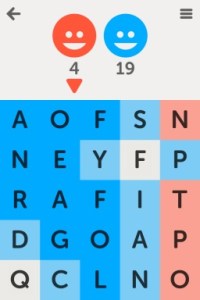
The dark blue tiles are protected, as they are surrounded by light blue ones. The blue player is close to victory.

Also, of course, the quantity and positions of the letters change from game to game. A game with multiple ‘E’s, ‘R’s, and ‘S’s available plays very different from one with lots of ‘Q’s and ‘Z’s.  You’re never allowed to play a word if it has been used before, or if it is entirely contained within a previous word. This means that variations of words might come up repeatedly, but you’re forced to move forward without getting stuck in a repeating loop.

The app is well designed, but bare bones. That Game Center integration, for example, lets the game match you up to network opponents with little effort on the developers’ part, but adds a few seconds of delay every time you launch the app to play your next move. It has a clean interface that makes it easy to play, though I miss features like chatting. And given that this game works best when played quickly back and forth, this game screams out for options such as time limits and in-person games shared on one phone. (The app itself is free to try, and 99 cents for the “full” version which allows multiple games at once. The first time your game gets hung up because an opponent stopped responding for a while, you’ll realize how vital that multiple-game option is.)

I haven’t had any issues like the network trouble other people allege, but I have run into one annoying bug: Ever since a player resigned against me, the Letterpress icon on my home screen has told me I have one game waiting for my move. Even turning the phone off doesn’t make that go away.

As for the game itself, the beginning and middle are great (other than my aforementioned wish for time limits – this really is a game that demands to be played quickly). The endgame can be frustrating, though. Whenever all tiles are claimed, whichever player owns the most has won. Since the score tends to seesaw back and forth with every move, you’ll want to make sure you leave enough tiles neutral to keep your opponent from ending it. This is clever in theory, since your territorial considerations now include which tiles you need to leave untouched. In practice, though, that means that if players are fairly evenly matched, neither dares open an endgame opportunity for the other. It can be obvious who is going to win long before it becomes viable for that player to claim a victory.

Letterpress has the potential to become a great game, but it isn’t there yet. I’m not sure if the developers plan to keep adding to it, or if they consider it to be complete. Either way, though, it’s fast and free to try out, so it’s easy to recommend that you give it a chance. As long as you’re willing to give Game Center a chance, too.

Grade: B


Quick Update:One week later, I am still enjoying this, and have learned to play so that my issues with the endgame aren’t as significant. I also managed to get rid of that extraneous notification about a waiting game by deleting that one from the history of played games. I’ve run into enough other issues to reaffirm my belief that this feels rushed and incomplete: After the multi-second delay for the app to log you in to Game Center, there is another pause before your games are updated. Since there is no visual clue as to whether this is still loading, and also no hint about whether it is your turn in games other than the one you’re currently looking at, playing multiple games is frustrating. When a game ends due to my opponent’s move, it is moved immediately into the app’s list of my previously played games, and I won’t notice it ended unless I think to look for it. And this morning, I finally did experience several hours in which my games wouldn’t update even though I knew one of my opponents had moved.

My basic conclusion is unchanged: This is an addictive but clunky implementation of a clever game that would be best played in person.

Dominion: Dark Ages (Game Review)

Dominion: Dark Ages box

Dominion: Dark Ages

After my lukewarm reception of the last couple Dominion expansions, I’m pleased to say that Dominion: Dark Ages makes the game feel truly exciting again. Its main themes (trashing and upgrading cards) are not new, but they provide plenty of territory to explore. There are a lot of clever abilities here, but even the cards that don’t seem original are consistently interesting, balanced, and have strong artwork. This are also a lot of combos, making this a great engine-building deck for experienced players.

Maybe the best part is the sheer quantity of gameplay that Dark Ages adds. The standalone Dominion sets have 500 cards, but half of those are used for the basic Treasure and Victory cards. The later “full-size” expansions had fewer cards to make room for mats and tokens. Dark Ages has no supporting bits like that, so it is the first to include a full 500 cards devoted to expanding the game. This means 35 Kingdom Cards, almost as many as a previous full-size and half-size expansion combined.

Rats and Graverobber cards

Two cards that do new things with the Trashing mechanism

Cards are a much more economical option for a game. Those 35 Kingdom Cards only account for about two-thirds of the cards included in the set, so the others can extend the gameplay in new ways. The lack of boards and counters doesn’t feel limiting at all. The Dark Ages theme is reinforced with Ruins cards (a deck-clogging type similar to Curses) and Shelters (new starting cards that give players more choices in the early moves). There are also several special types of cards which can only be gained by other specific cards. These feel like nothing that has come before.

A sub-theme seems to be a focus on cards with a cost between 3 and 6 coins, which form the “core” of most decks. It’s good to see certain abilities restricted to work only in this range, especially attack cards that otherwise would have had much more random effects on opponents’ decks. While for the most part, new Dominion cards stake out new territory without replacing old cards, this does seem to be a case where it specifically improves on some previous attack cards.

Hermit and Madman

A new type of upgrading: The Madman is a powerful one-shot card that can only be gained by trashing a Hermit.

It’s a little weird to consider the theme of the Dark Ages in this game, given that the trashing and upgrading abilities featured here actually help you make stronger decks. But no one would actually want to play a drawn-out game where everyone struggled through a representation of the collapse of civilization. The more important criticism is the one that has been present for the past few expansions: At this point, there are a lot of Dominion cards. With well over 200 types available and only 10 used in each game, you could play for a long time without missing any one set. Dark Ages is one of the best yet, but the game’s own success means that no expansion truly feels essential any more.

Yes, the biggest problem with this set is that Dominion is so consistently good that even excellent expansions stop being exciting. But it still ranks among the best, possibly second only to Dominion: Prosperity. It’s well worth buying.

Grade: A-


Kingdom Builder: Nomads (Game Review)

Kingdom Builder: Nomads box

Kingdom Builder: Nomads

Donald X. Vaccarino’s Kingdom Builder is a light but decent game, whose main draw lies in the promise of variety that later additions will offer. Kingdom Builder: Nomads therefore has a much larger responsibility than most game expansions do. The results are inconclusive; Nomads offers a good variety of new features, but it doesn’t seem to open up the Kingdom Builder system in the way that I’d hoped.

Nomads has four boards, each with a new building on it. Since each game uses four random boards, this adds to the variety of combinations available. These also put more effort into the mountain and water layout, making it much more interesting to plan around impassable terrain. The abilities of the new buildings vary. The Quarry, which lets you add “Stone” to block off tiles on the map, is a fun ability. The Caravan, on the other hand, is surprisingly confusing. While it plays a similar role to the Stables of the original game, it slows down turns and even causes good characters to make occasional mistakes.

Instead of Castle spaces, these boards include the “Nomad” spaces that give the game its name. Each of these holds a single tile that grants an ability slightly more powerful than the standard buildings. However, the tiles are used a single time and then discarded from the game. This is a great addition, since there are now more items to go for on the board, and new considerations about which ones will be the most valuable for the game.

The heart of Kingdom Builder is really the fact that the scoring changes completely from game to game. (Imagine playing a Chess variant where one game is a race to move your Pawns the furthest, the next is based around controlling specific spaces on the board, and so on. That will give you an idea of the variety of strategies that different sessions of Kingdom Builder offer.) Here, the expansion also has a good twist. Three new possible scoring conditions are added which award points for actions during the game instead of at the end. They are well balanced, and offer interesting new choices.

The only bad addition in the Nomads expansion is, fortunately, completely optional: Pieces for a fifth player may be welcomed by some, but I found the game to have too much downtime this way. Kingdom Builder is a fast-playing filler, and I don’t want to wait for four people to make moves between each of my turns.

Early in a Nomads game, with Quarries and Nomad tiles in use (plus the new red player pieces)

So if Nomads fleshes out the game in multiple ways, why am I somewhat disappointed? Well, part of it is the price. After adding a $35 MSRP expansion to a $60 MSRP base, I still feel like I have a light game that offers direct comparisons to Dominion but doesn’t have anywhere near the variety. Queen Games offers high-quality production along with its high prices, but that just makes me frustrated that the backs of the cards and boards don’t match the original. Apparently I have the American version of Kingdom Builder and the International version of Nomads, so everything has different backs. It can be worked around, but it feels shoddy given the price.

More importantly, though, is the nagging impression that Kingdom Builder is already running out of steam instead of promising new ideas yet to come. In a behind-the-scenes look at the game, Vaccarino flat-out admits that the number of scoring cards we’ve seen so far has been limited not by what Queen could afford to print for the game, but by what he could actually think of that played well. Having exhausted the basic possibilities in the first set, he now covered in-game scoring for Nomads. But what’s next? Will the next expansion need to add entirely new concepts just to justify three more scoring cards? This game already had to replace some existing score cards so that references to “Castle spaces” now say “Castle or Nomad spaces”, and it can be confusing for players to notice the distinction between them on the boards. It seems like the new ideas will increase complexity quickly.

If you like Kingdom Builder, Nomads has several clever additions that will double the game’s lifetime for you. It still dampens my hopes about the future of the game, though. At this point, I’m not sure if I’ll stick with it through the next expansion or not.

Grade: B-

Friday (Game Review)

Friday box

Friday

As I said in my Origins re-cap, Friedemann Friese’s Friday is the first deck-building game since Dominion to truly work, and it does this by not trying to copy Dominion at all. Most notably, you don’t hold a hand of cards. After choosing a challenge to fight against, you draw a certain number and see what total strength they provide. Winning gives you that card in your hand – half of the card describes the challenge, while the other half has a fighting strength or special power to use later. If the drawn cards aren’t enough to win, you can either pay a health point to draw another, or you can give up, losing one health per point that you lost. But these losses are an important part of your strategy, because for each health lost in this way, you can trash one drawn card. With a theme based on Robinson Crusoe, you start the game very healthy, but weak. The goal is to get rid of the bad cards you start with and gain stronger ones, essentially turning into a tough survivalist who is just a few accidents away from death. Every time you go through your deck, a bad “aging” card gets shuffled in, adding another threat to stay on top of.

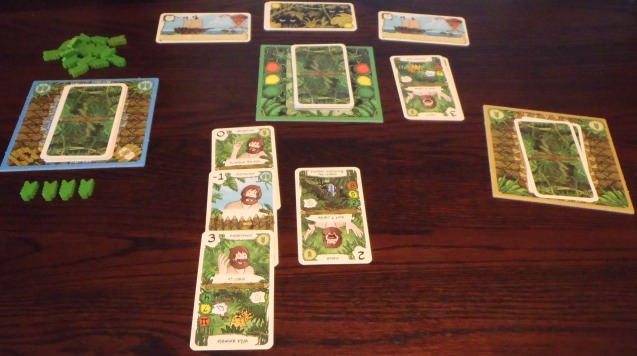
The middle of a game of Friday

The deck-building mechanic isn’t the only clever aspect, though. Friday is also a solitaire game. While some new games come with optional solitaire rules, this is the first modern one I’ve seen intended only for one player. As such, it’s a little difficult to judge. One friend I loaned it to pointed out that the various things you needed to keep track of felt too fiddly, and he’d rather use a computer if he’s playing solitaire. Personally, I thought the fiddliness was much easier to handle when I’m just counting points and special abilities in my head instead of justifying them to the table. Obviously, though, opinions about Friday will depend on factors different from multiplayer games.

I will say, though, that if you want a strategic solitaire game, this seems like the right approach. It’s inexpensive, can be packed in a purse or laptop bag, and plays in about thirty minutes. (If you lose, it may end more quickly.) On top of that, the four difficulty levels keep the game challenging but winnable for all players, as well as making sure that you experience the full arc of the gameplay in those early learning games.

The gameplay is streamlined but offers some worthwhile choices. Like a good deck-builder should, Friday works because its strategy involves more than just taking whatever you can. That 0-strength card that lets you draw two more for free is pretty good in the late game, but useless in the beginning when the cards it draws will probably also be 0s. Balancing the need for fighting strength with the cool powers that some cards have is a major tension, even more important than the balance between destroying bad cards and retaining health.

I don’t see this becoming a Dominion-style juggernaut. You play with the same cards every time, get the chance to put almost every card in your deck, and I haven’t found a better strategy than the one that I figured out early on. But there’s a good deal of replay potential within that strategy, and I can play Friday at times when other board games just aren’t an option. Friday is a good game regardless, but if I also give it credit for filling a new niche and doing deck-building right, then this is obviously a must-play.

Grade: A-

Origins 2012 Wrap-Up

Another Origins Game Fair has come and gone. For me, it will be remembered as the first one I didn’t get to attend completely. Due to various issues back home (over two hours away), I left, came back, and then left early again. I only got to spend two and a half days at the convention, instead of my usual four and a half. Really, though, that made me realize what a big deal this is for me. Like a holiday, I had to make it back for that partial Saturday, not due to considerations of whether it would be fun enough, but because I simply had to have a complete event. Origins punctuates my gaming year.

It’s too bad I was gone, because in some ways the times I was there were my best ever. It never once took me more than a few minutes to find a game to play. The crowds at the Board Room are open and friendly, the people in the Rio Grande room proactively suggest things to me, and even my trips through the Dealer Hall ended up with more demos than normal.

Maybe this is because Origins happened a month early this year. I don’t know whether the attendance was really as low as it seems – every time, people compare their memories of last year’s busy Saturday to this year’s quiet Thursday – but I’m sure it was down. It’s too bad, because this is the first time in my six years of attending that Origins didn’t have to share downtown Columbus with another large event. It was great not to have rush hour traffic at 2:00 AM for once.

However, I definitely noticed a lack of exciting new games. There are plenty of exciting Summer and Fall releases lined up, but apparently the earlier schedule made Origins miss out on them. I’m not sure whether to blame the convention organizers for shifting the schedule, or the game publishers for not planning around something that had a full year’s notice. Either way, though, the only game with real buzz was Mage Wars, an upcoming constructible deck game that had the largest promotional push I’ve ever seen at Origins. I saw several groups discovering Lords of Waterdeep for the first time (which I’d played a few weeks before), and several more talking about Sentinels of the Multiverse (which I never got around to trying), but most years I’d end up putting those two in the “light buzz” category. This year, I have to abandon my pattern of sorting games by the buzz-factor, because there just wasn’t any.

Seriously, on Saturday afternoon I asked several people flat out “What should I buy?” I was leaving early, I still had a few hundred dollars in my pockets that I’d expected to spend on great new games, and I wanted to find something cool. But after asking almost ten people I trust, with a wide variety of tastes, no one could suggest anything. It’s not that there aren’t good games out there, but there really wasn’t anything new and exciting.

Instead, the buzz mostly centered around special guests Wil Wheaton and Felicia Day. Origins has celebrity guests every year, but this is the first time I’ve heard people truly excited about them, and also the first time that it sounded like the guests stayed to enjoy the convention instead of just cashing their check. My Twitter feed was filled with people talking to and about them, and it sounds like they hung out to try lots of games and actually visit people. The celebrities aren’t why I go to Origins, but I think this is an encouraging sign. Next year, it will be back to its more popular late-June date, and the organizers now know a new trick.

So with all that said, it’s time to look at the new games I learned. They are ordered from the best to the worst, at least as well as I can do for first impressions of such a variety of games.

Continue reading

Origins Recap: 2010

Here are my notes from the 2010 Origins. I’m now all caught up on these recaps, since I posted 2011’s immediately after it finished last year.

This was the year that I finally stopped talking about games I already knew, and also talked more about themes of the convention. It definitely reads a lot better than the earlier years’ wrap-ups.

Continue reading

Origins Recap: 2009

Continuing my catch-up of old Origins recaps, here is 2009’s. This was my third time at the show, and the first one where I started to run into people I knew regularly. Also, I noted afterwards that finding games felt very different. In other years, I discovered a lot of new exciting games that I hadn’t heard of before. In 2009, I mainly knew about the games already. This was probably just because I was paying more attention to game news, rather than a big shift in the industry.

As with the 2008 recap, I tried to sort the games in order from best to worst, even though a lot of them are difficult to compare directly.  And it can be hard to decide for sure what I thought after one play (especially when I learn halfway through that we were taught wrong…)  But this is roughly in order.

Warning: I try to make most of my game reviews fairly accessible to people new to the hobby. But this is from an email I sent to serious gaming friends, and I was just getting experienced enough with board games to compare everything to each other. So this summary assumes that you are familiar with the other popular games that were out there in 2009.

Continue reading

Origins Recap: 2008

Last year, I posted a long Origins write-up to my blog. I had actually written these for my friends for a few years before then. I thought it would be interesting to post those for historical comparison. Here is the first of my old reports, with minor editing to make references to friends and current events clearer.

2008 was a significant year for my game-playing hobby. I left Origins most excited about games like Metropolys that found clever new approaches to the classic Euro approach: Just one or two mechanics for people to use in a roundabout way to earn points, and ending in 45 minutes. Little did I know that Agricola was currently blowing up in Europe and would be in the US later that year. Between that and Galaxy Trucker, another game that was long and component-rich for my tastes at the time, I’d finish 2008 with a very different attitude about gaming than I’d had in the middle of the year. (Also, I tried out a prototype of Dominion here. I thought it was clever, of course, but I had no idea how big a deal that game would be.)

Continue reading

Asara and Lords of Waterdeep (Game Reviews)

I enjoy worker placement games. If you’re unfamiliar with those, the idea is that each player chooses from available actions by placing one of their pieces (a “worker”) on it. For the rest of that round, that action is unavailable to be used again. To win, you’ll need to plan ahead for the upcoming actions you need to take, and figure out which ones to take first based on what you expect other players to block. In order to make these choices interesting, worker placement games tend to be long and complex. However, I recently played two games in this genre that simplified the mechanics a good deal. Here are my reviews of Asara and Lords of Waterdeep.

I have only played each game once, so take my opinions even more lightly than you normally should. But I’m unlikely to play either again in the near future (one didn’t impress me, and the other is owned by an out-of-state friend), and I did feel like I got a good feel for their strengths and weaknesses in that single play.

Continue reading

Ascending Empires (Game Review)

Ascending Empires box

Ascending Empires

When I had the chance to sample Ian Cooper’s Ascending Empires at Origins last year, I found it to be a clever mix of strategic empire-building and dexterity games, but wasn’t sure it would have staying power. Now that I’ve gotten to try it several times, I can report that each aspect would be unsatisfying on its own, but that the combination really is compelling.

The basic point of the game is to send spaceships out to colonize planets, and then add new buildings and troops to them. There are technology tracks corresponding to planet colors, and building research stations will let you improve various abilities. Of course, players will start attacking each others’ ships and planets once the galaxy gets a little crowded. Points are awarded for building, researching, and winning battles.

None of these rules are unusual, and the system is pretty simple. There are only three building types and four technology tracks, and most players will never go beyond the basic ship type. There are no engines to develop or clever synergies to build your empire around. Left alone, this part of the game would be a simple race to optimize your builds according to basic rules. However, this is all a context for the ship movement: Players actually flick the wooden ship disks around the board on their turn! This adds a decent amount of aiming skill, not to mention luck, to keep the game interesting.

I like the rules governing the ship movement, which are straightforward but work effectively. Players can choose to be either safe or ambitious in their movement, and the combat rules offer good incentives to aggressive players while giving some good benefits to the defender. Planets are heavy disks that get placed into holes in the board, so ships can’t dislodge them, and “orbital areas” surrounding planets become the goals for ships to land in.

Close-up of the game in play

Battle between the red and yellow players

Quality components matter when the game involves sliding pieces around a board, and Z-Man Games went the extra mile here. There is a large baggie to protect the board from humidity (and warping), extra stickers for the wooden pieces, and rules inserts with clear advice for using all these. (This is especially appreciated after Panic Station, whose initial rule set buried non-intuitive instructions for applying the stickers in the middle of its rulebook.) The board pieces snap together like a puzzle, which keeps it smoother than a folded board or unconnected cardboard would be. Despite all this, though, it’s still a problem that the bumps where the board pieces fit together can upset the best-aimed ship. I’m pleased to report that the pieces do wear well, and if anything fit more smoothly on game five than they did when first taken out of the box. Admittedly, it can be funny to watch the occasional ship careen wildly in the wrong direction due to these “folds in the fabric of space”, but at least one of my games was determined by a single unlucky break when going across one of these boundaries. If it weren’t for the strategy and theme, this wouldn’t hold up well next to a simple dexterity game like Crokinole – and while new Crokinole boards may be expensive, they set a standard well beyond what can be achieved with board game components such as this.

So why does this game work? Well, the main reason is that its quick turns give it a fast pace that perfectly matches its depth and slight chaos. A turn allows a single action, either adding a piece to the board, or making two to four (depending on technology level) ship movements. Even the especially careful ship moving turns will take under a minute, and the tension there is interesting for everyone to watch. If a player chooses a different action, they complete their turn in a few seconds. You’ll have a hard time finding another hour-long game that gives everyone as many total turns as this one. Once the battles start and tension rises, this pace does a lot to add to the excitement. It’s easy to overextend yourself, as every empire’s border is guaranteed to have holes. On the other hand, taking advantage of too many openings will just leave you more stretched and vulnerable than ever. Fighting off enemies on two fronts, while wondering if you can spare the time to ignore the battle for a turn and build more infrastructure, can be a tense experience that feels like it has no downtime at all. Concerns about simple, deterministic game mechanics are forgotten once they get mixed in with battles driven by aim and luck, but those strategic options still give the game an important dimension beyond “pure dexterity”.

Ascending Empires avoids problems with runaway leaders by making the game end quickly if anyone gains a strong position. The endgame is triggered once a certain number of VP chips have been claimed, so the more one player manages to dominate the others, the quicker they’ll end it. That doesn’t leave much time for the other players to sit there watching the game go on without them.

Not as strategic as most empire building games, not as crazy as most battle-heavy games, and not as elegant as most dexterity games, Ascending Empires succeeds by finding just the right combination of these elements. The result is a tense experience that still feels light-hearted and fun.

Grade: B