Archive for the ‘ Games ’ Category

The 2011 Dominion Expansions(Game Review)
Both game boxes

Dominion: Cornucopia and Hinterlands

Cornucopia and Hinterlands, the sixth and seventh releases of Dominion, have finally found the series reaching a point of diminishing returns for me. They are still great additions to the base game, but I’m at the point where I had enough Dominion cards already that these were “nice to haves”, not vital purchases. The main reason I’m only now getting around to discussing these 2011 releases is that I mixed them in with so many other cards that it became difficult to pick them out for specific review. Of course, your mileage may vary. Some people reached this point a few expansions ago, and others are still discussing the next release with the same eagerness I was using back in the Prosperity days. It’s probably telling, though, that Rio Grande is finally slowing down their schedule to one expansion per year.

Even if it arrived too late to feel vital, Cornucopia still adds fascinating new twists to the game. It’s only a half-sized release, the same size as the unloved Alchemy expansion, but this one is as interesting as a full-sized one. It turns a central tenet of Dominion on its head: One of the first hard lessons for new players is that buying every cool card available will lead to an unpredictable, diluted deck. Good players build a strategy around only a few Kingdom cards, sometimes as few as one. About half the cards in Cornucopia, though, reward you for owning a variety of cards. Whether it’s points for the “differently named” cards in your deck, coins for the different ones you played, or bonus draws as a prize for having no duplicates in your hand, they take varied approaches towards encouraging a wide-ranging strategy. A couple other cards actually increase the number of “named cards” available in a single game: The Young Witch is an attack that can be blocked by an extra “Bane” card in the supply (which is any random 2- or 3-cost Kingdom card), and the Tournament comes with five distinct “Prize” cards for players to win.

Cards from Dominion: Cornucopia

This turns out to work very well. Though varied decks are almost always weakened, they aren’t completely crippled. A minor boost in return for the variety can be enough to make it worthwhile. This means that a strategic approach that had almost always been weak in the past is now sometimes good and sometimes bad. This is exactly what makes Dominion such a great game: The new expansions neither fade into obscurity nor completely overpower the old cards. Instead, they open up new strategic avenues that hadn’t been considered in the past, while leaving the old ones available. It’s only the timing that keeps me from proclaiming Cornucopia to be a vital expansion; As it is, it still makes the game a richer experience.

Hinterlands, on the other hand, didn’t have that effect on me. This expansion’s theme is cards that have an effect as soon as you Buy or Gain them. While not completely new, it’s still a relatively unexplored area of the game that deserves more attention. However, one-time effects rarely feel as game-changing as abilities that can be used repeatedly, such as Cornucopia’s. Further, expanding this area of the game adds to the complexity of the rules. Do you understand the timing difference between “Buying” and “Gaining” a card? How does an ability that triggers “when you would gain another card” interact with the on-Gain effect of the card you would have gained? Don’t worry, the rulebook does explain these (with the typical thoroughness that other game publishers should learn from), but this is definitely a signal that Dominion is moving in a more complex, “experts-only,” direction. I don’t mind that in theory, but I wish the release that did this would feel at least as significant as the ones that came before.
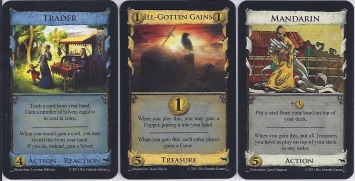
Dominion: Hinterlands cards

That said, both of these are solid expansions to my favorite game. I can play this nearly one hundred times per year, and I’m still frequently surprised by how different one set-up can be from the next. Cornucopia only offered a taste of the paradigm-shaking changes of the early expansions, and Hinterlands mixed right in without any surprise, but they maintain the current level of quality and are the reason this game will still feel varied to me a year from now. If I sound a little cynical, it’s because I’ve reached the point where I understand why some people have Dominion fatigue. I still say these games are worth buying, though, and I’m confident that I’ll be standing in line for the next one.

Dominion: Cornucopia: B+

Dominion: Hinterlands: B-


7 Wonders: Leaders (Game Review)

7 Wonders: Leaders box

7 Wonders: Leaders

Not long after giving 7 Wonders a great review, I got sick of the game. Everything positive that I said about it is still true, but it’s a somewhat repetitive filler based largely on guessing which cards you will get later. It’s very fun for what it is, but everyone wanted to play it all the time, instead of just as a filler. Within a couple months, I’d played it as many times as I should have over the course of a year. I’m definitely in the minority here, which means that my review turned out to be more accurate for others than for me (but also means that the game keeps hitting the table, so I stay tired of it).

Fortunately, the Leaders expansion has rekindled my interest in the 7 Wonders. It’s a simple idea and doesn’t change the spirit of the game significantly, but it adds enough variety to keep it feeling fresh. It adds a new “Phase 0” in which players draft four Leader cards. Each Leader offers a unique power, and the players hold them in their hand rather than playing them immediately. Before each of the three main phases, everyone plays a single Leader. (One of your four will never get played.)

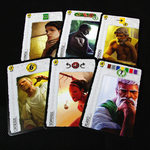
Some examples of Leader cardsSo without significantly increasing the playing time or adding new cards to the main rounds of gameplay, everyone is now in a different position. One player may receive extra symbols to support a Science strategy, while another can build Military cards more cheaply, and still another will receive points for playing certain combinations of card types. There are also cards that give immediate bonuses, or reward unusual things like having the card that lets you build a later one for free. Leaders cost different amounts of coins to play, which means money management also becomes slightly more important.

Does Leaders solve the fundamental issues I have with 7 Wonders? Mostly not. The winner will still be the person who got the most synergistic cards passed to them, which is something that skill can only partially mitigate. The Leaders arguably add another way for some people to get a much luckier combination than others. However, they also give you a new strategy at the start of each game, and make each player’s set-up much more distinct than the Wonder boards alone do. (Ignoring your Wonder is a perfectly valid strategic choice at times, but it means that your playing position is indistinguishable from anyone else’s. Ignoring your Leader cards is almost always a bad idea.)

I’m still being careful not to play 7 Wonders: Leaders too often, because I expect that it could become boring in the same way that the base game did. When just played from time to time, though, I’m happy to hear someone suggest it. I assume that for people who aren’t tired of 7 Wonders (which is most of the gaming community), the new life that Leaders adds is even more exciting. This is an excellent example of how an expansion can add something fundamental to a game without changing the elements that its fans love.

Grade: B

(Images above from Board Game Geek. Follow the links for the original and photographer credit.)


Panic Station (Game Review)

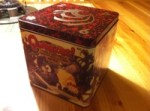
Panic Station tin

Panic Station

Panic Station features a new twist on the “cooperative game with a traitor” genre: The secretly evil character can recruit more players to his side, Invasion of the Body-Snatchers-style. It creates an unusual game experience, as players need to commit to fighting for their current side. A traditional board gamer, whose goal is to win, would be tempted to intentionally let the alien parasite infest them if the humans are losing. If you can get in the mindset to put a personal goal ahead of the strict winning and losing conditions (and shifting goals immediately if you get infected), then this can be a unique and tense experience.

Set on an alien space station, the players’ goal is to destroy a colony of parasites before they are taken over. Rooms are placed, and both players and aliens move through them, in the traditional dungeon-crawler style. This isn’t a new approach to cooperative games (see the popular Dungeons & Dragons board game series), but it is the first cooperative game with traitors that I know of based on this mechanic. It’s a natural fit, though: When the accusations and paranoia start to get too strong around the table, you can just barge in and attack the player you think is betraying you! Of course, you might be wrong…

The dungeon mechanics are well-suited to the game rules. With players having only a few action points per turn, and aliens and locked doors blocking paths off, the station stays very claustrophobic. Characters will keep running in to one another, and every time they do so they must either trade cards or attack each other. Trading is the way that the alien infection is passed. Bluffing comes in to play, as well: If the intended victim trades a gas can card, they are not affected by the infection card and can now identify the other player as a traitor. But because gas cans are also needed to destroy the parasite hive at the end of the game, humans that are too quick to trade away gas cans will lose as well.

Early game situation. The cards define rooms, and the player tokens (plus two aliens) are spread around them.

Panic Station is a collection of good ideas, but unfortunately it takes more than ideas to make a game work. First of all, it’s best with six players, so that the parasite side needs to infect multiple people to really become powerful. But waiting for five other people to finish their turn can be painfully long. Also, despite all the tension and arguments about strategy, the game will most likely be won or lost by a few key moves in which the traitor tries to infect others. Whether other players happen to block with gas cans at the right time will determine the course of the game, and even the side you end up on can feel determined by chance. I think that there is probably a little more strategy and depth to it than my first few plays revealed, but I can’t be sure: My friends have no desire to try the game any more, and I don’t have any good arguments why they should.

Chief among the reasons we gave up on it is confusion over the rules. The rulebook that came with my first edition is, without a doubt, the worst one I’ve ever seen in a professional game. Confusing and incomplete, game designer David Ausloos has admitted that the person who translated the rules to English did so without ever seeing the game. Ausloos has been very active on Panic Station’s Board Game Geek page in response to players’ questions, and he has since updated the rules with major improvements. Now at version 2.2, the game is finally playable and mostly makes sense, though the threads on BGG prove that it’s still not perfectly clear.

The problem isn’t just that the rules were poorly translated. This new version has major changes from the original, including a different game setup and an altered victory condition! It really makes me wonder how well the game was initially play-tested. At times, Ausloos and the games’ fans seem to be limited by an idea of how the game “should” play, and game-breaking strategies are dismissed with the explanation “that’s not in the spirit of the game”.

For example, the initial rules gave everyone a gas can to start with, which meant that no one could get infected as long as people always traded gas cards with each other. If anyone refused to trade a gas can, then the other player would announce that they had found the traitor. The rest of the table wouldn’t know which one to believe, but they could fight off both suspicious characters and proceed to win the game. It’s not a perfect strategy (sometimes it will be necessary to trade other items, but usually not until late in the game), but it’s foolish not for the humans to use it. I’d argue that it’s also in the “role-playing” spirit of the game: Of course the paranoid humans would try to protect themselves as much as possible! The new rules mix up the initial cards to make some people start without gas cans, injecting enough uncertainty to break this methodical strategy, but Ausloos still insists that the players who found this were not playing in the right spirit. I, on the other hand, wonder how this issue never came up in playtesting, and can only conclude that Ausloos simply told his players not to use that strategy. This goes hand-in-hand with other times when Ausloos issues rule clarifications that make sense from a thematic point of view, but seem to contradict previous things he has said.

I finally stopped trying to bring Panic Station to the table when I accepted that this is an exciting amateur work that somehow got published without any of the rigorous polishing that a successful game will need. I know that there is a fun game buried within here, but not many people will find it.

Grade: C-


Kingdom Builder (Game Review)

Kingdom Builder box

Kingdom Builder

Though Kingdom Builder is very different from Dominion, Donald X. Vaccarino’s previous game, it’s fair to say that they come from the same design approach. Both are based on rules so simple that it hardly seems like they could contain a worthwhile game, but include a variety of items that all interact with the rules in different ways. The player’s mission is to find the best use of the offered items, which is tricky because each game only contains a few of them. The vast differences in strategy when different combinations of items are available is what gives the game its depth and replayability.

The similarities end there, though. Dominion was built from elements so elegant that it’s hard to remember how original they were at the time: deck-building games, and, less obviously, systems of “undirected attacks”, came from Vaccarino’s mind. Kingdom Builder, on the other hand, starts with an element already exhaustively covered by Eurogames: placing cubes on the spaces of a map, which are defined by their terrain and possibly by neighboring special spaces. From there, he applied Dominion-style elements to provide different powers (based on the unique spaces that are included in the modular map) and scoring rules.

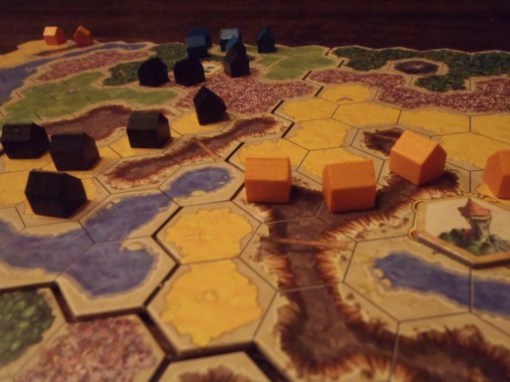
Kingdom builder in playThis isn’t a Dominion clone. Kingdom Builder feels less like a Dominion knock-off than deck-builders such as Ascension and Thunderstone. Just as two very different Reiner Knizia games can both be recognized as having common elements, these two Vaccarino games share a similar approach. They deserve to be judged on their own merits, though.
So, looking at its merits, different Kingdom Builder games do feel fairly different from each other. The presence of Stables, for example, which will let you jump one already-placed cube two spaces every turn drastically alters the strategy when it appears (the normal rules are strict about forcing you to play adjacent to your other pieces on the board, so the ability to move beyond that is huge), and scoring points based on spreading your pieces evenly around the quadrants of the board is very different from scoring based on majorities in each quadrant. Games last about 20 minutes, and the ideal strategies vary each time. While Kingdom Builder doesn’t feel like a completely unique game, it doesn’t quite feel like any other, either.

However, the game has some frustrating elements. For one thing, the terrain type you may play on is chosen by a card draw each round. While your “special” moves are generally not affected by that, it randomizes a major element of the gameplay. Also, this reverses the pattern of most games, in which players build up an engine and find themselves making their most powerful or point-gaining actions near the end. Instead, Kingdom Builder is usually won in the first few rounds, when players race to choose special powers and aren’t yet limited by having pieces on the board they must play adjacent to. If the game weren’t so short, either of these elements would be fatal to it. Fortunately, it’s the perfect length for its depth. Victories and good play still feel satisfying, but losses that were outside your control aren’t painful.

Pleasant but ephemeral, Kingdom Builder is a good game to own, but also not one that anyone should feel bad about skipping. It’s real worth will only be judged once the inevitable expansions are released. In this respect, Dominion comparisons are necessary again, because that game felt drastically different once a few expansions had opened up its possibilities. I’m unsure what to expect here. The potential of “place cubes on the terrain your card shows” doesn’t seem as broad as that of Dominion’s deck-building system, but Vaccarino has definitely earned the chance to prove himself. The only thing I can say for sure now is that this initial release of Kingdom Builder offers less variety than the initial release of Dominion did. With four of eight special buildings, and three of ten scoring rules, used every time, elements seem to repeat more often. No Kingdom Builder item yet changes the game as much as the most notable Dominion cards, and the most fundamental abilities (such as “play on an extra space of a given terrain”) feel less distinct than Dominion’s basic cards (such as “+2 cards, +1 action” versus “+1 card, +2 actions). My best guess is that Kingdom Builder will continue to be fun, but never essential.

Grade: B-


Quarriors! (Game Review)

Quarriors! Box

Quarriors!

The more games fail to live up to expectations as “the next Dominion“, the more people seem to want to make one. It’s not necessarily a fair way to judge a game, though; Can’t it succeed or fail by its own merits? Quarriors! owes a very obvious debt to Dominion, but its most notable strengths and flaws are unique to this game.

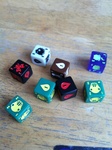
In short, Quarriors! takes the idea of a deck-building game and turns it into “dice-building”. Many elements translate from cards to dice pretty naturally: Players draw their “hand” of dice from a bag rather than a deck (making shuffling much faster!) and discard them on the table. Each turn, the player can buy one more die from the common pool and add it to their discard pile, and when the bag runs empty, all the discarded dice are mixed back in.

Quarriors! Setup with dice and cards in the middle of the table.

The game mechanics are elegantly built around the strengths and weaknesses of dice. For example, powers that let players manipulate the draw pile won’t work, but the discard pile is available for interaction. Also, since dice can’t hold as much information as cards, so each type has a reference card sitting in the middle of the table with a full description. The dice that go along with each card have a distinct color, making them easy to identify quickly. Cleverly, each color of dice has three corresponding cards (only one of which will be available per game) with different costs or special powers, meaning that the game can provide a good deal of variety without needing thousands of costly dice. In fact, publisher WizKids has done a great job of providing quality components (including a cool die-shaped tin for a box) at the price of a normal game. My only complaint, and it is a serious one, is that all three cards for a given die have exactly the same art, making it difficult to identify a given game’s setup quickly.

Being a dice game, Quarriors! obviously has a lot more randomness in it than Dominion. The game is designed around this, with a shorter play time and a theme of summoning creatures to do battle. Surprisingly, the rules for working with these creatures feel to be in the spirit of Dominion. After being played, they immediately attack the other creatures in front of all opponents equally. Any creatures that survive for one round around the table are scored and then discarded, eventually being shuffled back in to the bag. It’s the first balanced fighting system I’ve seen in a deck-building game, and I really appreciate the fact that creatures automatically attack all opponents equally, since deck-builders seem to do better without directed attacks. I also like the way that this game’s resource (“quiddity”, which is basically a quantity of magic) is used both for the “action” and “buy” phases of a turn. It requires quiddity to deploy monsters for battle, but that reduces the amount of buying power left afterwards. It’s as elegant, and potentially as tense, as Dominion’s “one action then one buy” rule.

Some of the dice in Quarriors!For all the clever ideas though, it feels like a lot of the gameplay was not fully thought through. There is potential interaction between the different types of dice, but the powers have a lot less subtlety than Dominion. Most abilities just increase the stats of a creature, which means that the exact combination of dice a player acquires isn’t as important as it should be. There is some strategy in deciding which and how many spells to mix with the creatures, but for the most part, a player won’t go wrong in simply buying the strongest creature possible. Since the more expensive creatures are generally higher on all stats and score more points, if one player gets an early chance to buy something like a Quake Dragon, the rest of the game feels more like a formality than a real competition. And since the rolls determine the strength of the dice, there is no card that can’t potentially be bought on the first turn, even though the average player won’t get it until past the halfway point. Quarriors! officially ends at a very low point score, apparently so that games won’t last long enough for the randomness to become frustrating, but the result of that is that players have almost no chance to catch up to the person who got a lucky start. There is an endgame mentality almost from the first roll. I generally play to a slightly higher point total. It’s still a fast game with a lot of luck, but at least then there is some chance that a player who spends time building a strategic set of dice will be rewarded. Even so, Quarriors! would require major revisions to change the fact that the first player to buy a Dragon usually wins.

All in all, Quarriors! offers a strange mix of strategy and randomness that is a little unsatisfying. Clever play is possible, but rarely matters more than luck. The game is light and fast, but it can take some focus to evaluate the multiple powers of each card and refer back to the middle of the table for information not on the dice themselves. Basically, to truly appreciate it you need to be able to follow somewhat complex timing rules, but prefer theme and randomness over heavy games. It is a very clever design, and everyone should enjoy playing it a few times. Long-term, though, the variety of setup options don’t keep the game from feeling somewhat repetitive and arbitrary.

Grade: B-

(Note: The images in this article come from Board Game Geek. For more information about each one, including the photographer, they all link back to the original.)

Confusion (Game Review)

The elevator pitch that I usually hear for Confusion is “It’s like Chess meets Stratego“. While this does cover a lot of the game’s basics, it’s also somewhat misleading. Because you can see what your opponent’s pieces can do instead of your own, it’s actually the opposite of Stratego. It will probably be easiest to show how the game works, and how cleverly the components support this structure, with pictures.

Continue reading

The Heavens of Olympus (Game Review)

“Zeus has decided that he wants to construct a universe.” I hope you don’t need theme, because that’s about as much as The Heavens of Olympus ever provides. Over the course of five days (marked by the phases of the moon, for some reason), players are charged with placing planets in the sky in order to form constellations. (Yes, these constellations are made of planets.) Points are rewarded based on the fact that Zeus craves variety. In other words, the game’s rules have nothing to do with either actual cosmology or Greek myth.
The game mechanics themselves aren’t bad, though. This, the first published game by designer Mike Compton, is a fairly abstract game about placing markers on a crowded board for points. Players select actions by playing cards simultaneously, and there are rewards for choosing different actions than anyone else. Conflicting rules offer points for forming constellations within the pie-shaped regions of the board, but also for majority control of the circular orbits that cross regions. It makes for a nice variety of choices, especially since players will also need to earn “power” (generally by playing to new regions) in order to create and place planets. The system is set up so that power will be hard to maintain by the end of the game, forcing players to struggle and do (minor) calculations to play effectively. Because they’ll also need to keep the strength of their “torch” high enough to light the planets during scoring, there are a decent number of factors to track. Combined with a simple but effective catch-up mechanism that makes the player in the lead pay higher costs, this is a decent design for a medium-light game.

In my plays, the game board was a little too busy and difficult to follow with five players, but it was decent with fewer. I’m not sure whether five is simply too many for this game, or whether better graphic design could have saved it.

Unfortunately, the idea that better design was needed comes up regularly while discussing this game. I suspect that, with dedicated professionals working on The Heavens of Olympus from start to finish, it could have been a decent, if unspectacular, game. Probably a B-, maybe a C+ if the five-player gameplay still didn’t pan out. But in its current form, almost every aspect of it is cheap and shoddily made:

  • As already discussed, the game’s theme seems to have been thrown together in five minutes. If nothing else, it would have been less insulting if the game had simply called the planets “stars” (since they light up and form constellations) and said that a cycle of the moon is one month rather than one day.
  • Along with making the five-player board easier to read, a little more consideration could have streamlined the rules that require two different first player markers to move around the table, and to help people remember each phase of the game (such as the “extra night” that occurs at the start, and the torch reduction that occurs at the start of each new day).
  • The colors of the planet markers don’t match the colors of the other player tokens at all. (And the cards that are used to select actions match neither.) Expect some mistakes.
  • The marker that displays the strength of a player’s “torch” is supposed to be placed one position higher than the actual value. The idea is that since the marker covers a number, the player’s strength is the highest value still visible. This is a confusing, non-standard rule; The same board has a scoring track, on which markers cover the player’s current score without confusion. If this was a real problem, then the publisher should have provided disks that show the number underneath.
  • The box is long and thin, similar to Monopoly dimensions, rather than the taller but more compact format that is commonly preferred today. The pieces were not designed for that box size, and the board slides around banging into the sides.
  • Similarly, the plastic insert within the box was obviously not made for this game. That’s become a common money-saving shortcut for Rio Grande, but it’s especially egregious in this case. The space for holding cards is too small to hold the ones that come with this game! Was the production so rushed that no one noticed this, or did they really care that little about the game’s quality?

Some of these flaws make the game a little more confusing and slower to play. Others are just aesthetic, but definitely impact the overall experience of the game. At conventions, I’ve sometimes talked to small publishers who were obviously a little embarrassed by the quality of the finished product they could deliver. Given their lower budgets and smaller audience, it is often possible to overlook a few flaws in order to find an undiscovered gem. But in this case, Rio Grande is one of the largest game publishers in America. That they would attach their name to such a amateur production is frankly an embarrassment for them, and a little insulting to me as a member of their intended audience. I wonder whether this is a one-time mistake, or a sign of shift in strategy for a company that should know better.

Grade: D

Origins 2011 Wrap-Up

I just got back from five days at Origins, the annual gaming convention in Columbus. I had a great time as always. While the convention encompasses non-computer gaming of all sorts (minis, CCGs, role playing, and so on), I always go for the board games. Specifically, I go to check out new games I haven’t played before. Here is my report of the convention from that point of view.

(Sorry, I didn’t have a camera with me. I’m still relatively new to blogging, and I didn’t think to bring one until it was too late. I’ll remember next year!)

I think that three main themes dominated the convention this year:

  1. Pretty much everyone I talked to, from friends to vendors to people on Twitter, agreed that the convention was slower this year than last year. Whether that meant fewer new good games, fewer attendees, or less money spent, everyone says it’s going downhill. I agreed that it felt a lot slower, but I’m not so sure now that I look back. I remember people complaining about how there were not enough good games last year, but I still found a lot of good ones then. I thought I had a lot of downtime this year, but looking back at 2010’s notes, I played approximately the same number of games (32 last year, 31 this year). I’m not going to bother calculating the total time they took, but it does seem that I just forgot about the downtime I had last year. Admittedly, I did learn fewer new games this year (19 instead of 24), but I blame that on my own unpreparedness. I’ve been getting ready for a wedding instead of researching the games I needed to find, and I arguably shouldn’t have taken five days for this at all. (On Sunday, I discovered several games I wanted to play, but I didn’t have time for all of them. Had I known about them ahead of time, those numbers would be closer.) So while there were a few worrisome signs of cutbacks, I think that this meme grew mainly out of human nature. We’re always comparing the present to the best parts of the past.
  2. Pure Eurogames are falling out of style. Last year, the big theme I noticed were that Euro- and American elements were finally being mixed together. My theory was that Eurogames were established enough that the American designers could draw on them successfully, and that Eurogamers were now thoroughly used to the basic mechanics of their games and ready for something new. This year, that has accelerated. There were a few good Euros out there, but they weren’t the ones with buzz. The dice games, dexterity games, and battle games were what everyone wanted to talk about this year. That makes sense, as the tastemakers in the Euro scene have always been eager for the next big thing. Five years ago, every new twist on area control and resource production was interesting to us. Three years ago, Agricola was ground-breaking. Today, all those things are familiar and dull. But making a balanced, replayable space battle based on flicking tokens around the board? That’s new.This ties in to my earlier point. The general consensus always seems to be that there aren’t enough good new games, but I still can’t keep up with them. The only problem is that as we get more familiar with the options, it’s harder to make everything seem new. Given that reality, I’m amazed by how much innovation I’m still seeing.
  3. Dominion is still a big deal, and now the deck-building knock-offs have arrived in force. Thunderstone is now established as a major game, and Nightfall, Ascension, and Resident Evil are jockeying for their position next. The retailers were giving these the sort of major promotional support usually associated with collectable card games, so they must expect huge results from this genre.I’m already on record complaining that all the new games have missed the elements that made Dominion great, without finding anything worthwhile to add. Overall, I found this new crop to be just as disappointing, but there are some glimmers of hope. Most importantly, though, I could still see a lot more games of Dominion being played than every other deck-builder combined. That game still has the fanbase it deserves.

Continue reading

Cargo Noir (Game Review)

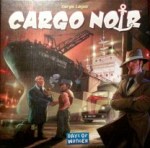
Cargo Noir boxWhile bidding games are incredibly common in the current board gaming scene, Cargo Noir manages to find a new twist on the mechanic. Each turn, a player has a few ships that they can send out to offer money for a set of tiles. Those tiles won’t actually be purchased until the player’s next turn, which gives every other player a chance to make a higher offer on those same tiles. If the initial offer is outbid, the player who made it will need to either withdraw or raise their bid on their next turn. Because this is a new offer, it will be yet another time around the table before the tiles are actually won.
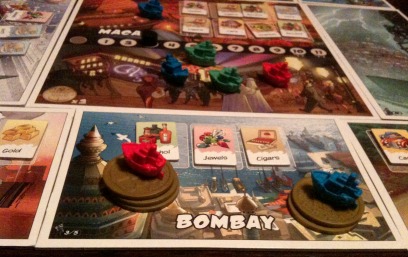
The result is a game in which many potential auctions are taking place at once, but most of them only receive a single bid. When someone is outbid, it’s a big deal: At a minimum, that person has just wasted one of their limited actions from the prior turn, and if they still want those tiles, they will need to wait at least another round to get them. The game lasts a mere 10 or 11 turns (depending on the number of players), so a one-round delay can be pretty significant.

Most people find this system a little unintuitive at first – they expect this to be a standard auction game, in which players get a chance to bid back and forth on a contested item within one turn. But once everyone understands the concept, it’s simple and elegant. The goal is to bid high enough to discourage other players from getting involved in the auction at all, but not so high that money is wasted: Earning more money requires a ship action. Wasting money effectively means that later actions will be lost to pay for it.

The red player outbids the blue player for the tiles in Bombay

The red player outbids the blue player for the tiles in Bombay

The flow of the game is very natural. Start your turn by seeing which of your bids from the last turn have survived uncontested, collect those tiles, and then send your ships out for new bids. Additionally, decide whether to cash those tiles in for points, or keep them for a later turn. (Yes, this is a classic “earn one resource, and then use it to buy points” Euro-game.) Turns move fast, and the fact that each action takes a round to resolve means that there is a feeling of continuity from round to round.

This system has a few flaws, too. Most notably, outbidding someone sometimes feels like too powerful an attack. Even if the other player is willing to bid higher for the tiles, they are still forced to lose an action and wait longer for the goods. Attacks in bidding games don’t usually feel so direct. Worse, they can sometimes feel arbitrary. You may find yourself willing to spend three coins to buy three tiles, and see that two other players have each made a bid of two coins for three tiles. With the way tiles are valued, it often makes no practical difference to you which auction you bid on, but the choice will have huge repercussions for the player who gets blocked! Expect accusations of “king-making” to come up a time or two each game.

The way the tiles are valued is interesting, but probably a little too simple. There are nine types of goods, and the most points can be earned by cashing in a set of matching ones. Sets of all-different ones can be cashed in as well. In either case, sets become much more valuable as they get larger, but only a limited number of tiles can be saved from turn to turn. Players will usually do best with the simple task of collecting different tiles, but matching sets are necessary to reach the highest-point cards. This choice creates a nice tension, but I do wish there was a little more to it. Too often, the different sets of tiles available feel more or less the same as each other, which leads back to the problem in which deciding where to bid has less to do with its value to you and more to do with which other player you want to hurt. Cargo Noir is a good game, but if it could have found a scoring system with the variety of Ra’s, the bidding choices would be much more interesting.

The game is published by Days of Wonder, which means that despite the pasted-on theme, it comes with high-quality bits and detailed artwork. This is nice, even if it is a little more extravagant than needed. For all the attention to the game’s appearance, though, it seems that someone could have put some effort into making  sure that all the pieces fit back in the box easily. There are ways to squeeze everything in there, but none of them are as simple as they should be.

All that said, Cargo Noir is a better game than many of Days of Wonder’s recent offerings. I don’t find the auctions themselves compelling enough to return to this one regularly, but the auction system is original and elegant enough to ensure that it won’t be forgotten.

Grade: B

7 Wonders (Game Review)

7 Wonders BoxIn some ways, a game that works for more than five people is the Holy Grail of the industry. In my opinion, even going past four people causes long delays between turns, and introduces too many factors that feel outside of a single player’s direct control. But when a group of friends gets together, it’s easy to end up with too many people to comfortably play one game, but not enough to split into two groups.
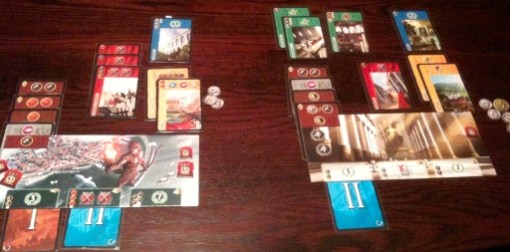
7 Wonders’ claim to fame is that it works for up to seven players at once. More importantly, though, it keeps everyone consistently engaged through its breezy twenty- to thirty-minute playing time. Its mechanics make this so simple that after one game, it seems amazing that no one has tried this approach before. Basically, there is no downtime because every player is making their choice simultaneously every turn. Choose one card to play, and pass the rest of your hand to the player next to you. Sure, other games have used this card drafting technique before, but 7 Wonders also addresses the other source of slowdowns in games with too many players: All your interactions are with the people to your immediate left and right, so you don’t need to get bogged down keeping track of more than two other players.

The game itself is a fairly straightforward entry in the “civilization light” genre. Each card gives you resource production, points, or abilities. There are too many resources to personally cover all of them, but you can buy the ones you need from your neighbors. Just keep track of what they are producing so you don’t duplicate their efforts, and so that you can build the ones that they’ll want to buy from you! Also watch their military strength, because at the end of each of the three rounds, your comparative power will gain or lose you points.

7 Wonders Play7 Wonders offers a decent amount of choices. You can earn points through cards, advancing your personal “great wonder” track, matching symbols, getting money, or having a stronger military than your neighbors. The “Guild” cards that appear at the end of the game even let you score points for how advanced your neighbors are in various categories! It’s impossible to excel in every area, but they are well-balanced enough that you can ignore any of those and still win the game.

It feels surprisingly meaty for a twenty-minute game, but there is a lot of chance hidden behind the mechanics. Drawing the right cards, especially when those big Guilds are dealt out at the end, makes a big difference. And while it may be fun to ignore the player on the other side of the table, it can be frustrating to learn you’ve lost to someone you weren’t even able to interact with. For that reason, I suspect that these mechanics wouldn’t work in a much longer game, as much as I wish they could. It’s not too frustrating to lose a filler game by chance, but it would be a deal-breaker if two hours of planning fall apart through no fault of your own.

The game also becomes a little repetitive before long. Despite the many paths to victory points, and the different “Wonder” boards that each player is dealt, the various strategies don’t really feel that different after several plays. They’re all based on getting resources, playing cards, and watching to make sure you bury any card that your neighbor desperately needs. There are already expansions on the horizon that promise to add more variety, but I’m not sure how well they’ll succeed. 7 Wonders feels like it has as many elements as its short playtime can support. Anything different enough to actually increase the replayability would probably be too overwhelming. On the other hand, designer Antoine Bauza has already made one near-impossible task look simple. If 7 Wonders could keep me interested through a seven-player game, then I suppose that the expansions could hold more surprises of their own.

Even after the initial rush of newness wears off, I don’t expect this game to stop being fun. And because it fills a niche that nothing else in my collection does, I’m sure it will remain in use for a long time. Looking for a filler to play as your friends are arriving, or when you’re winding down for the night? This works no matter how many people are there with you, and it feels heavier than just about anything else that plays so quickly. 7 Wonders not only has an original design, but is going to keep hitting my table long-term.

Grade: A-