Was the Book Better?

I have compared books to their movie versions a few times on this blog, and of course that topic comes up pretty often in conversation. The universal conclusion that I hear from everyone is “the book is [almost] always better than the movie”. Although I agree with their sentiment, I don’t actually think that it’s true. Here’s my explanation.

It is true that when a movie adapts a book, it’s almost always a disappointment compared to the original. But it’s also pretty common for people to write novelizations of movies. No one ever says “Yeah, Back to the Future was a good movie. But the book was so much better!” I remember, as a kid, finding a book version of Ghostbusters years before seeing the movie, but even though I read it first there was never any doubt that the movie was better. These days, movies often have comic adaptations instead of prose novels, but no one is talking about how the graphic novel of Django Unchained is the real masterpiece.

Your first reaction is probably to dismiss those examples by saying that those books don’t count. We don’t take novelizations of movies seriously. But that’s my point. We don’t take them seriously because the movie came first. Instead of saying “the book is always better”, we should be saying “the original is always better”.

Every medium has its own strengths and weaknesses, and almost no good works are going to translate easily into another medium. When someone tries, they’re likely to be hobbled by the need to “feel like” the original or please its fans, and they’re also more likely to be motivated by money than the original creator. In those rare cases where a movie does surpass a book, it’s almost always because the creators of the movie were confident and free enough to turn it into their own thing.

This rule is true for just about any creative medium you can imagine, and it does always work both ways. Video games based on movies are usually unimpressive cash-ins, for example, but it’s also the case that movies based on video games are consistently awful. The important thing to remember is that one medium is not inherently better than another. Instead, a fundamental truth of the creative process is that you get the best results when you’re not trying to duplicate something else.

Jello Biafra and The Guantanamo School of Medicine – White People and the Damage Done (Music Review)

White People and the Damage Done cover

Jello Biafra and The Guantanamo School of Medicine – White People and the Damage Done

It’s strange that I summarized Jello Biafra and The Guantanamo School of Medicine’s last album by saying that the band’s creativity covered up Biafra’s dated lyrics. In their new release White People and the Damage Done, it’s an energetic Biafra driving the project. The musicians are versatile for a punk act, but they’re mainly content to back up the star lead. Their accomplishment here is that the Guantanamo School appear at first glance to be a straightforward band, because their variations mimic Biafra’s own flights of fancy so well.

All that said, White People gives you exactly what you’d expect from a Jello Biafra album. His nasal voice and prankster attitude provide everything from intellectual arguments and ad hominem attacks, usually in service of political screeds but sometimes just for shock value. Biafra’s recent career in spoken word performances comes through for better and worse in “Shock-U-Py!”. At its best, the song is an inspirational speech set to music. Other times, though, his attempts at catchy verbal hooks fall flat: Lines like “to all of those who Occupy, and feel the spirit of Shockupy” are earnest but cringe-worthy.

The highlight is the blistering “Mid-East Peace Process”, a song that rivals “Holiday in Cambodia” in its ability to actually shock and unsettle the listener. The first verse is a violently noisy depiction of a strike on Palestine, while the second is slow, paranoid story of Israelis wondering who around them could be a suicide bomber. So potent that it should come with a trigger warning for anyone who’s lived through the past decade of fear, it will grab anyone’s sympathy by the time Biafra is screaming “I don’t want to live in a world like this, you don’t want to live in a world like this… No one should have to live in a world like this!”

It’s a sign of the album’s weakness that that song is followed up by the lackluster “Hollywood Goof Disease”. Biafra has nothing new to say about people’s obsession with celebrities, and his complaints (“what in the world is a Kardashian?”) are the opposite of “Mid-East Peace Process”‘ insightful commentary.

There are too many weak songs like that. “Crapture” takes easy shots at fundamentalist beliefs and makes an unsuccessful attempt at slowing down the music, while “Burgers of Wrath” is virtually unchanged from the version Biafra recorded twenty years ago. Other than “Mid-East Peace Process”, Biafra is at his best when he sticks to focused political rage that preaches to the choir. His distinctive voice and off-kilter views still keep that fairly interesting, but it doesn’t feel like he’s taking chances any more.

The album needs more songs like the remix of “The Brown Lipstick Parade” that appears at the end. The original is one of the good-but-unsurprising tracks on the album, but the bonus version replaces most of the guitar riffs with a brass band, to great effect. It’s still punk, but with an absurd carnival atmosphere that fits Biafra’s voice and jokes. If he’s going to turn out the occasional gem and fill the rest of the album with familiar repeats, then the goal should be unexpected twists like that.

Grade: B-


Dixit (Game Review)

Dixit

Dixit

As one of the more distinctive games in the Apples to Apples genre, Dixit has gained a lot of popularity over the past couple years. Though I’m not the target audience, I have to say the attention is well-earned. One game every few months is enough for me (sometimes more than enough), but it’s interesting, and I can play it with people who wouldn’t otherwise be interested in games.

Dixit is by otherwise little-known designer Jean-Louis Roubira, but artist Marie Cardouat deserves at least as much credit. After all, the first thing anyone notices about it is the evocative artwork. Each card is wordless, with a dreamlike, almost menacing, picture. They’re almost too weird to work for a family game, but the creativity and soft focus make them more interesting than off-putting.

The mechanics are solid, too. Players take turns being the storyteller, who must say a word or two about one card and then play it face down. Everyone else plays a card they think matches the description, and then each player except the storyteller guesses which one was played originally. Points are, of course, earned for choosing right and for convincing other people to choose your card.

Dixit cardsAll of that may sound like a typical Apples to Apples-style game, but Dixit is the only game I’ve seen like it that actually provides a balanced gameplay. First of all, almost everyone at the table is making a quick, simultaneous choice, which feels a lot less arbitrary than a single leader choosing one person to get a big bonus. But also, the storyteller’s goal is to have at least one person choose their card, and at least one person choose wrong! This forces them to be creative, offering hints that aren’t too strong, especially since a lot of the cards have similar themes. This resolves a lot of the issues that plague similar games. There’s no motivation to be especially clear or vague, and if the description is well-chosen, other players will have to play cards that are also only slightly like the description. There are real choices every round.

Playing with the same cards over and over does get tiring quickly (even if you buy some expansions), and it can be difficult to catch up if someone else gets a lot of points in the first few rounds. As I mentioned above, this isn’t the kind of game that usually grabs me. I definitely respect how well it fills the niche it aims for, though, and it’s a great choice for a lot of people. Dixit is proof that games with popular appeal don’t have to be lazy and unbalanced.

Grade: B

 (Images taken from Board Game Geek. Follow the links for the originals and photographer credits.)


Play By Email Week: DungeonWorld

Concluding Play By Email Week, the last game I’ve been playing lately is Madhouse Interactive’s DungeonWorld. As the name implies, it’s a hack-and-slash RPG heavily based on genre clichés. It is processed entirely by computer, with no human moderator making decisions based on your role-playing, but there are enough possible commands, different items, and unique rooms to keep it from feeling like a simple game of numbers. It’s also fairly hardcore, with character death being permanent and the signup page including a quiz to keep out new players who aren’t committed enough to read the rulebook first. I suppose that’s something I find intriguing about PBEM games: Though the players are very friendly, there is none of the hand-holding and guaranteed victory of modern games.

DungeonWorld is priced competitively compared to most other PBEMs, with a sliding scale that lets you choose how committed to become. In a brilliant move, your first character in each module is free. This allows up to eight free characters, from the heroic Kingdom of Bereny to a lawless jungle, an Arabian Nights-inspired desert, and even a steampunk setting. (All but one of those eight, a post-apocalyptic setting, are part of one large world that a strong character could traverse in a few years’ time.) However, it really starts to get interesting once you are paying for multiple characters who can work together and coordinate actions. Considering all the free gaming available, the cost of a couple paid characters seems more than fair. (The exact cost is variable, since it’s in British Pounds and the exchange rate fluctuates, and Madhouse frequently offers specials that let you pre-pay at a discount. But officially, a “position” costs £1, plus £0.50 for each character after the free one.)

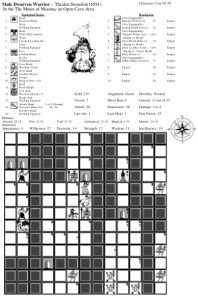
An example turn result, though there are a couple more pages after this to describe the results of the character's actions.

An example turn result, though there are a couple more pages after this to describe the results of the character’s actions.

Each turn of the game includes fifteen rounds of action, so you need to plan out moves without knowing exactly what will happen. There are a variety of options available for both moving and attacking to let your character perform intelligently (sometimes…) even if the situation becomes different than what you expected. As usual, PBEM allows plenty of room for simultaneous choices among players. Will you reach that loot before the character on the other side of the room? Are those orcs going to come after your weak Enchanter? Do you need to devote a whole turn to attacking an enemy, or will it be defeated in a couple rounds?

This simultaneous-choice game doesn’t go too far, though, because you’re almost never competing against other players. The community is universally friendly and very eager to assist new players. It’s a good thing, too, because the game does have several flaws that would be deal-breakers if not for this. The rulebook is inconsistent and years out of date, so most opportunities and information are passed around verbally. Also, the senior characters are orders of magnitude stronger than new ones, which would make this unfair if there were even a hint of competition between them. Finally, the person who runs the game needs to stay fairly active to correct mistakes, but he also ensures there are always epic quests going on. The game is huge enough to explore for years, but the community is small enough that within a few months I could contribute to the discussion and join in on a major storyline.

There are many email lists with different topics that are used for these discussions. I recommend them, but they’re all optional. You can enter orders on the website, and your results are emailed to you as a pictures and text in a PDF. Unfortunately, the website is not  guaranteed to work (it sends an email to the central server for you, and you get no confirmation that it arrived), and the other options for entering moves are Windows-based programs. Those are nice, but not a great solution to me as a Mac-user. Once again, I find myself wishing for an email order system that lives up to Diplomacy’s standard.

At two weeks between turns, events can take years to play out. My first characters, over a year old now, are halfway through the second level of one dungeon, and only got that far thanks to maps and experienced colleagues. However, that time was very interesting. Monsters and treasure spawn fast enough to keep things moving along, and playing with several characters guarantees that some of them will be in an interesting situation on every turn. Also, at least some experience accumulates every turn, and the system of training and skills allows you to spend experience for chances to improve as you travel along. There’s a constant feeling of forward growth, counterbalanced by the perpetual threat of defeat: Every month or so, another player will announce the death of a years-old character.

Though it has its flaws, DungeonWorld captures the dungeon-crawling experience very well. The slow, ongoing experience sticks with me consistently. Between the emails and my thoughts about what will happen next, it’s like a part of me is always playing. This is the sort of thing that makes PBEM unique.

Grade: B


Play By Email Week: Two from Flying Buffalo

Flying Buffalo is generally credited as the first company to make commercial Play By Mail games. Now a couple generations later, they’ve made the switch to email but still feel like the same small group of hobbyists they always were. The games are generally inspired by old-school wargames, and they have a per-turn fee.

The old-school vibe carries through everywhere, including the 1990s utilitarian design of their website. (If you want to send a credit card payment, you’ll find the page doesn’t even use SSL, and has a note on it that “the darn [security certificate] costs $100 a year, and doesn’t make any difference that I can see.” Fortunately, there are other ways to send them money.) And even though all games are run through a computer, they still have a staff of people who copy your orders from email into the program! I’ve found them to be pretty friendly and helpful, sometimes pointing out errors or even correcting obvious mistakes when it was too late for me to fix things myself. Even so, it can’t compare to the immediate, automated order checking of Diplomacy.

I tried two of their games, Nuclear Destruction and Starweb, which both offer a discount for new players to try out.


Nuclear Destruction is a very simple game about building missiles and factories, and then lobbing those missiles at opponents. You can, of course, negotiate with the other players (“major powers”) to choose targets, but a lot of the strategy comes from trying to win influence over the non-player-controlled “minor powers”. Gifting them money and bombs, or selling factories, could win their favor so that they attack the nation of your choice, or it could just be adding to the infrastructure of a country that’s under control of an enemy.

With its negotiation and simultaneous moves, Nuclear Destruction has some things in common with Diplomacy. The biggest design difference is the fact that there is hidden information. You get three spies per turn that can tell you the current influence and resources of other major and minor power, and otherwise you’re almost completely blind. It’s important to negotiate with others to increase your total information, though they could be lying to you. I find that idea to be really exciting, because hidden information adds a new element that the open board of Diplomacy can’t offer.

Otherwise, though, the game is lackluster. In fact, it’s so simple that there hardly seems to be a point. Anyone can attack anyone else, so there is no board or tactical maneuvering. The only difference between positions is in what minor powers you are vying to control. You can launch all your missiles at once if you want, and I don’t see much reason to hold back. Unless your target is annihilated in one round, they’ll be able to strike back with all of their missiles the next round. In my game, attacks usually knocked a player out of the game in one blow. For most of the attacks, including the one that wiped me out, I have no idea why anyone chose the targets they did.

The game is simple and relatively inexpensive, and if it ran quickly (say, a couple of turns per week), it might be a fun and chaotic experience. But instead, the standard length is three weeks between turns! Played like that, it’s ponderous without being weighty enough to justify it, and you’ll almost forget about it between turns. There’s just not much game here.

Grade: C-


The other game that I tried, though, has a lot going on! In fact, I find it a little scary that Flying Buffalo considers Starweb to be of only “moderate” difficulty. Turns in my game ran every two weeks, and they could take hours to plan out, in addition to all the negotiation going on at certain times. I wouldn’t have wanted it to be any faster. At first, I thought that the game seemed very overpriced. Though I had the introductory $1/turn rate, the normal price is about $5/turn, with games taking fifteen or twenty turns. When I thought of it as “this game is costing most players at least $75 each!”, it seemed ridiculous. But after a few months of experience, I realized it might be more fair to think of it as a hobby that cost $10 per month. At half the price of World of Warcraft, this immersive and time-consuming game (but one you can deal with on your own schedule) is actually justifiable. It’s all in how you look at it.

Starweb is, literally, about a web of wormholes between star systems. Thanks to these warps in space, the 255 worlds are not necessarily laid out in a simple two-dimensional (or even three-dimensional) structure. They don’t do a lot, mainly producing metal and building ships, but there are a lot of subtleties to the way that movement and battles work. Additionally, there are several different character types, and each one has its own powers and scoring. As your empire builds, and you control more worlds and fleets, expect each turn to involve about 70 individual orders to your empire.

The biggest criticism of Starweb is that it’s basically Spreadsheet: The Game. Much of the “fun” comes from all the information encoded in the dense reports you get every round, and in using your limited information to predict what the other players might be doing beyond your view. This probably sounds interesting to only a small percentage of my readers, but if it does, you should check it out.

Like Nuclear Destruction, this is another game of diplomacy with hidden information. Once again, though, the nature of the information makes the game very different from others. In this case, there is a lot of data out there, and everyone has only a little bit of it. Having the most information is a huge advantage, which means that you need to form partnerships that share it freely. This enforces complete trust, though: It’s suicide to betray someone once you’ve told them exactly where your strategic centers are and how they’re guarded. Besides, if a group gets held up by internal squabbles or withheld information, they will quickly be outpaced by more cooperative alliances. Apparently, as the Starweb community has come to terms with this reality, it evolved to the point where almost every (fifteen-player) game ends up with two or three large teams rather than lots of smaller, shifting alliances. Unlike Diplomacy, if you get a reputation for betraying allies, no one will ever work with you again. I’m not going to fight that system, as it clearly is the optimal strategy, but it was a little disappointing that the diplomacy phase of this game only lasted a few rounds. Once the alliances had settled down, that thrill was gone.

Though it won’t appeal to most people, Starweb is a unique and very deep game. I do want to try it more, but I definitely need a break first.

Grade: B-

 

Play By Email Week: Diplomacy

Before last year, the only Play By Email game I’d tried was Diplomacy. Following this blog’s standard practice of only reviewing things that are “new to me”, I won’t be officially grading this. However, it would earn an A or A- if I did, and I still want to talk about it because I think it’s the gold standard for how a PBEM game should work.

For those that don’t know, Diplomacy is a classic board game in which seven players fight over territory in pre-World War Europe. Every army is fairly weak on its own, so it’s important for players to make alliances to help each other. But the constantly-shifting strategic positions, as well as the zero-sum nature of the game, means that you’ll eventually have to break your promises and change alliances. Most of the game is spent with players simply talking to each other, and then they secretly write down orders that everyone turns in simultaneously. People either love or hate this game, as it’s long, intense, and gets players emotionally invested enough to take betrayal personally. Regardless of whether you like the game or not, anyone interested in email gaming should look at how online Diplomacy was implemented. There are two big reasons why I call this the standout for PBEM.

First of all, it’s amazing to see how much this changes when it’s played online instead of face-to-face. I said in my previous article that I’m not interested in email games that simply reproduce tabletop experiences, but I don’t think that’s the case here at all. For one thing, Diplomacy is complex enough that you could easily spend hours planning moves and negotiating with everyone, but typical games only allow fifteen minutes between turns to keep the game down to a single evening. It feels like a sprint that repeats itself every few minutes for hours. Over email, though, there are usually two or more days between turns. That’s enough time to plan and discuss extensively, even while going about your life. Even more importantly, though, face-to-face Diplomacy allows everyone to see who is talking to each other. You may not hear what they say, but you’ll know who may be planning to work together. Online, this is all hidden from others’ views, so you can talk to someone for as long as you want without making your current ally suspicious. In short, tabletop Diplomacy turns both time and conversations into a resource to manage, while email games take those out of the equation to let you focus on the core game. Neither is necessarily better or worse, but it’s fun to experience it both ways.

The second notable thing about PBEM Diplomacy is its implementation. This is written and hosted free of charge by fans, but it’s more reliable and feature-rich than commercial PBEM games. It may be because of its free nature that it’s so robust, because the hobbyists who run the servers don’t have time to handle anything manually. Everything, from requesting lists of open games or rules, to submitting your orders, can be handled with automated email codes. Even better, you’ll get an email back within seconds that tells you what you requested and whether or not you had typed in any errors. It even spells out details that the terse order codes don’t include, so it’s immediately obvious if you typed something wrong. Orders can be changed and errors corrected at any time before the turn deadline. Also, messages can be sent to other players through the system. This keeps the game anonymous if desired (since Diplomacy players try to avoid personal grudges), and lets you clearly identify players as “Italy” or “Russia” instead of “John” and “Dave”. When the game is anonymous, cheating is virtually impossible, because no one knows how to lie or spoof emails when they don’t know any other players’ addresses. These are all little things, but the make the system work very smoothly.

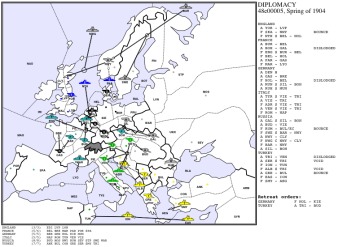
An example from a game I played, using an online mapping utility that helps visualize the game.

An example from a game I played, using an online mapping utility that helps visualize games on dozens of Diplomacy servers.

As fun as this is, though, I can only play every year or two. These games are too time-consuming and intense for me to stick with it more regularly. The standard two-day turnaround time forces you to put in significant effort every day. In addition to that, the game gives late players a grace period, so unexpected delays of hours or days will happen from time to time. Eventually, a late player will be kicked out, and the game will go on hold until someone new volunteers to take over the abandoned position. (And since it was probably abandoned because the player was losing, it usually takes a while before someone is willing to do so.) I think every game I’ve played has had a couple multi-week breaks because of this. This makes planning to play Diplomacy very difficult, because I don’t know what days over the next several months might be focused and busy and which days will have no gaming at all.

A great experience every couple years is still worth noting, though. Diplomacy’s email implementation is not only well-designed, but a fascinating study in the way environment changes a game’s mechanics.

Play By Email Week: Introduction

I’ve had a vague interest in Play By Email (PBEM) Games for a long time, but it wasn’t until last year that I finally made an effort to try them out. Now that I’m ready to discuss them on my blog, my plan is to devote my four articles this week to various PBEM games, starting with a general introduction today.

I haven’t talked about them much, because people usually get confused when I bring the topic up. They assume that I’m either talking about standard games like Chess, or free-form role-playing games with lots of flowery in-character emails. Those options do exist, but they never interested me, probably because they don’t offer anything that an in-person Chess game or RPG couldn’t provide. Instead of Chess, I’d want my email game to provide extra complexity and communication to take advantage of the long delays between turns. And I prefer things more structured than the RPG story-telling people think of, more World of Warcraft than Dungeons & Dragons. In short, these are games where people submit moves (in some pre-defined code) to a server, so a central computer can process them and send out results. The fun does come from talking and strategizing with players between turns, but the heart is a strict rule-based system.

So why am I looking at these games now, when there are so many other options available in 2013? Well, admittedly, the initial impulse was just scratching an itch from 20 years ago, when I heard about games like “Monster Island” through a friend of a friend of a friend, but the internet was so young (as was I) that there was no good way for me to find them. But even with my initial curiosity satisfied, they’re still interesting. As with gamebooks and text adventures, I’m fascinated by the story and game possibilities in niche hobbies that continue to evolve long after technology has passed them by. Besides, I love the tension that comes from games that let all players make simultaneous choices, and those are common when everyone submits secret orders in PBEM. Finally, from a practical standpoint, I don’t have a lot of time these days for long, drawn-out games that require me to schedule hours of time with a group. With email, I can catch up when I have time, but the game slowly builds (and sticks in my head) for months at a time.

The main drawback is that the PBEM community isn’t very robust. While gamebooks are enjoying a comeback due largely to nostalgia, and text adventures have flourished in a community dedicated to exploring their artistic possibilities, Play By Email has mainly continued on as a hobby for people who liked Play By Mail in the past. The audience tends to be older, conservative, and surprisingly unsavvy about technology, as well as (from what I’ve seen) universally male. The games are pretty much the same ones that you could find decades ago, and their prices often reflect a past era in which someone had to painstakingly copy all your snail-mailed orders into a computer . In fact, I’m surprised by how many things that could be done automatically are still handled manually by the person running them, because there was never any drive to evolve.

Still, I’ve enjoyed experimenting with these, and I plan to continue on with some of them. I don’t know how quickly I’ll get around to trying the other games that sounded interesting, so expect it to be a while before I post any follow-ups after this week. (PBEM games tend to move slowly. I started this experiment about a year ago, and I wasn’t ready to write up these impressions until maybe a few months back. So even if I sign up for new things now, It would probably be near the end of this year before I report back.) On the other hand, it’s interesting to note that each of the three topics in my upcoming articles had their own community, with almost no awareness of the other PBEM groups out there. I choose to interpret that optimistically, and say that the next game I try could be completely different from any one I’ve seen before. That possibility is always going to drive me on.

Sherman Alexie – Blasphemy (Book Review)

Blasphemy cover

Sherman Alexie – Blasphemy

Blasphemy is a short story collection about the Native American experience. Or at least, it’s about the experience of being Sherman Alexie. There is so much commonality between them, from pickup basketball games to 7-Elevens to classic Country Western, that it feels strongly filtered through the author’s own interests. Almost every single story takes place in Spokane, Washington, or occasionally with a Spokane Indian living elsewhere. By the time a later story mentions that there are only three thousand people with Spokane blood in the world, it feels like you’ve already read about half of them.

I recommend spacing these stories out over a several-month span, though, because as long as you can keep them from feeling repetitive, some are really good. Alexie writes painfully honest stories about life, and while the Native American perspective provides an interesting angle, most of it is universal. Still, Alexie’s loving but irreverent explanation of Indian culture is part of the draw. The protagonists are unromantic and sometimes sarcastic about their heritage. In the opening of the first story, the narrator explains that “powwow is like high school, except with more feathers and beads” and “whenever an Indian says he’s traditional, you know that Indian is full of shit”. But there’s respect behind the brutal honesty, and it culminates in “The Search Engine”, a story about a young woman and old man whose lives have both been driven by concerns about whether they are “Indian enough”.

The prose is straightforward and efficient, but literary, with an approach like a typical festival film. The events it covers are a mix of life-changing and mundane, but all are fraught with meaning… and often have no real conclusion. It’s a mixed success. Some quick character portraits are simply brilliant (“Idolized” may be the best one-page story I’ve ever read), while other times main characters feel stupid. It’s hard to have any sympathy for the successful author who starts listlessly giving away his possessions when he’s stood up by a woman he hadn’t yet met in person, and I’m just confused by the middle-aged man who walked home naked after an especially frustrating basketball game. (The story offers no help, saying only that he felt the need to “protest” something. But after the description of strangers and neighbors staring at him, I expected some sort of consequences for his public nudity. It’s apparently supposed to be symbolic only, so nothing comes of it.) Those are counter-balanced by excellent moments, though, like the questions about race after a man shoots a teenage burglar, or the fumbling ritual dances that open and close the book.

Blasphemy suffers a bit by being so comprehensive: At over 450 pages, one third of it could easily be dropped. But the great thing about short stories is that you can space them out. I read this over a two-month time period, and I think I would have liked it more if I had gone even slower. True, Alexie can be repetitive, but he justifies that by having worthwhile things to say.

Grade: B


On Kickstarter

Kickstarter, in case you don’t know, is a crowdfunding site that lets someone ask for money for their “art” project. They can offer various tangible and intangible rewards for different donation levels, and no one’s credit card is charged unless enough pledges are received to meet a set goal by a set deadline. I probably don’t need to explain that, though; Kickstarter has been a huge source of news and controversy lately.

I started this blog in 2011, and I linked to Kickstarter a few times in that first year. Then last year, I almost wrote an essay about how much my opinion of Kickstarter had changed, but I held back. Now I wish I had posted that, because by now my opinion has changed yet again. So I’m going to put this up as a time capsule, which I can look back on a year or two later with a mix of derision and amazement. I’m sure that in the near future, half the things I thought were worth pointing out here will seem self-evident, and the other half will be horribly wrong.

2011

A couple of years ago, it was just starting to become obvious what Kickstarter could do for people with a small, dedicated fanbase. Beyond that, though, I really bought into the idea that Kickstarter drives were significant on their own. Even though most of the “art” projects are commercial ventures to publish music, games, movies, or something similar, these were grassroots internet movements that would never get commercial traction! Each campaign was still pretty unique, and there was an implication that we should want them all succeed.

My early links reflected this. I pointed to a couple board game Kickstarters, with an explanation that was basically “I wouldn’t buy these, but I want to make sure everyone still hears about them before it’s too late”, and a webcomic’s crowdfunding campaign with the attitude “I just discovered this and there’s not much there to judge it on, but I should recommend it now because the campaign is almost over!”

2012

I became a lot more cynical after those early days, partly because of board game Kickstarters. Board games are tricky to design, and a huge percentage of traditionally published are disappointing. And since this is already a niche hobby, it’s not like the games getting turned down from Rio Grande and Z-Man were just too artsy and non-commercial. They were getting turned down because they were bad, and Kickstarter gave people the chance to sell a game with a cool high concept and no other vetting. Additionally, physical production is more difficult than most people think, and there were some high-profile failures in which people couldn’t deliver on their promises.

All of that can be generalized beyond board games, though: In most cases, people are backing the campaign because they want the eventual product. Sure, there are some projects where people say “the world would just be a better place if it had a statue dedicated to Harvey Pekar or Robocop”, but if you’re treating someone’s new commercial album as a charity, then that seems to be missing the point. Once you decide that a significant part of the funding is done as a preorder, then you need to think of it in commercial terms. Why was no publishing company willing to put their name and money behind this? They would have actually seen it ahead of time and known what they were getting into, so their support is in some ways a very informed endorsement. Why are you willing to buy the product without an endorsement like that?

Even at my most cynical, I definitely found reasons to support certain Kickstarter campaigns. If I was already familiar with someone’s work, and knew that I liked it regardless of its commercial appeal, it was a great opportunity. But for all those interesting-sounding campaigns that I knew nothing else about, I saw no reason to pay attention. They were just high-risk preorders with an especially long waiting time.

Then things got worse, and board games led the way there as well. Kickstarter became popular with a lot of established companies as well as independent dreamers. In short, cashflow is a huge deal to accountants, but most consumers don’t appreciate the value of the $50 that they just pledged on an impulse. Kickstarter let the companies get funding up front, without any traditional stakeholders around to ask pesky questions about whether their investment would pay off. It’s not that I hate this idea on principle; There’s no ideological purity test to art, and if people are willing to give you money, it’s fair game. The problem is that I personally wouldn’t want to buy the game until it was released and I could hear whether it was actually good. Since many games only ever manage a single print run, it became likely that a good game would never become available to anyone but the KickStarter backers.

That’s the point I was at by the middle of 2012: Kickstarter threatened to change the playing field so that the only way to get good products was taking a chance with pre-orders. And that was a step in the wrong direction.

2013

I’ve mellowed out since last year. I still ask the same basic questions: If you want me to back your project, I should have confidence that you can deliver something I’ll like. If there’s not a good reason to be sidestepping traditional funding sources, that will make me more cautious. However, I no longer think of this entirely in terms of venture capital.

The “normal” way to fund a publishing venture is to find people who are confident enough in your work that they’ll risk money, with the goal of making more money. This doesn’t always correspond to “people will like it”, and definitely doesn’t mean that I will like it, but there is some correlation there. Professionals with real money on the line tend to make smart decisions. Last year, I would have said that individual backers were a bad replacement for this. Their investment was money in return for eventual satisfaction, a trade that they can normally make without having to give up their money six months early. I didn’t see the upside for the consumer.

Successful Kickstarters are starting to answer my concerns, by bringing the backers in to the project. The frequent updates they send out, much more personal than the ones that would have been sent to commercial investors, are an extra reward that trickles in throughout those months. Bonus pictures and inside information can add value, and act as interest on the investment. Many projects even offer forums for their backers, creating a real community for people to enjoy. I have to admit that this is a great argument for crowdfunding as a new way forward, rather than a simple replacement of old systems.

Ironically, that doesn’t have a lot of interest for me. Some of the information provided is fun (especially Ryan North’s hilarious updates for To Be Or Not To Be), but I don’t have time for discussion boards and Double Fine’s half-hour videos. The books and music I already want to read take up my time, without each new product needing to entertain me for fifty hours before it comes out. However, even if this isn’t a huge draw for me, it’s really reassuring to see this evolution. We are figuring out how to make crowdfunding projects reward their target audience in ways that couldn’t have happened before. I don’t know what I’ll think in 2014, but this makes me optimistic.

Deck-Building Game Reviews: Core Worlds, For the Crown, and Puzzle Strike

I talk about deck-building games fairly often, usually to complain that they copy Dominion while missing the point. There have been some clever twists, but only one real success so far. However, these days Dominion is a well-established part of the board gaming scene, and we’re seeing more and more innovation.

Here are reviews of a few other games I’ve been trying out. Admittedly, each one is at least a year old, so they prove that this innovation has been growing for a while. However, I’m heartened by both the successes and failures here. Even when these have problems, it’s not that they misunderstand the game they’re copying. I think that the most exciting times for the deck-building mechanic may be just ahead. Continue reading