Lemony Snicket – “Who Could That Be at This Hour?” (Book Review)
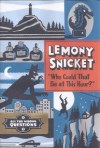
Lemony Snicket – “Who Could That Be at This Hour?”
Lemony Snicket’s Series of Unfortunate Events started out as a breath of fresh air for children’s literature. This was not just because of its repeated reminders that good people were doomed to a life of misery, but also due to the unique atmosphere: Snicket’s world is populated half by idiotic adults who advance the plot with foolish, but internally consistent, logic, and half by parentless-but-capable children who take on the roles of private investigators and secret agents in order to stay one step ahead of the conspiracies that drive the world. Also, of course, there are the vocabulary lessons.
The series fell apart in the final act, though, as it turned out that Snicket wasn’t just writing a sad series, but an intentionally unsatisfying one. The ending didn’t even provide a basic resolution, let alone one worthy of the convoluted backstory that had been repeatedly hinted at. Despite that, I had high hopes for his new series, All the Wrong Questions. It goes back to Snicket’s youth, so it would ideally answer more questions than it raises, and it’s only planned to be four volumes, so it shouldn’t turn in to the shaggy-dog tale that Unfortunate Events was.
I’m disappointed, though, to learn that Snicket apparently didn’t see any problem with the way Unfortunate Events played out. This new series may be shorter, but book one (“Who Could That Be at This Hour?”) jumps right into the mess that the last one was at around book nine. It opens with Snicket as a young boy, fleeing murderous pseudo-parents, and already part of a complex organization that ranks every chaperone in town and needs to measure the local wells. He goes out of his way to avoid explaining why they do any of this. That was at least somewhat cute when he was writing about the Baudelaire orphans, who were just as in the dark as the reader, but there’s no excuse for his personal memoir to refuse to share pertinent details. It’s just frustrating, and Snicket’s decisions about what to tell us feel arbitrary.
That’s not to say there aren’t many bright spots. Snicket introduces the unique and colorful town of Stain’d-by-the-Sea, along with characters that are just as memorable. This is a world of faded actresses, vigilant reporters, and even a young femme fatale to frustrate our hero. It features illustrations by indie cartoonist/design genius Seth, whose cover treatment probably made this the most attractive new book on the shelves in 2012. And Snicket is deft with his postmodern tricks: Apparently this entire series is built around the theme of people asking the wrong questions at key times. (People twice fail to ask “Who could that be at this hour?”, but there are plenty of other discussions of right and wrong questions.)
There are plenty of interesting, compelling, and even hilarious moments here. If I had any confidence that the series was building toward a resolution that would explain some of the mysteries, I would have loved it. But once it became clear that this is in the same vein as his last series, every new hint just felt hollow and mocking. Like Charlie Brown and Lucy’s football, it’s easy to imagine how wonderful Snicket’s stories could be. Only a fool would keep holding out hope forever, though.
Grade: C



 The most notable thing about the iPhone game Hundreds is its design sense. Simple but visually arresting, it just features black and gray circles on a white background, with the occasional burst of red. Items fade in or roll onto the screen after you win or lose a level, and the level select menu punctuates its whitespace with circular symbols that are labeled “statistics” but may as well be an artistic flair. The soundtrack, naturally, is simple looping music that always seems to mesh perfectly with whatever just happened on screen.
 The game is at its best when it lets you enter a simple Zen-like state. With no time pressure, you can watch the circles bounce around harmlessly while waiting for the right time to increase one by a point or two. (SemiSecret Software, also the publisher of Canabalt, seems to have a thing for simple games that reward a relaxed mind.) However, most levels don’t let you do that. The game introduces other types of objects, including non-growing ones you can drag around yourself, ones that shrink down towards “0” when left alone, and ones that reset anything they touch back to “0” immediately. Some of those add a time pressure, especially the ones that stay red, forcing you to complete the level before they bump into anything. (New rules about “frozen” pieces add some exceptions, but that isn’t worth going in to here.) Suddenly that meditative gameplay goes out the window, and you need to outrace objects that will undo all your work.


.jpg)
 Cult of the New