The Dead Milkmen – The King In Yellow (Music Review)

The King In Yellow cover

The Dead Milkmen – The King In Yellow

The Dead Milkmen were the class clowns of 80s punk, and the thought of them releasing a new album today seems both fascinating and unnecessary. The King In Yellow fills both those expectations.

As confident and unpolished as always, the songs are all over the place. Intelligent but absurd jokes sneak into the serious songs, while poignant observations can be found in the sillier ones. The bitter “Meaningless Upbeat Happy Song” is the closest to a “classic” Dead Milkmen song, but the band always featured too much variety to be pigeonholed. Contrast that song with “Fauxhemia”‘s more mature look at the life of an aging punk: They begins with the expected complaints about popular culture, but they don’t seem so proud of it now. (“I just don’t get Norah Jones, and maybe that’s why I feel so alone.”) It’s better to think of this as a collection of outtakes than a consistent album.

Some songs are surprisingly weird, and give the impression that you’re witnessing an inside joke. “Hangman”, for example, is a straight-faced story of condemned criminals staking their lives on a word game. Other songs are painfully literal, such as “Commodify Your Dissent”‘s complaint about corporations appropriating underground music. (Though you’re pretty much required to enjoy any song with the line “Johnny Cash died for you!”) There are also songs that seem to be closer to fragments than fleshed-out ideas: “Or Maybe It Is” ends immediately after bringing up the idea that a “horse race sniper” might not be committing any crimes. When all the elements come together, you get a clever deconstruction of modern life like “Solvents (For Home And Industry)”, and when they don’t, you get the unfulfilled plot ideas of “Quality of Death”. Imagine watching Monty Python for the first time, and you’ll have an idea of how it feels to listen to The King In Yellow.

In addition to everything else, there are enough songs about murder that even I, a big fan of murder ballads, feel a little weird about it. (The detailed fantasy of the stalker in “Some Young Guy” has a lot to do with it.) In fact, the title song is a (punchy, very fun) cover of an Irish folk song about a man killing his wife.

Intelligent and aimless, the modern Dead Milkmen are much the same as ever. Whether that is a good thing or not is a personal decision: Even the catchy songs are grating, and the lyrics are sporadically brilliant. Are you able to approach a Dead Milkmen album the same way you did decades ago, or would that just seem off-putting today? You may have to buy the album to find out.

Grade: B-


Stephen Malkmus and The Jicks – Mirror Traffic (Music Review)

Mirror Traffic cover

Stephen Malkmus and The Jicks – Mirror Traffic

Every few years, Stephen Malkmus comes out of hiding to remind you that he’s still cooler than you will ever be. His albums with The Jicks, like that high school friend you desperately looked up to, remain as effortless and confident as ever. But after staying unchanged for years, you eventually start to understand that that friend could stand to mature a little.

Mirror Traffic comments on Malkmus’ persona like no other album he’s made. “No One Is (As I Are Be)” pokes fun at himself with lyrics like, “I cannot even do one sit-up. Sit-ups are so bourgeoisie. I’m busy hanging out and spending your money.” A couple breakup songs treat the subject matter with a casual disregard for commitment. Specifically, “All Over Gently” can be seen as either fun or cruel, depending on whether the other party agrees with his opinion that it’s time for her to leave with no hard feelings. And though the political satire of “Senator” is arguably new territory for Malkmus, it’s really an experiment in what how slacker lifestyle would fit in with corrupt politicians.

In fact, Jicks albums can now be described entirely in terms of what has come before. Mirror Traffic is as poppy as their debut album, but with the full sound and varied instrumentation of Face the Truth. The experimentation of Pig Lib is almost nonexistent now, though the meandering jams of Real Emotional Trash have remained even in the shorter pop songs.

It is, honestly, one of the band’s stronger efforts. The Jicks are honing one sound rather than looking for new ones, and there is a perfectionist streak hidden behind their casual front. The production and performances are near-perfect, and they keep building on the tricks that worked best in the past. I do complain that the albums have started to feel similar, but I have to admit that no song directly copies a previous one.

Mirror Traffic is something of a milestone, in that Malkmus has now released as many albums with The Jicks as he did with Pavement. But while it was a sign of stagnation when Pavement’s releases started sounding similar, it seems that The Jicks will be content to play with their sound forever. There is good and bad in that, but they get away with it because new albums only appear every few years. That friend who hasn’t changed since youth might not be a good person to have around every day, but if he can only show up as rarely as this band does, you’ll keep looking forward to the next time.

Grade: B


Gauntlet of Fools (Game Review)

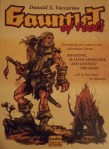
Gauntlet of Fools box cover

Gauntlet of Fools

Though I love the theme, most dungeon-crawling games are disappointing. The setting seems to invite not only randomness, but “screw you” cards that swing the game uncontrollably and special events that interact with each other in game-breaking ways. Given that, it’s a relief to say that Gauntlet of Fools is a fun game. Of course, there’s still a heavy amount of chance, but it feels appropriate to the theme without any of the pitfalls typical to dungeon-crawlers. That doesn’t mean it’s completely satisfying, though; Among other things, this is designed to be a 15-minute filler, so it won’t scratch that itch for an involved evening of monster-slaying.

The game is straightforward: Players each choose a Hero, and then they fight monsters from a deck of Encounters. Eventually, everyone will die, and whoever ends with the most gold wins! The key of the game, and the only real player interaction, is during the initial selection. Each Hero is paired with a random Weapon, and may receive additional “Boasts” that weaken it further. The Boasts are basically a thematic auction: If you want to use a Hero someone else has already claimed, you can announce “I can have the Barbarian run the gauntlet Blindfolded!” (That means that you’ll earn less gold each time you kill a monster and dodge their attack.) To take the Hero back from you, another player would have to add another Boast, such as Hungover (a serious attack and defense penalty that lasts until the Hero manages to kill their first monster). The first Encounter is revealed only once everyone feels that their opponents’ Heros have been weakened too much to be worth stealing.

The Armorer can improve his defense as he kills monsters, and he’ll need that with his penalty for Hopping on One Leg! The Bow has two ability tokens that let him dodge monsters, which will be perfect when his defense is low at the start.

The fun of Gauntlet of Fools comes from Donald X. Vaccarino’s design approach. The basic system for encounters is very simple, but it allows for a wide variety of ways for the Heros, Weapons, Boasts, and Encounters to interact with each other. It’s quick, clever, and manages to feel reasonably different from game to game. The dice rolls and shuffled deck of cards may do a lot to drive the game, but it also feels like you’re experiencing unique twists each time due to the simple yet varied ways cards can interact. (“The Giant Spider poisoned everyone, but my Priest’s healing ability made all the difference.” “I never should have said my Avenger could run the gauntlet without breakfast! He died first, and his ability only works after others have died.”)

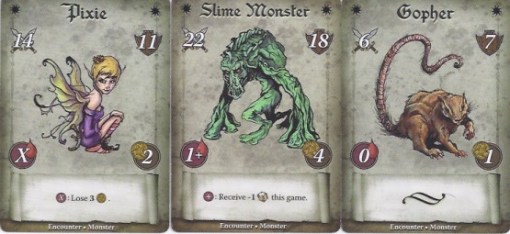
There are a wide variety of monsters. The Armorer is hoping for easy opponents like the Gopher, so he can raise his defense quickly. But the Slime Monster, which reduces the number of dice the Hero’s Weapon has, could keep the Armorer from ever getting the kills he needs.

That randomness still makes it feel arbitrary sometimes. There are real strategic choices in deciding what combination of Hero and Boasts will work best, and it will take a few games to figure this out. However, the “right” choice for a game won’t become apparent until the top cards in the Encounter deck are revealed. The Priest may be the best choice if a Spider is about to poison everyone, but you won’t find that out until after the auction is done. This works, but because it only aims to be a quick and silly game. The theme and art are fun, and the game unfolds without any of the painful events that derail other dungeon-crawlers. Make your choices, play up the theme of Boasting, and then take a few minutes to see who guessed right.

Grade: B


Amanda Palmer and The Grand Theft Orchestra – Theatre Is Evil (Music Review)

Theatre Is Evil cover

Amanda Palmer and The Grand Theft Orchestra – Theatre Is Evil

It’s easy to describe the music of Amanda Palmer and The Grand Theft Orchestra: It’s an amalgamation of goth and synth influences from the 1980s and 1990s, combined with heart-on-sleeve lyrics and performed with a theatrical flair. In fact, the album title Theatre Is Evil is as much of a joke as the sugary pink cover: Palmer’s real life is too intertwined with her art to ever separate her from her “theatre”, and her songs are frequently self-aware about that. (“I couldn’t do that, it is wrong/But I can say it in a song,” she explains in one refrain.)

The impact of her songs is much stronger than one would expect from that description, though. The styles may be openly derivative, and actually so varied that I wouldn’t expect the album to fit together coherently, especially since they were written over a period of several years. However, Palmer’s persona is the glue that makes it all work. Everything, from the Siouxsie to the Bowie to “Melody Dean” (which references “Love the One You’re With” over the riff to “My Sharona”) feels to be uniquely Palmer’s style.

With backing from The Grand Theft Orchestra, many songs take on an energetic sound that could fill arenas, but they somehow feel more personal than they ever did in her previous band: the stripped-down, thoroughly theatrical Dresden Dolls. “Want It Back” and “Olly Olly Oxen Free” are perfect examples of glammy pop-rock, while “Massachusetts Avenue” has a punk simplicity that approaches punk execution at the shouted crescendo. “Do It With A Rockstar”, possibly the highlight of the album, is a self-loathing pickup song packed with jokes, encapsulating the self-aware theme of “theatre is evil”.

Palmer and her band do slower songs, too. “Trout Heart Replica” is the sort of beautiful poetry that high school goths yearn to write, but it will be years before they have the life experience to examine relationships like “Grown Man Cry” does. “The Bed Song” does away with all the electronics, but its simple piano performance may be the emotional core of the album. And my other favorite song, “Bottomfeeder”, has the angstful but inscrutable lyrics that would have made it a hit on 90s’ radio. Theatre Is Evil has a variety that makes it incredibly satisfying as an album in addition to successes of the individual songs. (The only place the variety disappears is in the atmosphere. Even the fun, upbeat songs are uniformly depressing. “Melody Dean” and “Lost” are the only arguably happy songs. The former is a justification of an affair, and the second is an assurance that lost things can return.)

I wouldn’t expect to call a goth-pop throwback album a masterpiece, but Theatre Is Evil qualifies. My favorite songs are mind-blowing, and my least favorites obviously deserve to be loved by people with different taste. Nothing here is filler, so even those lesser songs feel like part of an experience. And for Palmer’s theater-meets-life attitude, it’s hard to come up with a better compliment than “this music is an experience”.

Grade: A


Letterpress (iPhone Game Review)

Letterpress in playThe new iPhone game Letterpress was just released last weekend, but it attracted enough players so quickly that people are wondering if it’s responsible for overloading Game Center. I wouldn’t be surprised: Game Center never gets much attention, and it’s an easily-ignored option in most apps that use it, so one big push may overload it. Personally, I think the fact that Letterpress requires Game Center is a major strike against it: The system feels a little sloppy, I didn’t like agreeing to the EULA for yet another information-gathering service, and as we just saw, the game is now at the mercy of hiccups in a service it doesn’t control.

Despite all that, Letterpress is worth checking out for its clever approach to word games. Players make words from the letters of a 5×5 grid, and each tile becomes “owned” by whoever used it last. But if a player manages to own a tile and every one it touches, it cannot be captured even if their opponent uses it. The unique thing about this system is that letters can be used without being adjacent, but the system of ownership and protection creates a map of shifting territories. You need to create a word not just from the 25 letters available, but using the specific letters that will most help your position. Another thing I appreciate is that the game rewards long words, which means that they’re almost always familiar to the players. It feels like a more natural use of language than word games that require you to memorize words like “QAT” and “XU” in order to be competitive.
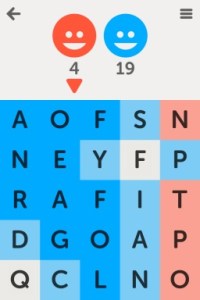
The dark blue tiles are protected, as they are surrounded by light blue ones. The blue player is close to victory.

Also, of course, the quantity and positions of the letters change from game to game. A game with multiple ‘E’s, ‘R’s, and ‘S’s available plays very different from one with lots of ‘Q’s and ‘Z’s.  You’re never allowed to play a word if it has been used before, or if it is entirely contained within a previous word. This means that variations of words might come up repeatedly, but you’re forced to move forward without getting stuck in a repeating loop.

The app is well designed, but bare bones. That Game Center integration, for example, lets the game match you up to network opponents with little effort on the developers’ part, but adds a few seconds of delay every time you launch the app to play your next move. It has a clean interface that makes it easy to play, though I miss features like chatting. And given that this game works best when played quickly back and forth, this game screams out for options such as time limits and in-person games shared on one phone. (The app itself is free to try, and 99 cents for the “full” version which allows multiple games at once. The first time your game gets hung up because an opponent stopped responding for a while, you’ll realize how vital that multiple-game option is.)

I haven’t had any issues like the network trouble other people allege, but I have run into one annoying bug: Ever since a player resigned against me, the Letterpress icon on my home screen has told me I have one game waiting for my move. Even turning the phone off doesn’t make that go away.

As for the game itself, the beginning and middle are great (other than my aforementioned wish for time limits – this really is a game that demands to be played quickly). The endgame can be frustrating, though. Whenever all tiles are claimed, whichever player owns the most has won. Since the score tends to seesaw back and forth with every move, you’ll want to make sure you leave enough tiles neutral to keep your opponent from ending it. This is clever in theory, since your territorial considerations now include which tiles you need to leave untouched. In practice, though, that means that if players are fairly evenly matched, neither dares open an endgame opportunity for the other. It can be obvious who is going to win long before it becomes viable for that player to claim a victory.

Letterpress has the potential to become a great game, but it isn’t there yet. I’m not sure if the developers plan to keep adding to it, or if they consider it to be complete. Either way, though, it’s fast and free to try out, so it’s easy to recommend that you give it a chance. As long as you’re willing to give Game Center a chance, too.

Grade: B


Quick Update:One week later, I am still enjoying this, and have learned to play so that my issues with the endgame aren’t as significant. I also managed to get rid of that extraneous notification about a waiting game by deleting that one from the history of played games. I’ve run into enough other issues to reaffirm my belief that this feels rushed and incomplete: After the multi-second delay for the app to log you in to Game Center, there is another pause before your games are updated. Since there is no visual clue as to whether this is still loading, and also no hint about whether it is your turn in games other than the one you’re currently looking at, playing multiple games is frustrating. When a game ends due to my opponent’s move, it is moved immediately into the app’s list of my previously played games, and I won’t notice it ended unless I think to look for it. And this morning, I finally did experience several hours in which my games wouldn’t update even though I knew one of my opponents had moved.

My basic conclusion is unchanged: This is an addictive but clunky implementation of a clever game that would be best played in person.

Colson Whitehead – Zone One (Book Review)

Zone One cover

Colson Whitehead – Zone One

Zombies are frequently metaphors for the barbarism that lurks behind polite society. It’s an unsubtle metaphor, to be sure, but it still makes a good match for a “literary” author looking to try something different. Zone One tells the story of slacker hero Mark Spitz helping to clear zombies out of Manhattan in the early days of society’s resurgence. Though this book should only be read if you have a stomach for the gore and hopelessness of a zombie movie, its prevailing atmosphere is more quiet and introspective: Most of the remaining zombies are quiet “stragglers” who seem lost in an echo of their past lives, giving the characters and the reader time to reflect on their pitiable state.

As far as post-apocalyptic fiction goes, Zone One feels halfway between the bleak tragedy of The Road and the outright satire of The Gone-Away World, with occasional bursts of horror to spice it up. Author Colson Whitehead is capable of hitting all those notes, and there are several amazing scenes. Most of the time, though, these contradictory elements just make the book an aimless muddle. The story jumps around in time frequently, often mid-scene, apparently to ensure the reader feels as detached as the “perpetual B-student” protagonist. This even breaks up the action scenes.

The satire has some clever elements, such as PASD (Post-Apocalyptic Stress Disorder) and corporate “sponsors” who control what items may be looted from stores. For me, though, it was derailed by a stubborn refusal of the author to provide specifics. No products or brands are ever named, relying instead of convoluted vagaries like “seasons one through seven of the hospital drama groundbreaking in its realism”. In fact, Spitz’ old job with a coffee shop chain is described for pages without ever mentioning a company name. This is pervasive throughout the book, and makes the narrator feel too out of touch for the social commentary to have any bite. I wouldn’t care if it mainly used made-up brand names, as long as gave the impression that the characters related to them like normal people.

Zone One leaves no doubt that Whitehead is a very talented author. Provided he doesn’t always use those vague generalizations in place of specific names, I’d definitely try more of his novels. This one, though, feels aimless. After the collapse of civilization, many of the characters wonder whether anything they do matters; That feeling pervades the story itself a bit too well.

Grade: C


Deer Tick – Divine Providence (Music Review)

Divine Providence cover

Deer Tick – Divine Providence

Divine Providence demonstrates that Deer Tick is a one-trick band, but it’s an excellent trick: Boisterous cock rock sung with a sloppy abandon. The stripped-down music perfectly emulates a lush arena rock band that’s too drunk for the subtleties they’d normally employ, and the lyrics have just enough of a self-conscious wink to win over people who might normally be put off by the frat boy personas. Despite that, it’s best appreciated without any irony. (The liner notes open with “You should play this fucker as loud as possible”, and that’s maybe a more accurate description than this entire review.)

The problem, though, is that they don’t fully appreciate that they should stay within the bounds of that one trick. Half the songs are slower, and, frankly, uninteresting. They actually aren’t bad, with solid hooks and a good variety, but songs that are merely tolerable become harder to wait out when the album is supposed to be a non-stop adrenaline rush. One or two might make an interesting break from the full-throated energy: “Chevy Express” has a bored tension that brings to mind an unsatisfying day waiting for the party to start, and “Now It’s Your Turn” has the weariness of the next morning’s hangover. But with a few more songs like them thrown into the mix, the album just feels watered down.

Deer Tick is excellent when they put their mind to it. You’ll be hard-pressed to find better anthems to the id than “Let’s All Go To The Bar” or “Something To Brag About”, but you’ll have to wade through a lot of filler to get to them. Fortunately, it’s easy to keep returning to those best few songs. I know I’ll be doing that a lot in the future, and honestly, that means more than my complaints about the skippable songs. But as an album, it’s hard to escape the feeling that this was a missed opportunity.

Grade: B


Dominion: Dark Ages (Game Review)

Dominion: Dark Ages box

Dominion: Dark Ages

After my lukewarm reception of the last couple Dominion expansions, I’m pleased to say that Dominion: Dark Ages makes the game feel truly exciting again. Its main themes (trashing and upgrading cards) are not new, but they provide plenty of territory to explore. There are a lot of clever abilities here, but even the cards that don’t seem original are consistently interesting, balanced, and have strong artwork. This are also a lot of combos, making this a great engine-building deck for experienced players.

Maybe the best part is the sheer quantity of gameplay that Dark Ages adds. The standalone Dominion sets have 500 cards, but half of those are used for the basic Treasure and Victory cards. The later “full-size” expansions had fewer cards to make room for mats and tokens. Dark Ages has no supporting bits like that, so it is the first to include a full 500 cards devoted to expanding the game. This means 35 Kingdom Cards, almost as many as a previous full-size and half-size expansion combined.

Rats and Graverobber cards

Two cards that do new things with the Trashing mechanism

Cards are a much more economical option for a game. Those 35 Kingdom Cards only account for about two-thirds of the cards included in the set, so the others can extend the gameplay in new ways. The lack of boards and counters doesn’t feel limiting at all. The Dark Ages theme is reinforced with Ruins cards (a deck-clogging type similar to Curses) and Shelters (new starting cards that give players more choices in the early moves). There are also several special types of cards which can only be gained by other specific cards. These feel like nothing that has come before.

A sub-theme seems to be a focus on cards with a cost between 3 and 6 coins, which form the “core” of most decks. It’s good to see certain abilities restricted to work only in this range, especially attack cards that otherwise would have had much more random effects on opponents’ decks. While for the most part, new Dominion cards stake out new territory without replacing old cards, this does seem to be a case where it specifically improves on some previous attack cards.

Hermit and Madman

A new type of upgrading: The Madman is a powerful one-shot card that can only be gained by trashing a Hermit.

It’s a little weird to consider the theme of the Dark Ages in this game, given that the trashing and upgrading abilities featured here actually help you make stronger decks. But no one would actually want to play a drawn-out game where everyone struggled through a representation of the collapse of civilization. The more important criticism is the one that has been present for the past few expansions: At this point, there are a lot of Dominion cards. With well over 200 types available and only 10 used in each game, you could play for a long time without missing any one set. Dark Ages is one of the best yet, but the game’s own success means that no expansion truly feels essential any more.

Yes, the biggest problem with this set is that Dominion is so consistently good that even excellent expansions stop being exciting. But it still ranks among the best, possibly second only to Dominion: Prosperity. It’s well worth buying.

Grade: A-


Paolo Bacigalupi – The Windup Girl (Book Review)

The Windup Girl cover

Paolo Bacigalupi – The Windup Girl

The Windup Girl takes place in the same desolate near-future as Paolo Bacigalupi’s short stories “The Calorie Man” and “Yellow Card Man”. The one-two hit of an energy crisis and food shortage means that all surviving industry is driven by manual labor, whose expense in “calories” will slowly kill the starving laborers. The book’s genetically engineered marvels may reflect the promise of the future, but it’s a not-too-subtle morality tale: The pandemics and food shortages that plague mankind are the the direct, perhaps intentional, product of greedy genetic engineers.

The previous stories of this world were collected in Bacigalupi’s Pump Six and Other Stories, one of the best books I read last year. This novel is good, though it doesn’t live up to the high standards those short stories set for me. The quicker tales can emphasize the desolation and hopelessness of the setting, but the author (sensibly) restrains himself from making a novel-length story that bleak. The longer format emphasizes Bacigalupi’s deft touch with other cultures – it’s set in Thailand, and both its setting and the foreigners mixed in feel natural – but the moral lesson at the end feels disappointing when it follows hundreds of pages of complex build-up.

If The Windup Girl doesn’t always emphasize the same things that the previous short stories did, it finds a new way to explore human cruelty: Emiko, the titular “Windup Girl”, is a genetically engineered slave, abandoned in a country where her kind are illegal. While prostituting herself to abusive clients who consider her less than human, she tries to keep a dream of freedom alive. Subservient by design, her fight against her own nature establishes the core theme of the book.

Emiko’s scenes have an additional duality: The writing is as violent and lurid as the worst exploitation material, but their power and humanity is undeniable. I wouldn’t blame anyone who found this book to be horrifying or unreadable, especially in the context all the recent debates about rape as a lazy writing tool. But I would say that even the worst writing tropes exist because people are trying to copy from other works that used them well, and The Windup Girl is one of those good ones. No topics should be completely off-limits, and this is an example of why. It’s too bad to think that the empathetic and necessary scenes here may inspire lesser writers to create awful, violent works.

The Windup Girl is a complex, controversial story built atop a world that Bacigalupi is now familiar enough with to keep in the background. It’s not what I expected from his previous stories, but it’s unique enough to work as both a companion piece to them and as a standalone novel.

Grade: B

Connie Willis – Doomsday Book (Book Review)

Doomsday Book cover

Connie Willis – Doomsday Book

Imagine that time travel is discovered a few generations from now, but the only application anyone uses it for is to send historians back to gather first-hand information. If you can keep from questioning this unlikely gimmick, then you might be ready for Connie Willis’ Doomsday Book.

The first of Willis’ novels about time-traveling historians, this one features a university student named Kivrin who becomes the first person to travel to the Middle Ages. The procedure is botched, though, thanks to an incompetent administrator eager to send Kivrin off before anyone can remind them that that era was considered too dangerous to travel to. Before long, the people in both times find themselves dealing with a disease outbreak, while the more reliable characters desperately try to figure out how to get her back safely.

The novel positions itself as both a comedy and a drama. It would have been better off as a pure drama, though. The humor comes entirely from one-note characters who are allotted one annoying character trait each (say, a love of playing the bells or the need to cast blame on others) that they use without pause. Unrealistic and irritating, this kept me from ever becoming invested in the characters. It’s a shame, because the dramatic portions would have been good if I had been able to buy into them. It is interesting to see the contrast between the way two different cultures handle a similar crisis, and Kivrin’s growth in response to a Medieval priest’s faith is surprisingly touching. Willis obviously had multiple big ideas that she was capable of handling in this novel.

The portrayal of the past is simple, but feels consistent and well-researched enough to fit the conceit that people are seeing the “real” era. The portrayal of the future is simple as well, and this is more problematic. After discovering time travel, making brain implants that can immediately adapt to a new language, and curing (almost) all diseases, how can the rest of their life be based on technology fundamentally unchanged from 1992? Our actual culture has changed more in twenty years than Willis predicted in sixty. On top of that, the time travel technology is so blatantly designed around the needs of the story that Willis may as well have just called it a magic spell: It may prevent items from going through if necessary to prevent paradoxes, and with such accuracy that it will block the germs carried by your body if the people in that time don’t already have immunity. Though you can travel to a different year, it must be the same date. This means that time effectively progresses the same for the people in the past and the future, so there is a risk that they will miss the rendezvous with Kivrin if everyone in the future is sick for too long. None of this is explained, nor do they ever give the impression that the scientists understand this technology enough to have invented it.

Doomsday Book wants to be a fast-paced airplane read with a few big ideas that stick with you. I was bored after the first third, which is a major problem for a story like that. I’m apparently in the minority – like most of Willis’ books, this won both the Hugo and the Nebula – but I don’t get the appeal. With taut drama sabotaged by ridiculous characters, science fiction derailed by a laughable foundation, and intelligent ideas that are usually overshadowed by these flaws, Doomsday Book has all the pieces it needs to succeed, but never fits them together.

Grade: C