Drew Magary – The Postmortal

The Postmortal cover

Drew Magary – The Postmortal

What would happen if we discovered an inexpensive way to stop people from aging? According to Drew Magary’s The Postmortal, everyone would quickly take “The Cure” and begin to wear away at our environment and social fabric. It’s a plausible answer, but a pretty shallow one that assumes a quick read of modern American culture is all we need to predict the next century. In fact, “shallow” describes the book pretty well.

It starts off pretty strongly, with an interesting hook that fits the book’s breezy, blog-post style. (That voice is a little weird if you worry about how convenient it is that the author’s explanations and details are perfectly aimed at a reader of the book, rather than a contemporary of his. But it’s easy enough to ignore.) And when the story suddenly jumps forward ten years to a world still celebrating The Cure, it stays believable. Magary’s depiction of our modern world may be a bit facile, but it feels real and manages to spark anger, curiosity, and sympathy at the right times.

Then it jumps forward again, twenty years this time. And the narrator acts completely the same, despite the major lifestyle changes he allegedly underwent during that time. The world is devolving into chaos, but his day-to-day interactions with the supporting cast feel the same as they did pre-Cure. The occasional interruptions to deal with disasters don’t feel like they belong in the same world he’s describing the rest of the time. And really, the entire plot just flows along as if that twenty-year break had actually been a week. The story gets put on hold whenever it jumps through time (it happens again), and plot threads that should be long-forgotten keep coming up as if the world revolves around just him.

It’s sad to see a light, enjoyable book go so far off the rails. By the end, the protagonist is making sudden, hard to justify decisions about crazy plot twists that stem from events that had been unresolved for decades. The rest of the world seems just as eager to bring things to a climax, and events that were obviously foreshadowed but never made believable begin to happen at a fast pace. What was supposed to be a thought experiment about human nature closes on a big mess of coincidences, rushed plot, and side characters who don’t have agency except to support or foil the narrator.

The Postmortal could have been good. The strong part, which seems more or less grounded in reality and gives us supporting characters to care about, takes up almost the first half of the book. But it lacks the vision to keep extrapolating, as well as the ability to keep the plot developing fairly. It has its strengths and weaknesses, but maybe the most disappointing part is the missed potential.

Grade: C
 

IFComp 2013

IFComp2013It’s October, and that means that IFComp is live once again! It’s been two years since I last tried to play through any of this, but I’m going attempt it again this year.

A quick refresher: This is the biggest event in the IF (Interactive Fiction) community every year. The high profile and low barrier to entry means that you’ll see everything from unplayable messes to works of genius. They are all designed to be playable in two hours at the most (sometimes much less), and if there are puzzles that may keep you from finishing it in time, the game will come with a walkthrough or hint system to help you along. “Interactive fiction” can refer to any non-linear story, but in practice generally means the aesthetic that was created by text adventures in the 1980s. Don’t think that these are limited to the arbitrary puzzles of Zork, though. The best of these free works have much more depth and narrative power than most people ever imagined when text adventures were popular.

I’m excited to see what the competition has to offer this year. For one thing, I enjoyed it a lot in 2011 even though I missed the best games. For another, the community seems to be evolving quickly. Over half of the thirty-five games in this year’s competition are web-based. (In 2011, only three were.) This means that they weren’t built around the traditional engines that grew out of text adventures, and from what I hear they do bring a very different approach to interactive fiction.

The competition runs until November 15. Realistically, I’ll be happy to get through about ten games, and I may need to cut back on my blogging to make time for it. Since I’ll be submitting scores to the competition, I’ve randomized the list of games to make sure there’s no bias in the subset that I choose. Expect me to take at least a couple weeks before I start posting reviews, since I like to take some time to get a feel for multiple games before I comment on one in a vacuum.

Hopefully some of you will try out the competition as well. Have fun!

Web-Based Gaming: What Kinds of Games Work Best?

As a follow-up to the past week’s looks at web-based gaming, here are some notes on what can make a game work or not. The turn-based systems I have been enjoying are great for certain games, but not right for others. (There are sites for playing games live, but I haven’t tried those yet. A big part of what I like about online play is being able to fit it into my unpredictable schedule.) Here are the main considerations:

Continue reading

Web-Based Board Games: Yucata

YucataYucata is much like Boîte à Jeux, which I reviewed earlier this week. Both offer free online play of board games, which are legitimately licensed and feel very faithful to their tabletop equivalents. The two sites have very different approaches, though.

Yucata is older, has heavier traffic, and over eighty available games. (Three new ones were released in just the past couple months.) There are a lot of good games up there (like Targi, Glen More, and Jaipur), but it also reads like a list of generic Euros from years past (Hacienda, The Hanging Gardens, and Oregon, for example). Also, the most popular games tend to be quick fillers like Can’t Stop and To Court the King. In general, the variety means that I can always find something I want to play, but it’s different than Boîte, which has a few games I want to keep playing over and over.

R-Eco is Yucata's latest game (added yesterday!)

R-Eco is Yucata’s latest game (added yesterday!)

Continue reading

Web-Based Board Games: Boîte à Jeux

Boite a Jeux logoThe first board gaming site I tried was Boîte à Jeux. It’s a bare-bones site by many standards. The different games have inconsistent looks and feels, the control buttons on each page – though useful – require some trial and error, and the translations to English are not always good. (The EULA looks like it was run back and forth between French and English a few times on Google Translate.) But the important thing is the game quality. And there, fortunately, Boîte à Jeux shines. All the games I’d played before in real life felt immediately familiar, and it was easy to start playing. The site offers about forty games, and adds a new one every few months. This includes some of my recent favorites (Trajan and The Castles of Burgundy), some old classics (Agricola), and even the Gipf series – a set of two-player abstract games that I’d always wanted to play more, but never had much opportunity before now.

The site's newest game, Ginkgopolis.

The site’s newest game, Ginkgopolis.

Continue reading

Web-Based Board Games: Introduction

I’ve been playing board games for years, but I always insisted on playing them in person, “as they were designed”. I saw online implementations a couple times, and they were always so messy and hard to follow that I had no interest in trying them out. Besides, I had a lot of opportunities to play games in person, so I wasn’t trying too hard to solve this problem.

But this year, I’ve changed my mind. Shortly after becoming a father and missing most of my in-person games, some friends recommended web-based game sites Boîte à Jeux and Yucata. They turned out to be nothing like my preconceptions. Above all, they’re faithful adaptations of the games, with all the art licensed and even the pickiest rules implemented correctly. If you already know the game, sitting down in front of the web page feels just like seeing the game set up on the table in front of you. They have ranking systems that help you find fair matches and also create a sort of meta-game that keeps every match interesting. Even once you know you’re going to lose, it’s still better for your ranking to come in third place than fourth! And most surprisingly of all, the sites are free and keep their ads very minimal. (Both do request donations.)

A game of Trajan on Boîte à Jeux. (Or at least what fits in the browser window at once.) Notice that the area on the upper right has tabs to let the user look at one person's play area at a time.

A game of Trajan on Boîte à Jeux. (Or at least what fits in the browser window at once.) Notice that the area on the upper right has tabs to let the user look at one person’s play area at a time.

These sites are turn-based, meaning that you could be playing many  games at once, and when you log in you might see that it’s only your turn in two or three of them. Not all games work well when they are spread out over days or weeks, but it’s great with others. Personally, I find it pretty easy to play about ten games at once, as long as they are all different types of games. That seems to put me at odds with a lot of players, who sometimes start up dozens of complex games at the same time. They don’t care if one or two of their games can go days without a move, but for me that means my only match of that type is stalling. Even so, I can usually find good people to play with.

The most surprising thing is how fun these are to play on my iPhone, even though I’ve largely lost interest in playing board games on iPhone apps. Many of the web implementations are too big to fit on my large computer monitors, but I still find it more natural on the iPhone to zoom in and out of the detailed screen than I do to follow some apps that attempt to make the playing area manageable. iPhone apps do typically offer decent tutorials, while these websites just have a rulebook to read, so many new players will probably want to stick with the apps. Much of it comes down to personal choice.

Playing a game of Targi (on Yucata) with my iPhone.

Playing a game of Targi (on Yucata) with my iPhone.

One thing really sets these web games apart from iPhone apps, though:  Both Boîte à Jeux and Yucata offer great systems to find matches with other players. Game Center on the iPhone is absolutely awful. It works ok for two-player games, or for explicitly inviting friends, but it’s almost impossible to find a multiplayer game with people you don’t know. Everyone has to choose exactly the same options as you, and by the time Apple has matched you together, one person has usually lost interest and never comes back. On these websites, you can browse the list of invitations, or make your own and leave it up until other people accept. No more hoping that enough other people happen to put in the same options you did in the few minutes before Game Center times out.

Online games don’t always replace in-person ones with friends, but this has been a great addition to my life over the past several months. In my next couple articles, I’ll look at each of these two sites more closely.

The Mountain Goats – All Hail West Texas Reissue (Music Review)

All Hail West Texas cover

The Mountain Goats – All Hail West Texas

Unlike many bands, The Mountain Goats’ recent, semi-major label stuff clearly outdoes the songs from their years in indie obscurity. That makes their new reissue of All Hail West Texas fairly inessential. It’s a classic piece of Mountain Goats history, and has a couple great songs on it. But all their albums have great songs, and it’s a lot easier to find them on the more recent releases. The band hasn’t sold out, lost their focus, or run out of things to say, and John Darnielle has grown as a songwriter and performer since West Texas. The liner notes to West Texas do add some meaningful symbolism to the lo-fi recording, but still, this was sung into a boombox (not even a four-track) minutes after being written. The solo acoustic guitar is functional but little more. Even after being remastered for this release, the quality isn’t as good as the live versions that were already available on YouTube.

I don’t want to distract from the fact that this album was good enough to help launch Darnielle’s career – 4AD picked him up right after this. He has a gift for describing life for the young and marginalized (when the narrator in “Jenny” has a moment of freedom, he explains “we were the one thing in the galaxy God didn’t have His eyes on”), and really poured his soul into songs that he didn’t expect anyone else to pay attention to. This stripped-down style works best when it portrays righteous anger, as in “The Best Ever Death Metal Band In Denton”. But despite all that, there’s no reason to get lost in the Mountain Goats’ daunting discography until you have at least four great releases from after this point.

This reissue adds a few pages of interesting liner notes, as well as seven new tracks which weren’t preserved quite as well as the original album material. Most of those songs either sound like the lesser tracks on the album, or were never completely recorded. (The original recordings are used here, including abrupt stops when the tape runs out.) It does include one great addition to the Mountain Goats’ canon, though: “Indonesia”.

Are you a hardcore Mountain Goats fan who just happens to have a hole in your collection were All Hail West Texas should be? Then this was made just for you. Are you still a casual listener of the band? In that case, don’t worry about this yet. There’s a good chance you’ll become a hardcore fan at some point, and then this will be waiting.

Grade: C+


Elmore Leonard – LaBrava (Book Review)

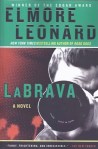
LaBrava cover

Elmore Leonard – LaBrava

Elmore Leonard’s LaBrava is a fun, fast-reading crime novel. Leonard has a strength for memorable characters, clear prose, and a plot that slips surprises into a comfortable formula. In fact, he revels in that formula, building the conflict around an aging actress who starred in films exactly like this.

Protagonist Joe LaBrava even serves as a stand-in for Leonard: He makes art that celebrates the characters on the streets, and he had a childhood crush on the “bad girl” actress. LaBrava is admittedly a more interesting character than the real-life author would have been: He quit the Secret Service due to his love of photography, but he can still throw a punch and is as quick-witted as, well, an Elmore Leonard hero.

This is a great book in many ways, but I found it to be a little uneven. The beginning is a deliciously seedy portrait of early 1980s Miami. Every new character is distinct and memorable, even if they’re just present for a few pages, and Joe’s banter with his friends is as fun as a Tarantino script. The end of the book features a very satisfying resolution to the crime plot. It seems predictable early on, but takes several clever twists that feel true to the characters.

In between that beginning and end, though, the book drags. The colorful characters and setting fade into the background once the plot gets going, but that plot takes a while to really become interesting. None of the time in the middle is really wasted, but it does seem like a poorly-planned structure. Two of those three sections are great, though, so it does still feel worth reading.

Some aspects of the female characters do bug me. (The rest of this paragraph has very minor spoilers.) For much of the book. LaBrava is sleeping with two women at the same time. And yes, that is a genre convention, even if he didn’t seem to have earned the second woman’s attention in the first place. But the thing that bothers me is that that second woman starts out as a very interesting character. After she sleeps with LaBrava, her character arc abruptly halts. They even discuss this in the book: She shows up a few times to complain that he’s ignoring her, but that she’ll still happily sleep with him any time. As if to rub salt in the wound, her only development after that is to change her hobbies to be more like his. The book couldn’t be more casually cruel to her if it tried, but there’s no sign that this is an intentional statement. LaBrava does play around with the cliché of the “bad girl”, but it can do nothing with its “good girl”.

Most of the book is good. The other characters tend to hit the right balance of lowlife and human, and the beginning and the end are both great in their own ways. The novel doesn’t come together in the right ways to realize its potential: That opening seems like the start of an amazing character study that never appears, while the ending has a wonderful plot that didn’t start up quickly enough. Even if I can’t get excited about the novel, though, almost everyone will enjoy it. This is a sporadic but memorable showcase of Leonard’s skills.

Grade: B-


It’s a Crime (Play By Email Game Review)

Update: A representative of KJC games found this post and contacted me about the issues listed here. I’m leaving this post as it is for now, but expect further updates to it.
Several months ago, I talked about experimenting with Play By Email games. I’ve since tried one more: It’s a Crime by KJC Games. Unfortunately, this is going to be a short review.

It’s a Crime, apparently like KJC’s other games, fills a space in between the strategic and role-playing extremes that I tried earlier. A basic description of moves makes it sound like it’s based strictly on a set of rules. This one, for example, features gangs trying to gain power in a 50×100 city grid. You recruit new members, scout or rob nearby areas, and attack new spaces by specifying the exact mix of members to send into battle. However, there’s a lot of chance to the results, and while the game provides guidelines, the exact “dice rolls” are secret. You can never be sure whether an order will succeed or fail, and the consequences (such as losing members or finding inexpensive drugs) are unpredictable. The results are given with lots of flavor text to explain how the situation went down.

There are things I like about pure strategy and about theme-heavy role-playing, but I’m not sure whether this mix works for me or not. I do like the online entry system, though, which lets you see graphical reports and guides you through creating orders. (It’s confusing at first, but makes sense quickly.)  I don’t think I’ll ever get to decide for sure what I think of the game, though. The first couple moves are free, and they were intriguing. Then I sent in a payment, and they never applied it to my account. I couldn’t keep playing. I emailed their support address, and never got a reply. I don’t believe that this was outright fraud, as I’ve found satisfied customers of KJC’s. But it’s definitely incompetence and poor customer service, to the point where I have to warn everyone not to trust this company with your money. This was an unplayable rip-off.

Grade: F

I’m disappointed by this, not necessarily because I was invested in this particular game. But KJC runs a lot of games, and I had been excited about trying more of them. Also, their games are run differently than the others that I’d tried, and I was curious about that from a design standpoint. That’s not relevant to the review, since this game fails regardless of its specifics. But because I’m always interested in how things are designed, I talk about this more, and how it relates to my Play By Email experiences in general, below the fold. Continue reading

BADLAND (iPhone Game Review)

BadlandBADLAND is a side-scrolling puzzle/platformer designed for the iPhone. That means simple controls on top of a powerful engine, beautiful graphics, and gameplay designed to be broken out into two-minute chunks. In a lot of ways, I appreciate that. I mean, I wouldn’t be playing it if I had to sit down for an hour at a time. But on the other hand, this makes me miss the more involved platformers of the past.

In fact, maybe “platformer” isn’t the best term for it, since your avatar floats through the air rather than jumping between surfaces. And it’s easier for me to appreciate when I don’t use the term. There is a lot of great stuff here. Frogmind has taken a very simple concept – tap to fly up and forward, do nothing to fall back down – and built almost every conceivable idea they could on it. There are power-ups that make you smaller, larger, bouncy, sticky and even change the flow of time. Some also give you “clones”, sometimes allowing dozens of your characters on the screen at once. This is necessary for some puzzles, since you may need to pick up items or flip switches in both a high and a low path, or trigger a deathtrap while other clones sneak through. It’s also fundamental to the scoring in the game, since you can keep replaying the level to see if you can save more clones next time. (Each level also has three missions, which include saving clones, but also picking up all the items, exploding all bombs, completing without needing a respawn, etc. Being a smartphone game, most of the gameplay comes from going back to old levels to try to do better.)

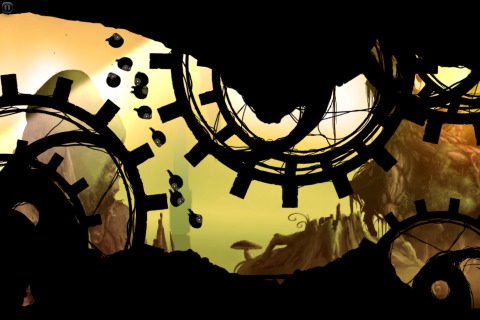
Badland 2The atmosphere is the most distinctive part of the game. Your character is a circular flying blob in an otherwise-unpopulated world. It appears to be an idyllic land that was turned into the dumping ground of a technological society. You have to maneuver around gears, buzzsaws, bombs, loose pipes, and more (though the main threat is often just keeping up with the scrolling screen). These foreground items are so iconic that they’re shown mainly in silhouette, while the background is defined by a beautiful color palette that changes as the levels progress.

Everything about BADLAND seems designed right. The rules are taught in-game. The difficulty curve is good. The puzzles and unique situations keep things varied and leave no idea undeveloped. It’s memorable, instantly recognizable, and easy to keep playing for just one more round. I like it, but feel like I should like it more than I do. It’s not really compelling. I’m not getting anywhere in the end or finding secrets, and when I put it down, it’s pretty easy to ignore for days at a time. But when I pick it back up, I always remember how fun it is.

Grade: B