Savages – Silence Yourself (Music Review)

Silence Yourself cover

Savages – Silence Yourself

The term “post-punk” is supposed to imply that bands are merging the brashness, honesty, and non-conformity of punk with a musical growth that DIY screamers couldn’t manage. But too often, the music seems to be all “post” and no “punk”, with meandering, barely emotional songs that sound like the musicians want nothing to do with their namesake. On Silence Yourself, Savages show what post-punk is supposed to be, with intense, emotional songs that also have an art-school reserve and depth.

Loud all-female groups are rare, but Savages don’t push too hard to exploit that. The best songs, actually, take sideways looks at the female experience. “Husbands” is a nerve-wracking song about a confused reaction to domestic bliss, and “Hit Me” is a brutal challenge to the world. But most tracks are human, slightly obscured in meaning, and don’t obviously apply to one gender when the lyrics are looked at in isolation. If the ironic feminism of “Husbands” and “Hit Me” doesn’t appeal to you, there is also “Strife”, a heartfelt song about a relationship that is strong specifically because of the hardships. “Strife” perfectly captures an awkward but real topic that few song address.

Silence Yourself is far from perfect. The middle fades into that forgettable drone that reminds me of standard disappointing post-punk. In fact, I had probably listened to it a dozen times before I realized that “Dead Nature” was an instrumental; That part of the album is just one long muddy delay before “She Will” kicks off the incredible second half. For an album meant to be loud and in-your-face, it’s unfortunate that the band loses their way like that. But the high points are some of the year’s best. Savages have established themselves as a vital band.

Grade: B+


Board Games on iPhone: Le Havre and Ticket to Ride

For years, I’ve insisted that board games were designed to be played in person, and therefore were generally best that way. But since becoming a father, it’s been a lot harder to find time for in-person gaming. I’ve finally started playing more online, and found that a lot of turn-based games are fun that way. The results are mixed – if there are going to be long delays between turns, it’s generally best to play weightier games where each turn is significant instead of ones where people make frequent simple moves.

Today I’m looking at two iPhone board game apps. I’ve found myself with very mixed opinions about iPhone gaming. It is very convenient to have the apps everywhere I go, and to find out it’s my turn through push notifications. On the other hand, Apple’s Game Center is still pretty frustrating. It’s fine for starting games with friends, as long as you know enough people who have iPhones and want to play the game, but it almost always fails if I try to start a game against random opponents. It seems to be at least partly because Game Center looks for people trying to start exactly the same game as you. I may be happy to play a three, four, or five-player game, but I still have to choose one before Apple will match me. It would be nice to know that, for example, there was a four-player game just waiting on one more person to join before it could start up. It’s even worse when the games have multiple set-up options, because whatever you choose has to be matched exactly by someone else or they won’t join your game. For anything with more than two players, it seems that usually by the time the game starts up, at least one player has wandered off and never thinks to check back. At this point, I’m willing to say that Game Center games are good only for friends or playing against a single random opponent.

The two games I’m reviewing today are ones that I already know and like in tabletop form. I’m not focusing too much on gameplay here, but rather in how well they provide the same experience in mobile form.


Le HavreLe Havre

Le Havre is a long, complex game that requires a large table and involves a lot of cards with detailed text and symbols. I was curious to see how someone could fit all that into a playable iPhone game, and the answer turns out to be that they couldn’t. They make a valiant effort, with different areas of the board that you can tap to expand. In the normal collapsed view, the cards are “stacked” so that the titles are readable as long as there aren’t too many yet. It even shows everyone’s play areas, with the current player’s given a little more space. All the information is there as long as you tap the right spots to get into it. However, it’s very hard to follow. I’m an ok Le Havre player, but I act like a complete novice in the iPhone app because I don’t notice everything that’s going on. Yes, all the information and actions are there (including a slow-to-page-through log of past turns), but I just can’t take it in on the phone.

Part of me feels like cutting the creators some slack, because this was a valiant attempt to fit so much complexity onto a small screen. They definitely did a better job than I would have. But the ads in the app destroyed my good will. It’s a $5 game, a premium price by App Store standards, but it still has frequent ads. Admittedly, they’re for other games by the same company rather than third-party ads. But still, they appear frequently and have “close” buttons that are almost impossible to hit on the first try. I’ve never had so much trouble just trying to hit a simple “X” button, and every time I fail, it takes me out of the app and into Safari. (Also, sometimes you may tap an option on the normal menu, and the app decides that you clicked a not-yet-seen ad.) I don’t know whether or not they intentionally tried to increase their hit rates by making it so easy to follow the advertised links by accident, but they couldn’t have done a better job if they had tried. (Oh, and did I mention that the screechy in-game music is so bad that I need to keep my phone on silent whenever I play?)

I’m told that Le Havre is playable on the iPad, and I can believe that. But it’s sold for the iPhone, and that’s what I’m reviewing. In that format, it’s a confusing, unplayable mess. I give them some credit for the complexity of the implementation, but that’s the best praise I have.

Grade: D

Ticket to RideTicket to Ride

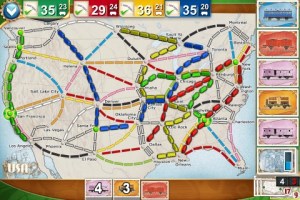
The physical version of Ticket to Ride is one of the classic “gateway” Euro games, and from what I hear, the app has been just as successful. I think it deserves that. It’s a near-perfect implementation of the board game, with all information fitting neatly on the screen. Your hand goes across the bottom, the cards you can draw from across the side, and your specific “tickets” (missions) down in a corner. You do have to cycle through the tickets one at a time, but that’s rarely necessary because the app automatically highlights every city you need to connect. The view of all required cities is usually all you need to know, unless you’re trying to decide which missions to give up on. Keeping track of those locations on the map yourself can be the most frustrating part of the game, so the app has a big advantage over the tabletop version. Though there’s no log of all past turns, it also does a nice job of displaying everyone’s most recent move in a status bar across the top. That bar also summarizes the number of cards and train tokens players are holding, so everything you could normally need to know is covered at a glance. I can think of several more obscure things I’d like to know: How many wild cards did an opponent use when they built that last track, or at which specific point since I last checked in did the available cards refresh? However, I would rarely use this information.

The app’s main flaws are outside of the game. The Game Center hassle goes without saying, and it’s debatable whether Ticket to Ride should be blamed for that. But it’s also difficult to enter and leave your existing games. When looking at a gameboard, the only way to back out to the main screen is a (hard-to-find) button labeled “Quit”, which I was scared to press at first. Then from the home screen, to get back to a game in progress, I have to go through all the steps of setting up a new game, even going as far as the Game Center dialog that looks like I’m going to invite new people! The news items (all ads for Days of Wonder products) can also be annoying, since they add to the count on the app’s icon, making it look like you have games waiting for your move. And you need to scroll all the way to the bottom of the news post to clear it from your count.

Still, all these hassles are peripheral to the main experience. Once you actually get a game going, this feels exactly like playing classic Ticket to Ride.

Grade: B


Kickstarter as a Brand

I didn’t plan to talk about Kickstarter so frequently on this blog, but I want to briefly bring up what I think is a little-talked-about huge issue for their future.

One of the big controversies of the past week was, of course, Above the Game, a Kickstarter-funded book that promised to help men pick up women. It turned out to a handbook for sexual assault, there was a huge outcry, Kickstarter let the campaign run to completion anyway, and then reversed course to apologize for their actions. (Update: The author has also apologized and offered to change the book. I don’t know the full details, but for the purposes of this article I’m refraining from commenting directly about him.)

I don’t have anything to add to the basic moral issues here. The book sounds disgusting, and Kickstarter’s apology was excellent, as it didn’t try to shift blame and involved concrete steps to demonstrate their sincerity. However, I was surprised at how much people were blaming Kickstarter for the situation, and their statements that this would taint every future Kickstarter project.

The question facing Kickstarter now is whether they are a hands-off service, or a curated brand. For example, I blog through WordPress, and (as far as I know) no company employee ever reviewed my writing for appropriateness. If something like Above the Game were written as a blog, people would be disgusted by it, but I don’t think many people would be calling on WordPress to shut it down. It just wouldn’t occur to them that WordPress, as a company, was responsible for the blog in any way. On the other hand, if that book were being published by a major company like Harper Collins, people would be very upset. Big publishing companies individually choose their titles to fit a brand, and their name is intended to be an indicator of quality.

So what is Kickstarter? Is it a general service like WordPress, or a controlled, curated brand like Harper Collins? Ok, I know it’s somewhere in the middle, but where in the middle does it fall? People who say they won’t trust Kickstarter any more obviously think of it as a brand that can be tarnished, and they’re mad that the company didn’t closely review the book before approving the project. On the other hand, Kickstarter seems to think of themselves as closer to the WordPress model: Their job is to put up the website and manage the money, but every time you back a project, you’re warned that Kickstarter has nothing to do with the creator’s success or failure. People have been sued for crowd-funding campaigns that made promises they couldn’t live up to, but Kickstarter has avoided responsibility even in those cases.

The tension now is that the company and its users have different visions of what Kickstarter is. And though Kickstarter takes legal shelter in their hands-off definition, they definitely profit from the belief that they are a curated brand. You only have to look at the way people react when they hear a project is up on Kickstarter: They’ll send money through that to people that they otherwise would never trust without more proof. Also, Kickstarter does impose restrictions on the types of projects allowed, and they’ll refuse to publish anything that isn’t “art” in some way.

So Kickstarter does make value judgments, imposes restrictions on their projects, and profits from the strength of their brand name. On the other hand, they say that they are just a middleman for the artistic creators, and have nothing to do with the qualities of the actual project. This contradiction cannot last, and it seems that things may be reaching a breaking point. I’m not sure how Kickstarter is going to handle this.

Origins 2013: The Other Games

Concluding my three part look at Origins 2013, here are the games I tried that weren’t brand new. Even so, “new” is a relative term. I believe King of Tokyo and Puzzle Strike Shadows are the only ones that even existed at last year’s convention, and King of Tokyo was getting a big promotional push. (I also spent some time with a prototype game and playing a game I already knew. I don’t cover that stuff here, and also don’t go into the games I looked into but didn’t try.)

It’s amazing that I was able to fill my time with new games so efficiently that a debut from last Fall’s Essen festival now seems old. Just a few years ago, I remember spending most of my Origins time in the Board Room, because there  weren’t enough games around the rest of the convention to hold my attention. And even then, a lot of what I played in the Board Room was a couple years old. Board gaming has really taken off, as well as taken a starring role at Origins. Admittedly, this probably gives me a skewed view of the convention as a whole. Not everyone agrees with my claim that the convention is healthier than ever, and that’s probably because I don’t notice how categories like RPGs and miniatures are fading away. My posts about Origins are admittedly biased towards the subjects I care about. However, I can say that in a short time, board gaming has gone from being an unimportant sideline of Origins to the main point. I don’t know whether it will be enough to keep the show going if everything else dries up, but I definitely hope so. This is an incredible event if you’re a board gamer.

And now, onto my first impressions of games.

Continue reading

Origins 2013: The New Games

To follow up on my general impressions of Origins 2013, here are the specifics about the games I played. I didn’t feel like I got a good handle on which games had “buzz” this year. Maybe it’s because I was running around from game to game so quickly, or maybe it’s because there were so many new, big releases that the board gamer buzz tied closely to what the community already knew to look for. Either way, I don’t think I can sort my games by buzz-level this year like I normally do. Instead, I’m splitting them up by how new they are. So many of them were brand new that if I just separate the Origins debuts from the ones that came out a few months ago, that divides my list pretty neatly in two. So today I’m going to cover the Origins debuts and upcoming games, and in a couple days I’ll look at the “older” titles.

I’m only looking at games’ US availability here. They almost all come out in Europe sooner, but I’m a US gamer, Origins is a US conference, and I think it’s fair to look at them that way. Also, as usual, I don’t want to give “formal” reviews for a game that I played once in a convention atmosphere. Instead of my usual letter grades, I’m using a 1-10 rating.

Continue reading

Origins 2013 Impressions

Origins Welcome

The 2013 Origins Game Fair finished today. Rather than my usual long article of impressions and game reviews, I’m going to break this up into two (still long) articles. Today I’ll talk about the convention as a whole, and later in the week about the games I played.

Personally, this was significant in that it was the first time in years that I voluntarily skipped any of Origins’ five days. Being a father now, this might be the new normal for me. It was strange to miss any of it, but it really did feel right being back home more. I still got to be a Origins for slightly more than half the time.

For the convention in general, this was an important year. Everyone was watching to see if they would spring back from a disastrous 2012, when the show was moved to May and attendance plummeted. Though the empty halls made it easy for me to find games, no one released anything new and people wondered if Origins had passed the point of no return. This year, after moving back closer to the normal date, it looked like everyone returned. Even better (from my point of view as an attendee), there were lots of new releases and big companies again. In fact, I’ve never had so many new exciting games to try out. I barely had time to get through my list of top-priority games to try, whereas normally I can spend half the convention browsing through older titles. I’m sure this was partly because I wasn’t around for as long, but even so the difference was notable.

Strangely, the one place that seemed to have lighter traffic was the Board Room. This is hub for serious board gamers, but there was a lot more space on the tables and less competition for the hot new games. As far as I can tell, everyone was still around, but just had more things to do in the other areas of the convention. In past years, I always said in no uncertain terms that the Board Room was the thing that made Origins worthwhile; This year, that room was far from essential. I still definitely got my price of admission out of it, and I played two of my three favorite games there, but I could have stayed busy and happy throughout the show even without it.

I don’t think that CABS (the Columbus Area Boardgaming Society, which runs the Board Room) is doing anything wrong. Rather, their philosophy has spread to the rest of Origins. When the Board Room started, it was almost rebellious to say that people should be able to sit around a gaming convention and play games. Rio Grande was the only company at the time running full, consistent demos without a fee or a cramped space. Now, that idea seems normal. The free Origins gaming library, while still nowhere near CABS’ standards, at least lets attendees borrow the award nominees for the year. The open gaming areas (free, but without access to the CABS library or hard-core gamer community) are bigger and much better populated. And every company of respectable size had space where they could teach their games to people for free. The paid events are still around, but free teaching areas from IELLO, Asmodee, and other companies even took over a good-sized chunk of the hall that used to be dedicated to for-fee events only.

Every year, people talk about how Origins is smaller than the year before. I don’t know if that’s actually true, but it’s at least been the perception. This year, it clearly grew. But that wasn’t just stabilizing after last year. With the size, the number of new releases, and the ease of finding good games to play and people to play with, I felt better about Origins than ever before. I don’t yet know what the official numbers were, but I can already say that from my perspective as a board gamer, the convention and community have never felt healthier.

Raymond Chandler – The Big Sleep (Book Review)

The classic noir novel The Big Sleep has in many ways not aged well. The female characters are petty, childlike, and even get smacked around a bit by the hero. That pervasive sexism is eclipsed by section in the middle with vicious, angry homophobia. And the famous “convoluted plot” (so complex that author Raymond Chandler reportedly forgot who shot one of the characters!) is actually pretty straightforward compared to a modern heist or mystery movie. (To The Big Sleep’s advantage, though, the plot twists feel more natural here, whereas many stories today go out of their way to cram in surprises.) And the ending, whose pop psychology probably seemed right to people in 1939, feels forced and unbelievable today.

But the core of the story still works surprisingly well. The main draw is Philip Marlowe, the private investigator at the center of this mystery. Confident and street-smart, he always lands on his feet (if not without much profit), and is in control even when on the wrong side of a gun. Almost everyone Marlowe meets is scared, hiding secrets, and making stupid decisions, but as the hero he sees right through them. This is a compelling fantasy. Like a cool friend we can aspire to be, seeing the world through Marlowe’s eyes makes us feel like we’re also smarter than everyone else.

The writing feels a little clichéd, of course. This story is the template for the hard-boiled PI, and everything is appropriately harsh and gritty. Marlowe uses metaphors of crime and violence just to describe everyday scenes, because that’s what is on his mind. While it does get ridiculous at times, most of it feels more natural than I’d expect. Lines like “dead mean are heavier than broken hearts” are easy to laugh at in isolation, but build a consistent character and worldview in their place.

The Big Sleep has some real strengths, and still works if you have the right sensibilities. Overall, though, I can’t quite recommend it. The book’s best parts can be found in other works today, without the offensive parts and dated references.

Grade: C+


Yeah Yeah Yeahs – Mosquito (Music Review)

Mosquito cover

Yeah Yeah Yeahs – Mosquito

Mosquito finds the Yeah Yeah Yeahs continuing their path towards laid-back electo-pop and disco beats. Karen O is the casual, confident center of the band. While these songs have nothing in common with “lounge music”, it’s easy to imagine her vocals as the lazy swirls of smoke through a trendy but seedy room behind a velvet rope. However, though these songs can’t be written off, they also don’t possess any of the urgency or meaning that first defined the band.

The dominant theme is a sideways look at kinky relationships. This is most obvious in songs like “Slave”, and the title track is also a metaphor for parasitic men. But while earlier albums had occasional flashes of insight mixed in with the sex and relationships, this offers nothing beneath the surface. Sometimes the songs can still be inspired, such as “Sacrilege” and its story about sleeping with an angel. But that song also feels like just an introduction that goes nowhere (“Fallen for a guy/who fell down from the sky/halo round his head/feathers in our bed” comprise about half the lyrics). Ultimately, the whole album is like that: Worthwhile ideas without much follow-through.

The gaudy album cover clashes with the band’s sleek presentation, but is a worthwhile representation of “Area 52”. That song is a sudden, upbeat plea from Karen O for aliens to kidnap her, and it has the beat and trashy sound of a Lords of Acid-lite club track from fifteen years ago. That’s not meant to condemn the song, though: As forgettable as “Area 52” is, Mosquito needs more unexpected turns like that. Instead, with the band staying on a fairly predictable path, the best way to approach it is just to find out which song is the new “Maps”, and skip right to it. (That song, “Despair”, is smooth, catchy, and finally shows real emotion… just don’t compare it to previous songs like “Maps” or “Turn Into”.)

Karen O’s personality still drives the Yeah Yeah Yeahs, and she’s still a frontwoman that most bands would kill for. But where that used to mean that every aspect of the performance was unpredictable and perfect for the song, now it means daring lyrics on top of tired music. Mosquito may be appearing after a four-year break for the group, but it doesn’t appear that anything changed in this time.

Grade: C


Board Game Capsule Reviews: Pre-Origins Plate-Clearing

Today I’m talking about a few board games whose only connection is that I’ve first tried them at Origins, and had the chance to play them more since, but haven’t yet written an official review. With the Origins convention happening again later this week, it seems like a good time to catch up on these.


20th Century box

20th Century

20th Century

20th Century intrigued me right away: A complex engine-building game whose driving design goal seemed to be to include as many types of auctions as possible. Despite that, though, it’s become obvious that this isn’t an “auction game”. Normally, all the bidding would act as an equalizer, guaranteeing that no one would be able to grab a resource for less than anyone else was willing to pay. Here, though, it’s common for people to get blocked out of auctions when they would have been happy to outbid someone else. This happens mostly because players can choose when they drop out of a round. The rewards for doing this early make dropping out into its own auction, but that means that the player will miss out on later bids, and the items might go way too cheaply.

Instead, the draw of 20th Century is the system you’re building. Everyone makes their own tile-based kingdom of cities, railroads, and, if they aren’t careful, pollution. It’s fun, but it does get repetitive. Despite the elements that are supposed to vary from game to game, they started feeling the same to me quickly. This is a fun one to try, but its best if you’re the type of person who intends to sample a bunch of games without playing them over and over.

Grade: C+


FITS box

FITS

FITS

This Tetris-inspired game ended up living up to its potential: It’s fun and accessible for non-gamers, but interesting for more serious gamers as well. Admittedly, it gets a little repetitive. About half the time I feel bored with it before its four rounds are over. The games are always interesting at the start, though, especially if there are new players to get excited over the possibilities of the system. It is fun as long as it only reaches the table occasionally.

Grade: B


GOSU cover

GOSU

GOSU

I got to play this only once more, so I still don’t feel ready to review it. However, I definitely have more context to add to my initial impressions: Based on two three-player games, I thought the system seemed interesting, but the strategy was lost in the chaos. Since then, I’ve tried it again with four players, and it was exactly the same. It was long, unpredictable, and while there are supposed to be strategic reasons to drop out of a round early, anyone who did so always had to sit out a for long time while the situation on the board completely changed. Also, this made three games in a row in which someone won using a special victory condition on a card that someone else had played!

One of the people with me was a big fan of the game, but he was shocked by the way this one played out. Apparently, it was the first time he had tried it with more than two players. I can see how that would make a difference. Having only one opponent would cut out most of the chaos, and would also mean that when you’re ready to end the round, the other person probably is as well. So at this point, I feel confident saying that Gosu is a complete mess with more than two players. However, it was designed with two players in mind, and it seems to be completely different like that. I’ll withhold judgment until I get to try it the “real” way.


Box images are from Board Game Geek. Follow the links on the images for details and photographer credits.

Kickstarter and Fake Excitement

Yesterday, Zach Weiner (aka Weinersmith; he seems to use both names interchangeably) posted his Kickstarter campaign for Trial of the Clone 2: Wrath of the Pacifist. Of course I want it. Trial of the Clone was a hilarious book, and if anything I underrated it with my B grade. But still, there was something that I found really annoying about this campaign.

Trial Of The Clone Stretch GoalsWeiner explained that they were starting with six illustrations in the book, but “we’re letting you decide how many illustrations go into it”. As the funding passed milestones of $1000, $5000, $10,000, and so on, he added more illustrations to the budget. They were “stretch goals”, using the common Kickstarter term. The only problem is that the funding goal was set at $20,000. It had to hit five stretch goals just to get funded, so the real baseline was eleven illustrations. This way, though, Weiner got to send out updates every few hours yesterday announcing that another goal had been hit and he was “amazed by what a freakin’ awesome audience I have”. Even though his previous book raised over $130,000, Weiner claimed surprise that he could get a fraction of that this time. Perhaps he just thought his last book had driven his fans away, but I’m going to go out on a limb and say that he was faking enthusiasm to encourage more supporters.

This is something that’s starting to irritate me. When Kickstarter first launched, the big success stories were projects that unexpectedly went viral, or people who had quietly built up fanbases for years but hadn’t yet asked for money from them. In those cases, the surprise and excitement is perfectly appropriate. But now that Kickstarter is mature, a new kind of project is dominating: Products by established creators, who can predict fairly well what results they’ll get. That is fine; Kickstarter is for everyone. But we shouldn’t expect them to follow the same model as the unexpected successes.

Right now, everyone seems to believe that you have to go through the excited motions of “the indie project that could” when crowdfunding. In fact, projects like Weiner’s are raising it to the level of (unintentional, as far as I know) parody: Acting amazed that a sequel is on track to do as well as the original, and pretending that we’ve donated enough to unlock stretch goals even before the planned minimum funding is hit.

Stop it. Tell us why your project will be awesome, send regular updates with jokes, production images, or whatever’s appropriate, and otherwise just get to work. Don’t act like your fans are easy to mislead.