Thoughts about Neil Gaiman’s Wayward Manor, and General Storytelling in Games
By now, you’ve surely heard last week’s announcement that Neil Gaiman is working on a video game named Wayward Manor. As he puts it, “I’m a storyteller. What I tend to do is try and find the right medium to tell the right story.” That’s worth a lot of attention on its own, because historically, games have not been known for very good writing. Most gamers love the idea that there are things that make their medium right for stories, but there isn’t a lot of evidence yet to demonstrate that. I have to wonder how this new project is going to work out, myself: I love adventure games, and I love Gaiman’s sensibilities, so I expect to like this game. (Though admittedly, I had similar thoughts about Starship Titanic.) But, even though Gaiman has excelled in many different genres and mediums, I don’t know whether he appreciates the unique challenges of storytelling in a game.
Most stories in games have been static. When you reach a certain point, you see the same cut-scene that every other player does. Maybe there are slight variations, or a few different endings available, but none of that impacts on the gameplay or overall experience. If there’s no interaction, and they only meaningful way for the player to impact the events is to die and restart, then how is that really “part of the game” instead of a split up movie or novel? (And if your answer is that it wouldn’t be very good as a stand-alone movie, then is it really any good in the game either?)
The other problem is pacing. Traditional stories are meant to be read in a way controlled by the author. Games are meant to give the player a challenge that they may not be able to overcome for a while, if ever. I mean, I’ve never made it to the last cut-scene in Ms. PacMan. That’s not a big deal because I didn’t care about the story, but I sure would be upset if I couldn’t unlock the last third of American Gods. The specific genre that Gaiman is writing for is especially notorious for this, because each puzzle in an adventure game will stump some people for longer than others. If you are moving through the game quickly, but then you get stuck for three days on a puzzle right at an interesting part of the story, then it probably won’t seem as interesting once it resumes. The easy way to prevent this is to make sure that each puzzle happens in between concrete chapters of the story, but then we’re back to this being a serialization that feels separate from the game itself.
I’ll admit that I haven’t kept up with most recent games, so I can’t comment on the ways that they are trying to overcome this. I also haven’t been very active in the interactive fiction community, whose main focus is on the literary potential of games. But these are the three major approaches that I can come up with:
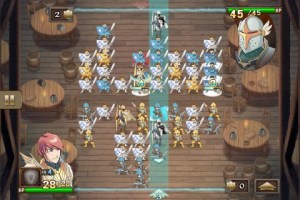 The first thing you’ll see when starting Might & Magic: Clash of Heroes is a warning that quitting the game at the wrong time will corrupt all saved game data. That’s just not an acceptable flaw for an iPhone game to have, and it’s the first sign that this Nintendo DS port may not have been planned very carefully.
 Even with a bigger screen, there would be other problems. The fights don’t become interesting until you gain a few levels and earn enough units to fill the battlefield. You need to wait for frequent load screens. Worst of all, the gameplay is slow, with the “minutes played” counter on the save screen feeling less like an interesting fact and more like a note about how much time you’ve wasted. Once your units are ready to attack, they take a certain number of rounds to charge up. This is important to the strategy, since you may use that time to set up combos, and your opponent may try to prepare with walls or by setting up a faster attack in the same column. However, it means that you may still have a few rounds left to play after the outcome of the battle becomes obvious. And the rounds play slowly. With the animations of each unit charging up or fighting and the slow-paced opponent moves, you’ll often need to tap your screen to keep it from falling asleep between the time you end one round and begin the next! That feels way too passive. By the higher levels (which you get to quickly, since the game is a series of campaigns), the no-risk battles against minions can easily take eight to ten minutes, and a battle featuring defense and healing abilities could feasibly take half an hour! They never feel meaty enough to justify that time.
 Juggernaut: Revenge of Sovering is an attempt to translate the feel of a big-budget video game to handheld devices. They found a lot of interesting ways to make the combination work, but main effect was to make me think about how the line between hardcore and casual gaming is a lot finer than most people think.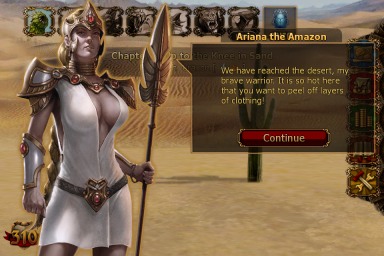

 Cult of the New