Archive for 2011

OFF! – First Four EPs (Music Review)

First Four EPs cover

OFF! - First Four EPs

Who would’ve expected that the most vital-sounding supergroup in years would be a bunch of middle-aged hardcore musicians? OFF!, whose members come from bands such as Circle Jerks and Rocket From The Crypt, appeared out of nowhere in 2010 to release four EPs, each one squeezing four brutal songs into less than five minutes of playing time. Those are all collected on First Four EPs, which feels like a complete, satisfying album despite its 18-minute length. This approach seems more than a little gimmicky, given that all four EPs and the collection were released in a matter of months, but it’s hard to argue with the results.

The songs are, of course, uniformly short and intense. Though the band only has one speed, they manage to keep each song sounding different. Most manage to squeeze chord changes or a verse-chorus-verse structure in despite their short length, and all of them are distinct musically and lyrically. These are sixteen fleshed out songs, not just throwaway clips. The songs also cover an impressive range of topics, from confrontational political songs to a eulogy for punk singer Jeffrey Lee Pierce. Quite a few of them address depression and social anxiety. That’s a topic that I’m not used to hearing in punk music, but the band’s honest, straightforward approach makes it seem like the most natural idea in the world. “Blast” is a rare uplifting track, with singer Keith Morris unapologetically celebrating that he “slashed and burned through my fifteen minutes of fame.”

One good thing about the EP format is that there isn’t any space for dead wood, especially with such a short length. There’s not a single disappointing track on this CD. However, the full collection also feels like it lacks standout tracks. One or two longer, meatier songs could have gone a long way towards fleshing this out as an album. That’s the only complaint I can come up with, though. First Four EPs is a stunning argument for the relevance of fierce, vicious hardcore in today’s world.

Grade: A-

The Unwritten (Comic Review)

Note: So far, I’ve only reviewed comic series after they concluded. I’d to occasionally examine ones that are still ongoing, as well. As issue #24 of The Unwritten was just released, it seems like a good time. This is the point where most Vertigo titles are cancelled, so it’s now safe to say that this series should have have a long life ahead of it. In this case, it also happens to be the point where author Mike Carey says the first act is concluded. In a happy coincidence, as I was writing this review, I got word that volume 2 of this series had been nominated for a Hugo award.

Ever since it was birthed by Sandman, the Vertigo comic line seems to have a fascination with stories about stories. From the modern hit Fables (in which fairy tale characters literally live in New York), to more obscure titles like Testament (with rebels in a near future dystopia who repeat the mythic cycles of traditional religions), to constant spin-offs of Sandman itself, like the current House of Mystery (which features a different character narrating a story-within-the-story every month), this is the closest Vertigo comes to a unifying theme. The Unwritten is the latest example of this, with a plot that literally explores the power of stories to control the world.

Continue reading

Agnostic Front – My Life My Way (Music Review)

My Life My Way cover

Agnostic Front - My Life My Way

When I reviewed the new album from Roger Miret And The Disasters a few weeks ago, I didn’t realize that Miret also had a new release with his original band, Agnostic Front. It’s been four years since their last release, making it the longest gap in the group’s two decades of existence. Maybe that’s to be expected. All these years removed from the youthful energy that pushed them to the top of the New York hardcore scene, what does the band still have to sing about?

In some ways, My Life My Way is a very safe take on what Agnostic Front should be in 2011. The music is almost as intense as ever, though the songs are now consistently two minutes long instead of one. The lyrics focus once again on the punk scene and Miret’s life on the streets, with the difference that his stories are now in the past tense instead of the present.

So is this a retread, or a return to form? Given that Agnostic Front had evolved to cover other topics in the past decade, and that The Disasters seemed to be Miret’s outlet for stories about his youth, one could be forgiven for assuming that it’s the former. The music supports that cynical position: Music has never been Agnostic Front’s strong point, but this album takes their sludgy, undifferentiated metal riffs to a new extreme. After 15-20 listens, I don’t think there’s a single song I could identify with the vocal track removed. (Take out the drums as well, and I don’t know that I’d ever learn to tell them apart, except for the extra-intense “That’s Life” that sounds lifted from their defining Victim In Pain era.)

On a closer listen, though, the lyrics do justify this album. Miret seems to have grown into a more contemplative, adult outlook on life, and his takeaway from a violent youth turns out to be a heartwarming philosophy of self-determination and the power of friendship. True, songs like “Self Pride” and “More Than A Memory” (an ode to a fallen friend) would have fit in at any point in Agnostic Front’s career, but Miret hits those points more than ever in this album. Then he goes a step farther, with life lessons like “sometimes you have to walk away from everything to get a new start” and the acknowledgment on “The Sacrifice” that he hasn’t lived up to the standards set by his heroes. It’s not deep, but it’s heartfelt, and more introspective than you can usually expect from hardcore. The songs are honest, enjoyable, and keep the band moving forward rather than treading water.

It seems that Miret is trying to impart some fatherly wisdom to the next generation of punks. He has enough credibility, and couches the message in vicious enough music, that he may get his message through where actual fathers are failing. If so, good for him. There aren’t many elder statesmen of punk, and Miret’s one of the few possible contenders.

Grade: B-

Cargo Noir (Game Review)

Cargo Noir boxWhile bidding games are incredibly common in the current board gaming scene, Cargo Noir manages to find a new twist on the mechanic. Each turn, a player has a few ships that they can send out to offer money for a set of tiles. Those tiles won’t actually be purchased until the player’s next turn, which gives every other player a chance to make a higher offer on those same tiles. If the initial offer is outbid, the player who made it will need to either withdraw or raise their bid on their next turn. Because this is a new offer, it will be yet another time around the table before the tiles are actually won.

The result is a game in which many potential auctions are taking place at once, but most of them only receive a single bid. When someone is outbid, it’s a big deal: At a minimum, that person has just wasted one of their limited actions from the prior turn, and if they still want those tiles, they will need to wait at least another round to get them. The game lasts a mere 10 or 11 turns (depending on the number of players), so a one-round delay can be pretty significant.

Most people find this system a little unintuitive at first – they expect this to be a standard auction game, in which players get a chance to bid back and forth on a contested item within one turn. But once everyone understands the concept, it’s simple and elegant. The goal is to bid high enough to discourage other players from getting involved in the auction at all, but not so high that money is wasted: Earning more money requires a ship action. Wasting money effectively means that later actions will be lost to pay for it.
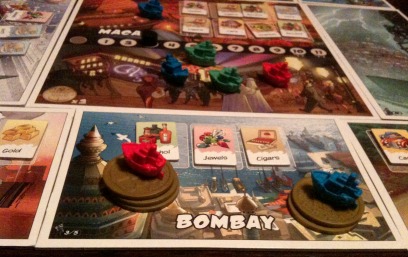
The red player outbids the blue player for the tiles in Bombay

The red player outbids the blue player for the tiles in Bombay

The flow of the game is very natural. Start your turn by seeing which of your bids from the last turn have survived uncontested, collect those tiles, and then send your ships out for new bids. Additionally, decide whether to cash those tiles in for points, or keep them for a later turn. (Yes, this is a classic “earn one resource, and then use it to buy points” Euro-game.) Turns move fast, and the fact that each action takes a round to resolve means that there is a feeling of continuity from round to round.

This system has a few flaws, too. Most notably, outbidding someone sometimes feels like too powerful an attack. Even if the other player is willing to bid higher for the tiles, they are still forced to lose an action and wait longer for the goods. Attacks in bidding games don’t usually feel so direct. Worse, they can sometimes feel arbitrary. You may find yourself willing to spend three coins to buy three tiles, and see that two other players have each made a bid of two coins for three tiles. With the way tiles are valued, it often makes no practical difference to you which auction you bid on, but the choice will have huge repercussions for the player who gets blocked! Expect accusations of “king-making” to come up a time or two each game.

The way the tiles are valued is interesting, but probably a little too simple. There are nine types of goods, and the most points can be earned by cashing in a set of matching ones. Sets of all-different ones can be cashed in as well. In either case, sets become much more valuable as they get larger, but only a limited number of tiles can be saved from turn to turn. Players will usually do best with the simple task of collecting different tiles, but matching sets are necessary to reach the highest-point cards. This choice creates a nice tension, but I do wish there was a little more to it. Too often, the different sets of tiles available feel more or less the same as each other, which leads back to the problem in which deciding where to bid has less to do with its value to you and more to do with which other player you want to hurt. Cargo Noir is a good game, but if it could have found a scoring system with the variety of Ra’s, the bidding choices would be much more interesting.

The game is published by Days of Wonder, which means that despite the pasted-on theme, it comes with high-quality bits and detailed artwork. This is nice, even if it is a little more extravagant than needed. For all the attention to the game’s appearance, though, it seems that someone could have put some effort into making  sure that all the pieces fit back in the box easily. There are ways to squeeze everything in there, but none of them are as simple as they should be.

All that said, Cargo Noir is a better game than many of Days of Wonder’s recent offerings. I don’t find the auctions themselves compelling enough to return to this one regularly, but the auction system is original and elegant enough to ensure that it won’t be forgotten.

Grade: B

The Wormworld Saga: A Profitable Webcomic?

I just read the first chapter of the webcomic The Wormworld Saga. It’s too early to tell how good it is yet, but there is definite promise. The setup hits all the clichés of the “imaginative but damaged boy discovers a fantasy world”, but it has a great feel for the childish wonder that should drive such stories, as evidenced in the hidden room at his grandmother’s house. The painted colors are a little chunky and occasionally lifeless for my taste, but the art is undeniably skilled. And the real selling point is its infinite canvas, with each chapter being a single long, long page that the reader keeps scrolling down through. The first chapter doesn’t always take advantage of this, but it does create an absolutely stunning opening, as the downward scrolling leads from the sky to a kingdom below the ground, which morphs back into a real-world scene. And while that glimpse of the other kingdom is the only time this chapter leaves reality, I absolutely love this fanart which uses that same canvas to slowly reveal more and more of an impossible world.
But the content of the webcomic itself, whether it ends up being good or bad, isn’t what motivated me to write this. Instead, I’m fascinated by the way Daniel Lieske, the creator, is hoping to make money from his story.

Continue reading

.357 String Band – Lightning From The North (Music Review)

Lightning From The North cover

.357 String Band - Lightning From The North

One common approach for alt country bands is to mix traditional instrumentation with punk-influenced vocals. I’m sure that many people who could otherwise see this music as a reverent, skilled alternative to modern pop country are too put off by the rough singing to appreciate it, and I’ve wondered how this contributes to the divides within country music. Personally, though, I’m a fan of that sound. The aggressive singing is a battle cry for bands trying to reclaim a musical heritage that has been watered down by mainstream expectations, and if this sub-genre has run too far from the wholesome, moral side of country, well, I’m the wrong person to complain to about murder ballads and outlaw songs.

.357 String Band is a perfect example of this style, with their main distinction being their focus on bluegrass instead of more general country. (They call their sound “streetgrass”, but I don’t know that a new term is needed for it.) The members are very skilled country musicians, whose playing adds a lot of complexity to the traditional bluegrass sounds, and with production that retains the energy and layers that most classic bluegrass recordings sadly lose. The lyrics are unmistakably country when considered song-by-song, though very few classic singers would have included so many songs being no-good troublemakers without a few gospel songs for balance. But the singing, of course, is where the band would lose most traditionalists.

I have mixed feelings about the singing on Lightning From The North. Some songs are perfect examples of why this punk approach can mix so naturally with country – witness the authenticity it gives to the hard-partying life in “Dust Devil”, or the world-weariness it brings to the more tender “The Days Engrave”. In many other songs, though, the vocals fall a little flat. The singer seems more intent on hitting all the words at the right time and getting through the song than with actually portraying the emotions that should be behind it. “The Harvest Is Past”, for example, laments social decline (“thieves and beggars prosper while good men wither and die”) with all the subtlety of a high schooler who has been called on to read Shakespeare to his English class, This album features two singers, with the good performances generally coming from Joe Huber, and the weaker ones from Derek Dunn. Both singers have their shares of successes and failures, though. Whether this is from the punk influence on modern country, or the fact that bluegrass music traditionally pushes its performers to stay fast and upbeat on all songs, the band would be a lot better if they would slow down and emote at times.

Lightning From The North is an occasionally uneven, but usually good, collection of songs. It finds a surprising amount of variety in bluegrass, a style that often sounds the same on the downbeat songs as the upbeat ones. My concerns about the singing aside, this is a solid entry in a style that is all too rare among alt country bands.

Grade: B

Jayke Orvis – It’s All Been Said (Music Review)

It's All Been Said cover

Jayke Orvis - Its All Been Said

Was Jayke Orvis serious when he named his album It’s All Been Said? True, he sticks faithfully to country music fundamentals here, but the sum of the parts is nothing quite like I’ve heard before. He provides brilliant instrumentation, mixing a guitar, mandolin, bass and dobro into a richly layered sound that belies his trashy, stoner persona. The music owes a lot to his bluegrass background, but is often toned down and paired with somber vocals: I don’t think there’s a “downer country” movement, but this album makes me want one.

The album’s flaws don’t come from the songwriting at all, but from a lack of focus. It opens with “A Recipe For Tea”, a mix of sampled phone calls and TV horror hosts that sounds like it should be kicking off a witch.house album instead of a country one. The second track is appropriately country, but it’s an upbeat instrumental that feels out of place on the depressed album. It could be made to work, but sticking an instrumental right after a pointless intro presents it as filler instead of a legitimate song on its own.

The next several songs establish Orvis as a modern country virtuoso, mixing technically brilliant music with memorable, personal lyrics and strong, understated vocals. He lightens the “downer country” mood with a few upbeat songs that, unlike the early instrumental, still fit in the album thanks to their gritty production and references to the hard side of life.

Even once the album gets going, though, it makes several confounding choices. Why is “Streets” mixed with distracting hoots and applause from an audience, or “Shady Grove Gypsy Moon” introduced with another horror movie sample? “Dreadful Sinner”, a quiet recounting of vigilante justice, should be one of the best songs in recent years: The rich instrumentation is a prime example of how, despite the album title, it has not yet “all been said”, and Orvis’ matter-of-fact vocal delivery makes the lyrics haunting and unshakeable. (From his mouth, “wickedness is painless, but it’s blazing strong and true” sounds as simple and country as the later “that’s what we do with the dreadful sinner, hold him in the river till the bubbles are few”.) But Orvis apparently couldn’t find a way to start or end the song, with a half-minute of unnecessary sound clips on each end. What we’re left with is something that sounds like the middle portion of a longer epic, rather than a satisfying song on its own. (I recommend the video, which is scattered in other ways, but at least makes the opening and closing feel tied to the song.) It’s All Been Said may be excellent two thirds of the time, but a disappointing third is too much when it’s only 34 minutes long.

Jayke Orvis is an amazing talent, with a style that should be able to bridge the gap between standard country fans and the alt country scene. It’s no surprise that Saving Country Music named him the “Artist of the Year” based on the strength of It’s All Been Said. But the album doesn’t quite deserve as many accolades. It’s often excellent, but also uneven. I can easily recommend it, even though I’ll have to keep waiting for the classic that Orvis is obviously capable of creating.

Grade: B+

The Extra Lens – Undercard (Music Review)

Undercard cover

The liner notes to Undercard cover each song with John Darnielle’s typically playful and pithy commentary. The discussion of “Cruiserweights” provides a context that I use to understand the entire album:

There are people out there who transfer footage of old fights from worn VHS to DVD, and through a couple of these people, I’ve managed to put together a small collection. Half of these fights, if I do not personally watch them, will never be remembered by anyone, anywhere, under any circumstances. There are tragic heroes, and then there are really tragic heroes, and then there are guys who, knowing that they’re never going to get rich or famous, will nevertheless consent to have most of the bones in their faces broken in front of an auditorium full of other guys who’ve paid to watch it happen.

The song makes good on this description, tenderly describing a boxer’s thoughts as he is beaten to a pulp. But almost every track on this album fits the theme described here, examining events that would be forgotten if they weren’t captured in song. From the literal (the staff in “Only Existing Footage” laboring over a movie that will never be finished) to the figurative (the immigrants of “Programmed Cell Death” furtively meeting as they watch their culture die off), from the mundane (multiple songs about affairs) to the fantastic (a family trying to forget the horror from the deep they uncover on a fishing trip), Undercard captures these quiet moments. If you doubt the value of snapshots such as these, the album closes with the narrator of “Dogs of Clinic 17”, dying of an unnamed medical experiment, reminding you “there’s a light in all of you who hear my song”.

This album itself may be one of those easily lost events. The Extra Lens released their only other album a decade ago, and that was under the name “Extra Glenns”. Undercard would receive more attention if Darnielle released it as a project of his usual band, The Mountain Goats, or if Franklin Bruno associated it with The Human Hearts. But the ephemeral nature of a side project makes these songs all the more poignant.

The songs themselves are as thoughtful and poetic as anything from The Mountain Goats. Bruno handles more complex musical arrangements than Darnielle would make on his own, but this is definitely a lo-fidelity album, more at home with the anti-folk style of The Mountain Goats than the lusher pop sounds of The Human Hearts. The result is something that feels more vital than most official Mountain Goats releases. If Undercard is both about and an example of personal, easily forgotten moments, it makes an excellent case for its own existence.

Grade: B+

First Wave (Comic Review)

From Doc Savage to Superman, from The Shadow to Batman, superheroes grew fairly directly out of the pulp movement. Since DC Comics has since acquired the rights to many of these influential characters, it isn’t surprising that they would try to breathe new life into them. First Wave was an attempt to create a shared world of gritty, low-powered heroes based on reinterpretations of classic figures. Not a bad idea, but DC did an astoundingly bad job with it.
The plan was that First Wave would be a six-issue miniseries that set up a status quo, with two ongoing titles (Doc Savage and The Spirit) immediately spinning off from it. A solid plan, but it doesn’t mean anything if the comic itself isn’t very good. First Wave’s story follows a convoluted plot involving a world-spanning secret organization, a drug that turns victim’s blood into gold, and a machine that can manufacture tsunamis. Even after re-reading it for this review, I’m not quite sure how those pieces fit together. Nor am I sure how the different heroes all got involved: I count six to eight plot threads following different pulp heroes or groups (depending on whether Doc Savage and his associates are counted separately), and weaving those in and out of six comics is a tricky task. When a character suddenly appears in a new issue, it can be difficult to remember what they know and what their current motivations are.

Writer Brian Azzarello and artist Rags Morales are both associated with high-profile comics events, but they weren’t necessarily the right combination for this title. Morales’ crisp combination of realism and cartoonishness is the hallmark of modern-day superhero art (especially mixed with this book’s bright colors), and it contrasts with the darker, gritty pulp story that Azzarello is trying to tell.

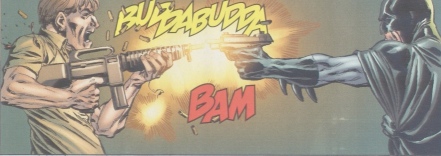
The Bat-Man and his gun

The one bright spot of this relaunch is the clever ideas that were applied to the characters. The once heroic Blackhawks are now mercenaries who care mainly about money, and even after they turn against the bad guy, they have little regard for the lives of less capable heroes. Doc Savage, “the perfect man”, is set against a skeptical press and a public who can’t trust the motives of an alleged hero. And I’d love to read further adventures of this rookie “Bat-Man”, who carries guns and is as interested in the adrenaline rush as the justice. Unfortunately, a series based on him would probably turn out to be a disappointment, based on the spin-offs that we did see. The Spirit had possibly the most interesting reinvention of all, being paired with a corrupt police force who sneer and trade barbs with him. The new Spirit comic, though, quickly forgets this. Instead of just getting tips from Commissioner Dolan (a “bad cop but a good guy” who cares about his own wealth and safety first, but will help The Spirit do his job on the side), within a year the vigilante is publicly walking around the police station with his “best friend” the commissioner. It’s not a bad title on its own, but contradicts First Wave enough to ruin the effect that a shared world is supposed to have.

This isn’t a review of The Spirit, or the standalone Doc Savage title (an inoffensively bland action story), but it bears noting that the problems with First Wave extended to very poor editorial control across the intended line. There was also a one-issue “First Wave Special” last week that I was waiting for before doing this review. That issue actually wasn’t bad: A creative team with a grittier style, a story that addressed plot lines in the recent Spirit and Doc Savage titles, and a confrontation between some of the major players that emphasizes each one’s different personality. The First Wave Special actually made a good case for these characters as part of a new interconnected line. Unfortunately, I think the damage has already been done. First Wave itself was a hard-to-follow mess that introduced interesting characters, but failed to do anything worthwhile with them. More than a year after the experiment started (yes, the six-issue series was plagued by a lot of delays), it is obvious that the momentum it was trying to build is not going to happen.

Grade: D-

7 Wonders (Game Review)

7 Wonders BoxIn some ways, a game that works for more than five people is the Holy Grail of the industry. In my opinion, even going past four people causes long delays between turns, and introduces too many factors that feel outside of a single player’s direct control. But when a group of friends gets together, it’s easy to end up with too many people to comfortably play one game, but not enough to split into two groups.
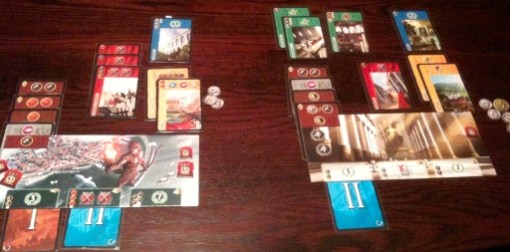
7 Wonders’ claim to fame is that it works for up to seven players at once. More importantly, though, it keeps everyone consistently engaged through its breezy twenty- to thirty-minute playing time. Its mechanics make this so simple that after one game, it seems amazing that no one has tried this approach before. Basically, there is no downtime because every player is making their choice simultaneously every turn. Choose one card to play, and pass the rest of your hand to the player next to you. Sure, other games have used this card drafting technique before, but 7 Wonders also addresses the other source of slowdowns in games with too many players: All your interactions are with the people to your immediate left and right, so you don’t need to get bogged down keeping track of more than two other players.

The game itself is a fairly straightforward entry in the “civilization light” genre. Each card gives you resource production, points, or abilities. There are too many resources to personally cover all of them, but you can buy the ones you need from your neighbors. Just keep track of what they are producing so you don’t duplicate their efforts, and so that you can build the ones that they’ll want to buy from you! Also watch their military strength, because at the end of each of the three rounds, your comparative power will gain or lose you points.

7 Wonders Play7 Wonders offers a decent amount of choices. You can earn points through cards, advancing your personal “great wonder” track, matching symbols, getting money, or having a stronger military than your neighbors. The “Guild” cards that appear at the end of the game even let you score points for how advanced your neighbors are in various categories! It’s impossible to excel in every area, but they are well-balanced enough that you can ignore any of those and still win the game.

It feels surprisingly meaty for a twenty-minute game, but there is a lot of chance hidden behind the mechanics. Drawing the right cards, especially when those big Guilds are dealt out at the end, makes a big difference. And while it may be fun to ignore the player on the other side of the table, it can be frustrating to learn you’ve lost to someone you weren’t even able to interact with. For that reason, I suspect that these mechanics wouldn’t work in a much longer game, as much as I wish they could. It’s not too frustrating to lose a filler game by chance, but it would be a deal-breaker if two hours of planning fall apart through no fault of your own.

The game also becomes a little repetitive before long. Despite the many paths to victory points, and the different “Wonder” boards that each player is dealt, the various strategies don’t really feel that different after several plays. They’re all based on getting resources, playing cards, and watching to make sure you bury any card that your neighbor desperately needs. There are already expansions on the horizon that promise to add more variety, but I’m not sure how well they’ll succeed. 7 Wonders feels like it has as many elements as its short playtime can support. Anything different enough to actually increase the replayability would probably be too overwhelming. On the other hand, designer Antoine Bauza has already made one near-impossible task look simple. If 7 Wonders could keep me interested through a seven-player game, then I suppose that the expansions could hold more surprises of their own.

Even after the initial rush of newness wears off, I don’t expect this game to stop being fun. And because it fills a niche that nothing else in my collection does, I’m sure it will remain in use for a long time. Looking for a filler to play as your friends are arriving, or when you’re winding down for the night? This works no matter how many people are there with you, and it feels heavier than just about anything else that plays so quickly. 7 Wonders not only has an original design, but is going to keep hitting my table long-term.

Grade: A-