Peter Clines – 14 (Book Review)
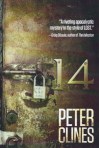
14 – Peter Clines
Nate Tucker’s inexpensive new LA apartment seems too good to be true, but it also comes with a lot of quirks. Several doors are heavily padlocked, one unit has a reputation for suicides, and the cockroaches are actually mutated. Despite the building manager’s threats, Nate soon finds himself obsessing over these mysteries, putting his job (and possibly more) at risk. This is the set-up of Peter Cline’s novel 14.
14 is an enjoyable page-turner, though the journeyman writing keeps it from ever becoming engrossing. Cline’s descriptions get hung up on details about the way an item is laid out or a person performs a simple task. It’s never bad, but it often keeps things from flowing smoothly. If this book engrosses you, it will be because of all the twists and secrets, not because you get lost in the prose. Similarly, the quantity and variety of the oddities can be a little hard to accept, as are some lucky coincidences that keep Nate’s investigation moving forward. (Strangely, though, some of the later things he uncovers are huge, and don’t actually rely on him following the trail of breadcrumbs that led him through the first half.) The characters are quirky, even by LA standards, and though the book promises that they have secrets, it’s more that they all have exactly the right skill sets to move the plot forward.
Still, Clines’ gifts lie in the plotting, and the story definitely progresses smoothly while raising the stakes and ensuring that new details are uncovered frequently. Most chapters are a few pages each, with cliff-hanger endings, making it easy to read. (These chapter breaks feel a little forced once you realize that they are consistently placed after surprises instead of at logical breaks in the action. Conversations are often split between two chapters so that one chapter can end with a surprise revelation, but then a major scene change will fall in the middle of the following chapter.)
Strangely, I appreciated 14 as a mystery-thriller novel, but Clines intended it to be a horror novel. It does seem a little creepy at the start, because it is scary to think of moving into a new building where you might not be safe, but that aspect quickly fades away once it takes on the structure of an investigation. Nate and his new friends follow patterns that seem safe and formulaic, in which pieces come together and curiosity is rewarded. This is the stuff of comfortable thrillers, not horror novels. Bad things happen to people, but they’re at the points in the plot where someone should be expected to pay a price. The big reveals late in the story do have some trappings of the horror genre, but by that time, my thought was just “I wonder how the intrepid gang will get out of this!” Had it been a horror story, I would have been wondering if they were going to get out of it.
14 is never as clever or original as it apparently intends to be, but it’s a fun genre exercise. This was one of the three books I was recently reading simultaneously for my book clubs, and it was often the one I was most eager to come back to. On the other hand, when it ended I didn’t feel any need to keep thinking about the story or to look into the author’s other works.
Grade: C+



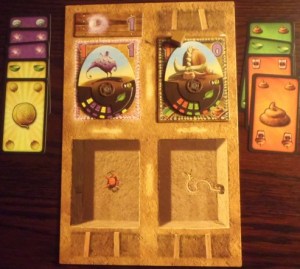


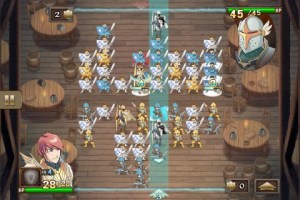 The first thing you’ll see when starting Might & Magic: Clash of Heroes is a warning that quitting the game at the wrong time will corrupt all saved game data. That’s just not an acceptable flaw for an iPhone game to have, and it’s the first sign that this Nintendo DS port may not have been planned very carefully.
 Even with a bigger screen, there would be other problems. The fights don’t become interesting until you gain a few levels and earn enough units to fill the battlefield. You need to wait for frequent load screens. Worst of all, the gameplay is slow, with the “minutes played” counter on the save screen feeling less like an interesting fact and more like a note about how much time you’ve wasted. Once your units are ready to attack, they take a certain number of rounds to charge up. This is important to the strategy, since you may use that time to set up combos, and your opponent may try to prepare with walls or by setting up a faster attack in the same column. However, it means that you may still have a few rounds left to play after the outcome of the battle becomes obvious. And the rounds play slowly. With the animations of each unit charging up or fighting and the slow-paced opponent moves, you’ll often need to tap your screen to keep it from falling asleep between the time you end one round and begin the next! That feels way too passive. By the higher levels (which you get to quickly, since the game is a series of campaigns), the no-risk battles against minions can easily take eight to ten minutes, and a battle featuring defense and healing abilities could feasibly take half an hour! They never feel meaty enough to justify that time.
 Cult of the New