Thao & The Get Down Stay Down – We the Common (Music Review)
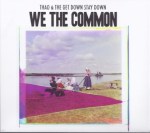
We the Common cover

Thao & The Get Down Stay Down – We the Common

Thao Nguyen has a voice that mixes simple honesty with a winking cleverness. With stripped down instrumentation and a slight reverb added to her singing, it’s attention-grabbing. Nguyen’s utter confidence and uncomplicated voice make her into an indie success story. However, on We the Common, performing as Thao & The Get Down Stay Down, she rarely sticks to that basic winning formula.

Admittedly, it would get a little repetitive if she never did more than that. The epitome of the simple folksy style that pulled me in is “Kindness Be Conceived”, a twee duet with Joanna Newsom. It’s hooky and adorable, but no one would want to listen to variations on that for a forty minutes. The best model for her would be the opening track, “We the Common (For Valerie Bolden)”. It starts and ends with Nguyen on her guitar, alternately representing a vulnerable woman and a united people (the song apparently inspired by the story of someone she met when visiting a woman’s prison). In the middle, the band joins her with a slowly building beat and a wall of sound to fortify the conviction that she presents. I want to hear more songs like that.

Otherwise, the really compelling moments come and go throughout the tracks. The Get Down Stay Down are talented and versatile, but so varied that the album has no consistency beyond Nguyen’s voice. (The band is perhaps nothing more than a rotating cast brought in to fulfill her vision, as fourteen other performers are credited, not counting the ones who contribute only background vocals.) There’s no commonality between the slow-as-molasses “Clouds For Brains” and the clanking mechanical soundscape of “City”. Elsewhere, some songs are bouncy and poppy, while others throw in a soulful saxophone or even organ. The vocals are intriguing in almost every case, and even most of the weaker songs would make me curious about the rest of the album if I heard them in isolation. Put together, though, the album only sporadically lives up to the potential that the pieces promise.

Grade: B-
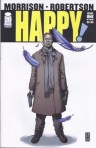
 

Image Comics Capsule Reviews – Harvest and Infinite Vacation

Continuing from Wednesday’s article, here are the other two Image miniseries I finished recently.

There is no doubt that Image’s output has improved a lot in recent years, but there is a certain sameness to a lot of its comics now. Of the four stories I’m looking at this week, Multiple Warheads is the only one that didn’t feel like it was a movie pitch at some level. Maybe it wasn’t intentional in all the others; Once that approach has become the norm, you can find yourself following it even if you do just want to tell a good story. And it’s difficult to know how much to criticize this change, because the quality really is better now. It’s still a tradeoff, though, because the big comics now are slick and more predictable. We have lost something as we left behind the chaos of comics’ less commercial days.

I still liked both of the comics from last Wednesday, even if neither one thrilled me. These next two were less interesting. (Because this article is a little wordier than the previous one, I’m putting the reviews below the fold.)

Continue reading

Image Comics Capsule Reviews: Happy! and Multiple Warheads

It’s time for another quick catch-up on recently completed miniseries from Image Comics. I plan to cover two today, two more in a few days, and catch up on the ongoing Morning Glories soon afterwards.


cover to Happy! #1

Happy!

Happy!

After years on an exclusive contract, the hyper-inventive Grant Morrison seemed to become a little set in his ways. For this reason, Happy!, his first non-DC work in a long time, carried a lot of expectations with it. The results are inconclusive. It’s a fun, competently-told story, but there’s no hint of deeper meaning or a long-suppressed muse bursting free.

Happy! is an especially twisted take on Morrison’s obsession with reality and fantasy crossing over. It opens with tough-talking gangsters preparing for a hit, straight out a Garth Ennis comic. It even features excellent art from Darick Robertson, who excels at this sort of gritty but amusing hyper-violence. By the end of the first issue, though, it’s taken a surprising twist. The crime story is never left behind – this is a Christmas comic reminiscent of Bad Santa in the uncomfortable way it plays with redemption – but it would be more accurate to compare it to Bad Santa Meets The Smurfs.

The first issue is the best. Morrison turns out to be good at darkly humorous crime scenes, and those early scenes with no reader expectations are thrilling. Once it settles on its protagonist and main conflict, it becomes a little more by-the-numbers. This is the sort of story where a character finds a way to look at other people’s hands in Poker, but the only way the writer knows to show him winning is to give him high hands every time. On the other hand, in a flashback to the anti-hero’s backstory, Morrison shows that clichés can be effective.

Happy! is a fun, fast read, if you’re looking for something grotesque and slightly surreal. There’s no real hook to keep you interested afterwards, though. Despite the craft it was made with, it will fade as quickly as you can read it.

Grade: B-


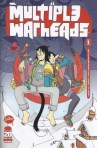
cover to Multiple Warheads: Alphabet to Infinity #1

Multiple Warheads: Alphabet to Infinity

Multiple Warheads: Alphabet to Infinity

Brandon Graham’s Multiple Warheads has a convoluted history: Starting out as a indie porn about an organ smuggler who steals a werewolf dick for her boyfriend, it led to an Oni Press series that never went past the introductory issue, and is now a series-of-series from Image. Despite all that, it’s not really necessary to understand any of the title’s past. This is like Graham’s classic King City, a cute story jam-packed with ideas in a science fictional setting that allows for anything Graham wants to happen. Tossed-off ideas and puns fill in all the margins, with an attitude somewhat like Groucho Marx as a sci-fi-loving graffiti artist.

In many ways, Graham’s work is a celebration of indie comics in their purest form. An uncommercial labor of love that costs less than most superhero comics but takes three times as long to read, these can be pure joy. But at this point, I’m starting to wish for some actual plot and consistency to tie it all together. In these four issues, the main couple (Sexica and Nikoli) go on a road trip past a bunch of fatal threats that never feel dangerous, and another organ smuggler named Nura (who has no connection to the others as far as I know) heads out on a mission. I wasn’t always sure what was going on other than that, but these ended right when the story seemed to start up. There may be dangerous secrets at the hotel Sexica and Nikoli are staying at, and there are some interesting side characters serving them there. But after building that up, the final issue was entirely about Nura getting in a fight that ended inconclusively. It was misleading to call this a mini-series.

Multiple Warheads is fun, but aimless. I’m really glad that Graham has started to try out other storytelling styles, such as the slightly more focused Prophet. Still, as long as he keeps comics like these as an occasional side project, I’m likely to keep up with them.

Grade: B-


Because April 1st is Such a Smart Day to Change Your Website…

This is just a quick note that I’ve finally updated the About Page that I threw together back when I started this blog. It’s still not great – I’d rather to put my time into the normal articles – but the page gets hits almost every day. Hopefully now I will stop cringing when I see that a new reader checked it out.

Peter Clines – 14 (Book Review)

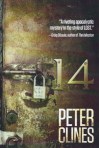
14 cover

14 – Peter Clines

Nate Tucker’s inexpensive new LA apartment seems too good to be true, but it also comes with a lot of quirks. Several doors are heavily padlocked, one unit has a reputation for suicides, and the cockroaches are actually mutated. Despite the building manager’s threats, Nate soon finds himself obsessing over these mysteries, putting his job (and possibly more) at risk. This is the set-up of Peter Cline’s novel 14.

14 is an enjoyable page-turner, though the journeyman writing keeps it from ever becoming engrossing. Cline’s descriptions get hung up on details about the way an item is laid out or a person performs a simple task. It’s never bad, but it often keeps things from flowing smoothly. If this book engrosses you, it will be because of all the twists and secrets, not because you get lost in the prose. Similarly, the quantity and variety of the oddities can be a little hard to accept, as are some lucky coincidences that keep Nate’s investigation moving forward. (Strangely, though, some of the later things he uncovers are huge, and don’t actually rely on him following the trail of breadcrumbs that led him through the first half.) The characters are quirky, even by LA standards, and though the book promises that they have secrets, it’s more that they all have exactly the right skill sets to move the plot forward.

Still, Clines’ gifts lie in the plotting, and the story definitely progresses smoothly while raising the stakes and ensuring that new details are uncovered frequently. Most chapters are a few pages each, with cliff-hanger endings, making it easy to read. (These chapter breaks feel a little forced once you realize that they are consistently placed after surprises instead of at logical breaks in the action. Conversations are often split between two chapters so that one chapter can end with a surprise revelation, but then a major scene change will fall in the middle of the following chapter.)

Strangely, I appreciated 14 as a mystery-thriller novel, but Clines intended it to be a horror novel. It does seem a little creepy at the start, because it is scary to think of moving into a new building where you might not be safe, but that aspect quickly fades away once it takes on the structure of an investigation. Nate and his new friends follow patterns that seem safe and formulaic, in which pieces come together and curiosity is rewarded. This is the stuff of comfortable thrillers, not horror novels. Bad things happen to people, but they’re at the points in the plot where someone should be expected to pay a price. The big reveals late in the story do have some trappings of the horror genre, but by that time, my thought was just “I wonder how the intrepid gang will get out of this!” Had it been a horror story, I would have been wondering if they were going to get out of it.

14 is never as clever or original as it apparently intends to be, but it’s a fun genre exercise. This was one of the three books I was recently reading simultaneously for my book clubs, and it was often the one I was most eager to come back to. On the other hand, when it ended I didn’t feel any need to keep thinking about the story or to look into the author’s other works.

Grade: C+


Ray Wylie Hubbard – The Grifter’s Hymnal (Music Review)

The Grifter's Hymnal cover

Ray Wylie Hubbard – The Grifter’s Hymnal

After I named Ray Wylie Hubbard’s previous album one of the best albums I discovered in 2011, you’d think that I’d know to check out his next one as soon as it came out. But I missed out again, waiting until now to try his 2012 release The Grifter’s Hymnal. And while I don’t think this one is quite going to make it on my year-end list, it’s a reminder that I need to pay closer attention to Hubbard.

Hubbard is an old country bluesman with a penchant for slide guitar, but he’s more versatile and experimental than you’d expect from that description. He sounds a little more settled down this time, which is probably why it didn’t quite live up to my expectations. But still, it features the rocking, irreverent “New Year’s Eve at the Gates of Hell”, half-spoken stories of his restless youth in “Mother Blues”, and “Henhouse”, a catchy tale that rambles through country life and exaggerated character studies. Mostly about sinning, with a few heartfelt moments about God, Hubbard still sounds wild and fun despite the knowing way he looks back on life. And songs like “Moss and Flowers” provide a soulful counterpoint to his jokester moments. This is still a varied, well-rounded album.

Even when he’s playing around, music is serious business to Hubbard. Throughout tales of sex, drugs, and faith, it’s obvious that music is what really drives him. Some songs address this directly, such as the DIY blues set-up of “Coricidin Bottle”, while others just mix music directly in with the rest of his life. When he is judged in “New Year’s Eve at the Gates of Hell”, Hubbard mainly considers his musical accomplishments (“Sure I drank a lot of gin and tonic, but I never threw away my Panasonic.”) It’s a philosophy that should make Hubbard a friend to any music lover.

Though my preferred Ray Wylie Hubbard album was A. Enlightenment B. Endarkenment (Hint: There Is No C), don’t let me scare you off of The Grifter’s Hymnal. It’s an excellent celebration of life, as seen through the eyes of a man who mixes the best parts of youth and age.

Grade: B+


David Wong – John Dies at the End (Book Review)

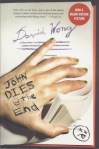
John Dies at the End cover

David Wong – John Dies at the End

David Wong, the author of John Dies at the End, is a pseudonym for Cracked editor Jason Pargin. Cracked, of course, is that humor site that turns out to be full of bitterly intelligent essays with sophisticated points hidden behind the obscenities. John Dies at the End brings that same sensibility to horror-comedy. It doesn’t necessarily make any larger points, but it’s easy to read while building an atmosphere that’s both juvenile and consistent. It proposes that the reality behind what we see is one bad drug trip, and then sells that premise.

More comedy than horror, John Dies is about lazy fuck-ups who learn to see demons and ghosts. The only thing that saves them is that the powers that want to destroy humanity are as dumb as they are. On the other hand, maybe only someone with their approach to life could withstand the barrage of surreal sights that they face. Though there are some consistent rules being built behind the madness (again, just like Cracked), the book is full of absurd humor. Whenever you start getting comfortable with this mix, though, horrifying things will happen to shake you up.

This often works great. Wong is a funny man, and he has a clever take on one of the clichés of horror: The idea of people being insignificant specks in a malevolent universe is a common theme, but it’s difficult to make the reader believe in the incomprehensible beings that are supposed to be out there. Wong finds a mix that lets him dial up the weird humor to a level that would normally be annoying, but in this case it’s a representation of just how wrong our everyday expectations are. By really making the reader feel lost sometimes, the message is conveyed.

However, John Dies works much better at the beginning. The story was serialized online, apparently with modifications, over the course of years, and the collected version still feels episodic. Early on, it feels like the author has free reign to go in any direction he wants, and the unpredictable story is a lot of fun. By the end, it feels like Wong is trying to force a plot into this. Some people get traditional story arcs that don’t fit the anarchic sentiment the book opened with, and the things that aren’t explained feel a lot more arbitrary once certain mysteries are figured out. It’s still funny, but the one thing that really does bug me is the way it derails that horror formula. The heroes become too important and are watched by the bad guys. I can’t shudder at the idea of being lost in an incomprehensible universe when the main characters turn out to matter after all.

Despite that, John Dies at the End is a hilarious, unique book. It’s smartly stupid humor and quirky worldview are worth experiencing.

Grade: B


Nick Cave and The Bad Seeds – Push the Sky Away (Music Review)

Push the Sky Away cover

Nick Cave and The Bad Seeds – Push the Sky Away

This blog mixes reviews of artists I’ve known for a long time with ones that are new to me. I’ve often wondered if I’m consistent in my approach to these categories. I think I am overall, but there are ways I can be skewed in either direction. Nick Cave is an excellent example. As a big fan of for years, and I’m able to find things to like even in his less popular works. On the other hand, when I already know of the best options he presents, it’s difficult to get excited about the ones that don’t reach those heights. His new album, Push the Sky Away, falls into that category: It has good moments, and if this were my first exposure to him, it might be enough to make me look into his other works. But compared to what a Nick Cave album should be, I know that it’s especially weak. There’s no reason to recommend this, especially when it follows on the heels of the excellent Dig, Lazarus, Dig!

The main problem is that it feels reserved. Cave has always been defined by a fearless, if not outright foolish, extremism. Whether talking about love, hate, joy, or angst, his lyrics and The Bad Seeds’ accompaniment is always over the top. Here, he seems comfortable in the persona of an aging crooner, taking no risks and refusing to lose control. I’ve described his music as a “psychological exorcism” before, but this would be better suited for a dinner party.

The Bad Seeds’ membership has always been in flux, but with Blixa Bargeld and Mick Harvey gone, the only prominent musician left is Warren Ellis. Possibly because of this, many of the songs do a great job of evoking a darker, threatening atmosphere behind their gentle sounds. The good moments fall into that category, with repeated lines like “you grow old, and you grow cold” or “we know who you are, we know where you live, and we know there’s no need to forgive”. Cave doesn’t always go for that dark, quiet approach, though, and he has nothing else for the other songs. Effectively, only one dimension is fleshed out here. At the very least, Cave needs to add a guitarist to the group next time.

“Finishing Jubilee Street” is the one exception, an interesting track whose appeal comes from its novelty instead. It’s not one to listen to repeatedly, but it’s interesting in a blog-post-as-song sort of way. (It’s a simple story, and repeating refrain, inspired by a dream Cave claims to have had after he wrote another song on the album.) Otherwise, Push the Sky Away features the least experimentation or artistic restlessness of any Cave album ever. He has good lines (“she had a history but no past”), execrable lines (“I was the match that would fire up her snatch”), and everything in between, along with a strange approach to naming songs: The titles “We No Who U R” and “We Real Cool” sound off, fitting in neither with Cave’s established persona or the style he adapted here.

As I said at the start, Push the Sky Away is certainly not bad. There’s half of a good album here, with some quiet, evocative examples of a mature Nick Cave. But that portion doesn’t offer a lot of variety, and the rest is forgettable. He’s set the standard by which albums like this should be measured, and this one isn’t necessary given what else is available.

Grade: C+


On Book Clubs

Almost two years ago, I joined a Twitter-based book club called #1book140. Last year, a couple friends and I decided to start a book club of our own. So last month, when some coworkers started looking around for people who might want to form a club, I sensibly said I couldn’t. But I decided to try this month, and that’s how I’ve found myself way behind on three books at the same time. So I think it’s a good time to talk about book clubs.

I’ve enjoyed being in these clubs a lot. Though reading is normally a solitary experience, I like to discuss it. (I’m sure that’s related to the reason I write this blog.) It’s also good for me to have some sort of goals and structure to drive my hobbies: Last year, I read more books than any other time in my adulthood, and I credit my book clubs with giving me motivation. Normally, comics take up a lot of my reading time instead, largely because they come out on a weekly schedule, so there’s a constant feed to keep up with. I’m not trying to judge whether books are better or worse than comics, but the switch in focus has definitely worked well for me.

In fact, one of the first things I tell people about book clubs is that it’s a lot more fun to read books I don’t like if I get to tell people why afterwards. I do really appreciate the fact that these clubs have introduced me to a wider variety of books, but it’s simply the ability to share that I find best. Actually, that exposure to different categories has pros and cons, since I’m a little more likely to find books I don’t like that way. I definitely do enjoy the variety, and I’m glad that it pulls me away from the science fiction and fantasy that would otherwise be my default, but this variety is something to be careful with. I often have to read three books in a month just to find time for one of my own choosing, which means my personal to-read pile is getting dangerously high. There were novels I was eager to read a year ago still sitting on top of the stack!

The positives far outweigh the negatives, though, or I wouldn’t still be doing it. I’ve also enjoyed the very different experiences of the real-world and Twitter clubs. My Twitter one discusses general business on the #1book140 hashtag, and individual sections of the current book on tags named #1b140_1, #1b140_2, and so on. There’s a nominal schedule for the sections, but the separate tags let you join in at whatever time works. This means that the conversation is ongoing. It also means that sometimes people are saying things like “I really wonder what happens next!”, which sounds a little silly when they could just read another chapter to find out. But when I join my monthly group in-person, where we all finish the book before discussing, sometimes I wish we’d had the chance to talk back when we still had more questions than answers. It just goes to show how different one group can be from another.

If you’re considering starting your own book club, here are a few tips I’ve picked up:

  • I recommend voting on the choice every month. We do let people take turns choosing the nominees, but I think it helps a lot that everyone gets some input each time. For a small group, you probably won’t have any bitter arguments about this, but it will guarantee that if someone is strongly against one choice they get a chance to steer the group to a different one.
  • My local group spent some time early on trying to figure out ground rules. Should someone be considered a full member right away, or do they need to show up a certain number of times before they can vote or nominate titles? The answer turned out to be much simpler than we expected: About three-quarters of the people who expressed interest never showed up to a single meeting. Of those who did come once, almost every one turned out to be a dedicated member. So now, as soon as someone reads a book and joins a meeting, we just assume they’re a full-fledged member.
  • Don’t feel bad about skipping books from time to time. Everyone needs to find their own balance between book club books and ones they picked out themselves, and as I said earlier, I have to struggle to keep up with the ones I already bought. I probably participate nine or ten of the months each year for #1book140, and the work club will definitely be a sporadic thing for me.
  • Most of all, enjoy it! Book clubs fit a social role much like going out to see a movie, but everyone actually interacts with each other instead of just sitting in the dark. It’s a good experience.

Bob Wayne – Till the Wheels Fall Off (Music Review)

Till the Wheels Fall Off cover

Bob Wayne – Till the Wheels Fall Off

Since reviewing Bob Wayne’s Outlaw Carnie, I’ve wondered if I was too harsh on it. My general opinion holds true: He has a good country sound, if a little rough and obviously metal-influenced. And while some of the songs are fun, the overall impression is that of a boorish party animal who’s more interested in telling you how he wins all his fights than in reflecting real life. Despite that, I do keep going back to the best songs, because they’re worth listening to. The album as a whole is obnoxious, but the standouts arguably redeem it. I bought his latest release, Till the Wheels Fall Off, to give him another chance. Unfortunately, this one sees Wayne doubling down on the outlaw posturing, and is definitely a lesser work than Outlaw Carnie.

Part of Wayne’s problem is that his vocals aren’t singing so much as a country affectation and exaggerated quaver. It’s not out of bounds by the standards of harder underground country, but it definitely makes it easy to question his authenticity when the songs get a little unbelievable. This happens with tracks like “There Ain’t No Diesel Trucks in Heaven”, which can’t seem to decide whether that’s supposed to be a relief for weary truck drivers, or a curse. A couple songs about killing drug dealers and rapists barely even try to establish a plot or characters; Wayne sounds too eager to get to the vengeful fantasies.

I just have to laugh at “Fuck the Law”, in which he complains that the government is against him just for “writing and living these songs”. In another song he claims that he’s shot at cops for fun, so I have to agree that living out his songs would be a problem. Maybe that gets to the root of the matter: There’s nothing wrong with living vicariously through songs (even if I do complain about how one-dimensional these get at time), but there’s a confusing mix of reality, too: As far as I can remember from a live recording a while back, “Fuck the Law” was a real response to him being barred from Canada. So it’s real, but the idea that he’s “living” these songs in general is a delusion.

As I said before, the best songs are very good in isolation. “Devil’s Son” is the most fun example of claims to bad-assery, and “All Those One Night Stands” comes close if you can forget that he already covered similar territory with “Chatterbox”. “Lost Vegas” and “Hunger in My Soul” show that he can write moody, somber songs when he wants to. They’re still odes to sin, of course. Don’t expect any of the reflection from his previous highlight, “Blood to Dust”. The only one that tries at that is “Wives of Three”, a surprising song about a polygamist begging his mother to accept him for who he is. In different hands, that would be a touching character study with an unusual point of view. In the context of this album, though, it’s hard to believe that Wayne isn’t really cheering at the idea of having someone having his own little harem.

I still want to like Wayne, and it looks like every album will have a couple tracks good enough to give me hope. He’s heading in the wrong direction, though.

Grade: D+