Dungeon Petz (Game Review)

Dungeon Petz
Vlaada Chvátil’s Dungeon Lords has become one of my favorite games. Admittedly, it’s a long game that puts lots of emphasis on two short battle rounds, so a brief mistake can be devastating. But it’s still very fun, with a hilarious theme, choices that have lots of ramifications, and an action-selection system that stays interesting even after it has become familiar. Now Chvátil has created a new game, Dungeon Petz, set in the same fantasy world. Where Dungeon Lords centered around evil beings building underground lairs, this is about the hard-working imps creating pet shops that raise various monsters.
The art, humorous rulebook (with very clear explanations), and playing time will all be familiar to a Dungeon Lords fan. Both games are also built around worker placement, with a twist that comes from players making simultaneous choices. But that’s where the similarities end. In Dungeon Petz, the choice is in how to group your imp workers at the start of the round. When they’re all sent out to market, the bigger groups will have more “buying power”, and thus get to go first. This lets you decide whether you want to take a few actions before everyone else, or many actions after the other players have taken the good spots, or some mix in between. The goal is to buy baby monsters, set up cages suited to their unique needs, and then earn points by showing or selling them.
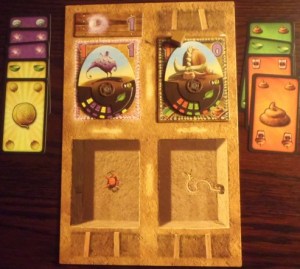
A view of two pets and their needs (with one poop cube in play!)
Of course, there are a lot of different factors to track in the game. The most important is in meeting the needs for each animal. Each one has multiple dots of different colors, with an elegant wheel increasing the total number of dots as the animals “grow” from round to round. After actions are chosen, you must draw cards of matching colors, and assign them to your pets so that each one has the same number and types of “needs” as its figure shows. Those needs, which include eating, playing, pooping, and unstable magical energies, must be met by paying certain resources or having a cage designed for them. (The cards are random, but each color has a different focus, so you can make educated guesses ahead of time.) If needs can’t be met, that pet will be less appealing to customers. Also, there are cubes to mark the amount of poop each pet makes. As with Dungeon Lords, this is a funny game, despite its complex, balanced rules.
In fact, I would say that Dungeon Petz is arguably the better-designed game, as it features scoring opportunities on almost every round (exhibitions and potential customers). Points accumulate gradually, and a single bad round won’t determine everything as it can in Dungeon Lords. I still say that Dungeon Lords is the more fun one, though. It may be difficult to control, but it has the personality to make up for it. And the simultaneous selection in that game is pure genius. Outguessing your opponents can lead to them taking actions that don’t help because they didn’t get other actions they needed. In contrast, Dungeon Petz feels like a much more traditional worker placement game. The initial choices just determine how many actions each player will have, and in what order. After that, everyone takes turns choosing actions, so if you didn’t get everything you wanted, you can immediately readjust your strategy. There’s nothing wrong with that, but the actions don’t feel that interesting. It’s the pet management on your personal board that feels fun, and that is only a portion of the game. Also, each round of Dungeon Petz involves several phases, which are difficult to remember even when looking at the reference card. This can make the game confusing, especially since planning ahead is vital.
It works best with three players. With four, everyone plays fewer rounds to keep the playtime down, which means that the endgame planning has started by the time the game really gets going. This makes a nice alternative to Dungeon Lords (which plays best with four people), but the three-player game does add extra rules to account for a “dummy” player blocking certain actions.
Dungeon Petz isn’t a great game, and it depends a lot on the goodwill generated by Dungeon Lords’ rich, amusing theme. But it still adds to that world, and it is fun if less distinctive. Very importantly, the two games feel related but are still different enough that one person can justify owning both.
Grade: B-


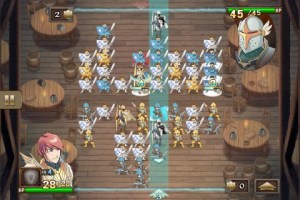 The first thing you’ll see when starting Might & Magic: Clash of Heroes is a warning that quitting the game at the wrong time will corrupt all saved game data. That’s just not an acceptable flaw for an iPhone game to have, and it’s the first sign that this Nintendo DS port may not have been planned very carefully.
 Even with a bigger screen, there would be other problems. The fights don’t become interesting until you gain a few levels and earn enough units to fill the battlefield. You need to wait for frequent load screens. Worst of all, the gameplay is slow, with the “minutes played” counter on the save screen feeling less like an interesting fact and more like a note about how much time you’ve wasted. Once your units are ready to attack, they take a certain number of rounds to charge up. This is important to the strategy, since you may use that time to set up combos, and your opponent may try to prepare with walls or by setting up a faster attack in the same column. However, it means that you may still have a few rounds left to play after the outcome of the battle becomes obvious. And the rounds play slowly. With the animations of each unit charging up or fighting and the slow-paced opponent moves, you’ll often need to tap your screen to keep it from falling asleep between the time you end one round and begin the next! That feels way too passive. By the higher levels (which you get to quickly, since the game is a series of campaigns), the no-risk battles against minions can easily take eight to ten minutes, and a battle featuring defense and healing abilities could feasibly take half an hour! They never feel meaty enough to justify that time.


 Cult of the New