New DC Comics, Part 5 – The Dark Series

DC’s relaunch has involved a surprising number of “dark” books. There’s a lot of variety in this, from true horror to dangerous magic to pulpy monster hunting, but it definitely is distinct from the classic view of moral heroes and ineffectual villains. Maybe it’s surprising that DC would go in this direction right when they are aiming for new readers, but maybe they expect that new readers will be intrigued to see a different side of superheroes. Either way, here are reviews of three of the new darker series.

Though the sixth issue has come out for all of these titles, the reviews are based on the first five. Frankenstein, Agent of S.H.A.D.E. begins a new storyline with issue #6, so I am putting it off until after this review, and I disliked the other two enough to stop reading them. Well, I guess that gives you a hint of what these reviews will be like. (I should say that I certainly don’t dislike comics just for being dark. For example, see yesterday’s review of Animal Man and Swamp Thing.)

Continue reading

New DC Comics, Part 4 – Animal Man and Swamp Thing

cover to Swamp Thing #1

Swamp Thing

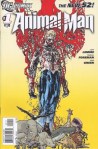
cover to Animal Man #1

Animal Man

Two of the most intriguing titles of the DC relaunch have been reinterpretations of classic Vertigo characters: Animal Man and Swamp Thing. Not only are the interesting on their own, but they are setting the stage for a shared story: While one hero is the avatar of The Green (or plant life), and the other is in touch with The Red (animal life), they are both at odds with the death-forces of “The Rot”.

One noteworthy thing about these series is how eager they seem to be to distance themselves from the old stories. In direct opposition to the classic Alan Moore status quo, this Swamp Thing starts with Alec Holland as a human, horrified by his memories of being the avatar of The Green. The first time he meets his old love Abby, she points a gun at him. Animal Man, meanwhile, undoes Buddy Baker’s alien-based origin story to make The Red into an elemental force like The Green. However, both still have a lot of obvious love for the classic stories, and there’s arguably nothing more that can be done with the characters without going back to basics here. Both titles have a history of author-mandated changes, anyway: The alterations being made to Swamp Thing now mirror the ones that Moore made when he began his stories, and the classic Animal Man run was a metatextual commentary on how the author can mold the character as desired. So really, I’m happy to judge these by their story quality.

That quality is very good. Jeff Lemire’s Animal Man had the best opening issue of any new DC title, managing to establish characters, explain the backstory (without boring readers who already knew it), and lead to the creepy shock that kickstarts this conflict with The Rot. Buddy Baker’s status as a family man is as important to the story as his powers, and the plot has combined those aspects in a way that brings out Animal Man’s strengths. Swamp Thing, meanwhile, is handled by hot new horror writer Scott Snyder, and he mixes in some tense pacing and genuinely disturbing moments with the introductions of the opening issues. A common theme is that the plant world is much more violent and destructive than we give it credit for, but it’s still easy to root for them against some evil agents of The Rot.

The art quality definitely separates the two of them, though. Swamp Thing has lush, beautiful art from Yanick Paquette. Expressive and often featuring creative page compositions, it is appropriate to both the human characters and the plant-based scenes. Animal Man, on the other hand, has sparse, dry artwork by Travel Foreman. The “everyday” scenes are bare and flat to the point of boredom, and sometimes the shapes of the people just feel unnatural. The weirder scenes, as Buddy goes into The Red or the evil “Hunters Three” shift bodies, are mixed. Sometimes they are appropriately strange and visceral, capturing the wet, meaty essence of animal spirits. Other times, though, those images seem incomplete and slightly off.

Animal Man is still worth reading on its own, and the connection to the excellent Swamp Thing makes it an obvious choice. I’ve found Foreman’s art to be more frustrating as the series goes on, but he is soon being replaced. Meanwhile, issues like #6 are a reminder that Lemire has plenty of tricks up his sleeve. Composed mostly of a scene from a movie that the hero starred in, it develops the series’ themes of family and responsibility from a different angle, while providing a respite from the impending doom of the main story. Swamp Thing, on the other hand, lets the doom build remorselessly, but it’s appropriate to the horror legacy of the character. These first six issues have featured a slightly standard introduction to the tale of a reluctant hero, but the scope and power of the threat have been shocking enough to make it feel new.

If you’re only going to read one of these series, it should be Swamp Thing. (In fact, if you’re choosing only one DC series to read at all, Swamp Thing would be a top contender.) Animal Man, though, is a very original twist to the standard superhero stories, and it seems that the connection between the two comics will strengthen them both.

Grades, based on issues #1-6:

Animal Man: B-

Swamp Thing: A-


Neal Stephenson – Anathem (Book Review)

Anathem cover

Neal Stephenson - Anathem

I gave up on Neal Stephenson sometime during his Baroque Cycle. That ponderous history tome took pages to explain some concepts, but other times assumed the audience was already familiar with the same things as Stephenson. After several years away, though, I’m very glad that I finally tried his novel Anathem. I can see how many readers would have issues with it similar to my problems with the Baroque Cycle, but I can also say that for the right people, this is a masterpiece.

Set in a world where scholarly types remain cloistered in systems that are half-convent and half-university, this features a complex and initially confusing culture. The book is filled with slightly awkward people who like nothing more than to learn and debate each other. (They even have a formal system of “Dialog” reminiscent of Socrates.) Much of the pleasure of the book, especially at the beginning, comes from geeky characters simply talking and going about their lives. This system is low-tech, but it’s still recognizably the place where our world’s computer programmers and philosophers would end up.

The religious and academic development of this world is very different from ours, but some ideas are familiar, with direct parallels for everything from the Holocaust to Occam’s Razor. Other concepts, such as Plato’s Theory of Forms, are twisted into something recognizable but different. There is a lot to learn, but the mix of the familiar and the unfamiliar makes it go smoothly. In such a setting, the hints found in the wordplay (“anathem”, for example, being a ritual that is both “anthem” and “anathema”) are helpful rather than cloying.

The book doesn’t intentionally hold things back; Despite some of the complaints I’ve heard, it starts describing things right away, and sets up situations (such as the once-per-decade festival in which the sheltered characters can mix with civilians) that are designed to explain the system to outsiders. There is a lot to learn, though, and the bulky 900 pages is just barely enough for the novel to cover all of its material. If that scares you away, then this is not for you. However, if you enjoy genre fiction, at least part of that is probably the joy of understanding new worlds. Anathem is just an especially heady version of that experience. I think a large part of the reason that this worked for me where the Baroque Cycle failed is that Stephenson couldn’t make assumptions about which parts of this world I already knew. He (eventually) had to explain everything the reader was supposed to appreciate.

Stephenson’s flaws are still evident, but he has found a perfect vehicle for them. If the characters are sometimes simplistic, it helps that they are various types of nerds safe in a culture devoted to abstract learning. The multi-page lessons for the reader are easier to swallow in dialog format. And if obscure topics that come up in passing always become vital later on, at least the epic length of the story gives them a chance to develop naturally. Happily, at least one of Stephenson’s weak points has been addressed, as this is his first novel to feature a satisfying ending.

I can’t really say much about the plot. In my mind, avoiding spoilers means that I shouldn’t talk about the things that come up after the reader has put effort into the book, and in this case, that covers at least 80% of the story. Suffice to say that Anathem begins with a simple world seen through the eyes of youth, but quickly grows to encompass mysteries and political intrigue. It gets exciting, too: despite Stephenson’s reputation for long, dense books, he has a gift for page-turning adventure. The scope is way beyond what might be expected from the closed society of the early chapters, and by the end, the novel has developed themes even bolder than the fascinating culture it started with. The changes aren’t always welcome at the time, as I felt that I could have stayed immersed in the narrator’s initial boyhood innocence forever. But that, too, worked to the novel’s advantage, because I felt the same nostalgia he did as the situation became progressively stranger. Also, the alternate world isn’t just a clever gimmick. By the end of the story, its quirks have been justified, and it becomes clear that the differences from our reality were all in service to the story and Stephenson’s ideas.

The worst thing I can say about a novel is that only some people will consider it a work of genius. Rich and complex, taking full advantage of its 900-page length to make very foreign systems come alive, Stephenson has mixed his love of geek culture and appreciation for history into his first alternate world. It’s the sort that most writers would spend a lifetime trying to create.

Grade: A-


New DC Comics, Part 3 – The Unexpected Titles

DC’s comics are based on superheroes, but the fifty-two relaunched titles allow a lot of room to experiment. Here are three of the series that go furthest beyond the standard expectations of a DC story. Don’t expect realism, romance, or anything too different, of course, but these show that there is some territory at a major comics company beyond men in tights punching each other.

Continue reading

Slim Cessna’s Auto Club – Unentitled (Music Review)

Unentitled cover

Slim Cessna's Auto Club - Unentitled

The gothic Americana of Slim Cessna’s Auto Club seems to be both authentic and an affectation. Intelligent, literate, and often unforgiving of the simple country characters who populate their songs, the lyrics nonetheless have an honesty that could only come from living the lives they deconstruct. Cessna’s adenoidal voice has a great range, but is not easy for country music fans to embrace. Like their previous releases, Unentitled will find devoted fans and rabid haters.

There are haunting, almost baroque ideas throughout. In Cessna’s world, problems with childbirth are a source of family shame, folksingers are ritually castrated, and finding the right dog to guard your property can become a consuming, self-destructive quest. The song quality varies widely, though. For example, “Three Bloodhounds, Two Shepherds, One Fila Brasileiro,” that song about finding the right dog, has little to offer on repeated listens. “United Brethren,” on the other hand, stays interesting due to its simple style and guilt-ridden vocals (in this story, the townspeople convert between Christian denominations in hopes of ending a drought). “The Unballed Ballad of the New Folksinger” has a menacing air appropriate to a song about castration, but “Thy Will Be Done” is simply monotonous and plodding. On balance, fortunately, there are more good moments than bad: Whispered chants of “dig the pit, fill the pit” and a militaristic call-and-response of “do you know the enemy?/yes we know it truthfully” provide the hooks for a band that refuses to simply make catchy music.

The gem of Unentitled is “Hallelujah Anyway”, a seven-minute story about a corrupt town leader demanding grandchildren, even though their birth would mean his daughter’s death. Told by the hapless fool who is being pressured to father a child, it takes on an air of impending tragedy. “Hallelujah Anyway” has scene changes, singers for the multiple characters, and an uncomfortably vague moral lesson.

Unentitled is worth hearing, though it demands effort of the audience before it can be appreciated. Its chief failing is that not all songs continue to reward that attention after the initial listen, but the ones that do provide an experience that no other band can offer. Not everyone will love Slim Cessna’s Auto Club, but everyone should have an opinion on them.

Grade: B-


Lev Grossman – The Magicians (Book Review)

“Magic, Quentin discovered, wasn’t romantic at all. It was grim and repetitive and deceptive. And he worked his ass off and became very good at it.”

The Magicians cover

Lev Grossman - The Magicians

Lev Grossman’s The Magicians is a deconstructionist, more realistic take on the tropes of Harry Potter and Narnia. Magic is dangerous and mysterious, and the faux-Latin wand-waving is replaced by borderline autistic kids in a boring, demanding school. However, The Magicians isn’t just designed to make Harry Potter seem ridiculous. It’s a complex, exciting story in its own right, and while it’s aimed at an audience tired of fantasy clichés, what it offers in the end is still a fantasy tale.

What Grossman does right, he does very right. The world of magic feels consistent and thought-through in a way that Harry Potter, with its arbitrary spells and inconsistencies, never approaches. Magic is a dangerous, unknown force, and if the school’s body count is low, that’s only because the students are studying for tests instead of fighting dark lords. The fundamentals of magic are still undefined, though; The Magicians wins the reader’s acceptance partly by being more glib than other stories. Where Harry Potter spent hundreds of pages on each school year, The Magicians covers Quentin’s entire young adulthood in the stretch of one book. Many elements do feel like they would fall apart on closer examination (such as the workings of the wider magical community), and a few items (like the Quidditch equivalent) are unnecessary additions just to draw parallels to Harry Potter.

I’d hate to think that the only way to make good adult fantasy seem consistent is with Grossman’s fast pace and lack of details. In this case, at least, it works because we want to see the passage of time. The Magicians is a strong character-based book, and Quentin and his friends evolve considerably over the years. The writing doesn’t dwell on this, but the characters do change slowly but noticeably, and believably, as they age. Once the world and plot are established, Grossman often uses a single scene to stand in for an entire stretch of months or even a year. That one scene will have the detail needed both to paint a picture of the characters’ current lives and to give some assurance that the magical system is rich and consistent, even if the reader can’t stop to learn everything.

The Magicians is an exploration of aimless young adulthood. Magic is tempting, but it doesn’t automatically give meaning to life, and the power it offers can be a dangerous distraction from the concerns that keep mundane people grounded. Just as in real life, these people need to find their own way, and the latter part of the book actually becomes laugh-out-loud funny when the more stubborn believers in fairy tales try to live to those expectations. The most common criticism of this book is that the characters are whiny and unlikeable, though I always found them to be so believable that that wasn’t a concern. The conclusion offers some resolution to this, but is also a little frustrating: There are at least three scenes that feel like the set-up to a final status quo, and every one is suddenly reversed by the next. The actual ending feels a little arbitrary, as it’s the least satisfying and the best for a sequel, but at least it promises that the sequel will be a very different story. Quentin grows up more over the course of this book than Harry Potter does in seven, and that’s a great argument for why his story should be allowed to continue.

Grade: B+

New DC Comics, Part 2 – Keeping the Backstory

While most of the new DC titles tried to be “new reader friendly”, they definitely approached it in different ways. A few seemed to ignore the concept entirely, and just slapped a “#1” label on top of a story that had been going on for some time now. I’m told the most obvious example was the Green Lantern titles, but I haven’t been reading those. Here are the three series I am reading that would be challenging for a new reader to start with. Ironically, two of them were new to me with this relaunch.

Continue reading

Black Lips – Arabia Mountain (Music Review)

Arabia Mountain cover

Black Lips - Arabia Mountain

Forget people like Kurt Vile; garage rock may be the true heir to 90’s slacker scene. The lo-fi sound and unassuming production make for an exciting contrast with the craft that the best performers bring. Black Lips may not sound anything like Pavement or Sonic Youth, but they invoke the same impression of being both your stoner friends and musical geniuses.

The breadth of sound on Black Lips’ Arabia Mountain is impressive. The gentle introduction to “The Lie” recalls “Stairway To Heaven” more than the demon god that the song is about, and “Time” has the freewheeling poppiness of a subversive Beach Boys. “Dumpster Dive” begins in a sloppy garage-folk style, but throws in piano flairs once the band starts rocking out. “Bone Marrow” is a post-breakup pep talk driven by clapping hands and heavily reverbed drums. They pull from all elements of rock tradition, from classic pop to modern metal and even to the creepy lounge music of “Noc-A-Homa”.

The aren’t limited by any concern for accuracy: A song about how Spider-Man “kills them dead” is followed by one celebrating the satanic messages hidden in rock music. However, their subject matter varies widely, with no theme (from women to drugs to everyday life) coming up enough to wear out its welcome. Each song has something to say – not always anything sophisticated, but none are a waste of time either.

Generally, though, the songs start out at their most creative and all veer towards the same territory by the middle: Chanting out enthusiastic but flat vocals along with music which tries to match the singer’s cadence with a surprising simplicity. At times, they could practically be a satire of spastic high schoolers unsure how to write songs. Fortunately, this sound is more of a home base for the band than a crutch. They circle around that simple territory, but always return to whatever specific style they are playing with at the moment – and their ability to write complex songs is evident, if obscured.

With sixteen tracks, it’s impressive that the band never seems to repeat themselves. They also avoid any missteps, with the possible exception of the slower space rock of “You Keep On Running”. Arabia Mountain is a fun journey through the possibilities offered by garage rock. If no individual song seems to contain enough promise for a full career, the overall effect is much more satisfying.

Grade: B


New DC Comics, Part 1

We’re now entering into the sixth month of DC’s relaunched universe, and the situation looks similar to what the first month promised: Plenty of bad titles, but also quite a few good ones, with several unusual series that would never have gotten a fair chance under normal circumstances. At this point, I think that there have been a few more disappointments than I expected, but the DC Universe still seems healthier and more promising than it did beforehand.

These series are now mature enough to be harsh reality to set in. It seems that only about half of them still have the same creative team that they started with, and DC has already announced the first six cancellations. But the most cynical predictions haven’t been borne out: The customer base is still supporting more monthly titles than DC had before, and every title has stayed on schedule. The matter of scheduling has been one of the bigger surprises, actually. DC and Marvel have both been notorious for delays in recent years, but since the relaunch, DC has been quick to swap out creators or provide fill-ins where necessary. It sometimes hurts the quality, but it maintains the thrill of a monthly story, and is probably part of a strategy to keep new readers who aren’t committed enough to follow favorite creators through inconsistent schedules.

I’ve tried out twenty-two of the fifty-two series, though that number is dropping heavily now that I’ve seen what I like. My plan is to review all twenty-two of those this month. To start with, here are four basic superhero titles that reached a good conclusion with issue #5, so I’m ready to review them before #6 arrives in the upcoming weeks.

Continue reading

David Anthony Durham – Sacred Band (Book Review)

Sacred Band cover

David Anthony Durham - Sacred Band

David Anthony Durham’s Acacia was wordy and awkwardly paced, but raised unusually nuanced moral questions for a fantasy story. The sequel, The Other Lands, lost sight of the moral topics but made up for it with tighter writing. While Sacred Band doesn’t fully live up to the potential of either, it makes use of both books’ strengths to provide the most satisfying volume of the trilogy.

Picking up immediately where the second novel left off, this could easily have been the latter half of one big book. War is looming, and the Acacian royal siblings are scattered around the world dealing with their own problems. The question isn’t just whether the “good guys” will win, but what the world will look like after they do. Their family has been responsible for too many atrocities for the reader to simply accept their victory as a happy ending, and all the siblings have different visions of how, or if, they should change that legacy.

These ethical questions aren’t always subtle, but they do fit in the story very naturally. Meanwhile, Durham includes a few too many subplots and is drawn to fantasy clichés, but he writes with a fluidity that makes this rise above most earnest high fantasy. Sacred Band’s biggest strength, though, is in drawing on the previous books in the trilogy. Though sometimes messy and inconsistent, they built up a strong emotional core, and this final novel isn’t afraid to cash in on everything that they set up. Almost every plot thread from the series is tied up in a way that feels both satisfying to the reader and well-earned for the character.

Durham has strong ideas and solid writing. I do hope that for his next novel, he sets his sights higher than princes, princesses, and dragons, and keeps the focus on the more original parts of his vision. However, the Acacia trilogy was an enjoyable read wrapped up in a satisfying way, and I don’t want to sound too hard on the current book. Where Sacred Band is flawed, it’s highlighting the marked improvements its author has already made in the course of a few years, and when it’s at its best, it provides some unique thrills for high fantasy.

Grade: B