Gods Behaving Badly (Book Review)

Gods Behaving Badly cover

Gods Behaving Badly

Obsolete gods withering away after their time has passed; It’s a well-worn idea in fantasy literature. In Gods Behaving Badly, though, Marie Phillips gets some mileage out of this concept by putting the Greek gods in modern London. The broad strokes of the plot feel like they could easily fit in with the classic myths if not for their new setting. However, the original myths rarely went into details about the petty bickering and foolish mistakes that typified these characters. By fleshing out those particulars, as well as devoting half of the time to the humans’ side of the story, we get a very different view of the Greek gods.

Phillips can write in a laugh-out-loud, Douglas Adams-esque style when she wants. See the first chapter (in which Artemis talks to a mortal recently turned into a tree) for the best example. However, this isn’t her default mode. Instead, she plays most of the book straight, allowing the epic powers, juvenile sulking, and casual incest to give the story an absurdist air.

The result is a fun, light read. It doesn’t always work if you stop to think about it too much (despite the gods’ waning powers, it’s difficult to believe that they couldn’t have gotten better jobs and avoided some of the traps they find themselves in), but it’s easy not to overthink it. After all, this is the story of Aphrodite making Apollo fall in love with their housekeeper to avenge a minor insult. It’s not designed for deep thought.

That said, Phillips does a great job in portraying their views and motivations. The gods are immortal, but bored and lazy, and have lost most of what they believe is their due. While they aren’t necessarily vengeful, normal people matter to them about as much as a plant would to us. The novel gets inside their heads and actually justifies this boredom and self-importance by showing us how differently they react to normal situations. In one memorable scene, Artemis considers what she would do if she “only” had another century to live. Faced with such an immediate fate, she realizes that she would move out of the dysfunctional family house. With the timescales they think in, it’s hard to believe that human lives matter. Also of note, repeated sex scenes with Apollo and Aphrodite start out interesting, but eventually demonstrate how anything can become mundane and pointless after millennia. The chapters that focus on the human characters are a more straightforward, cute love story, but the contrast shows the gulf that exists between the mortals and immortals.

There are still some frustrating aspects that took me out of the book. Much of the plot hinges on the repeated inability of intelligent people to recognize the Greek gods even when all the evidence is right in front of them. Then at the end, the resolution to the conflict is based on something that is so fundamental to this sort of story that it felt unfair to have the characters come up with it thousands of years late. Whether your frame of reference for fantasy is more Pratchett, Gaiman, or Eddings, this is something that will occur to you long before it occurs to the gods whose existence depends on it. That marred an otherwise solid portrayal of unusual characters.

Gods Behaving Badly provides a fun, subtly humorous story that makes the Greek gods into more robust characters. The story is sympathetic overall, but be warned that the obscenity and casual cruelty that mark the original myths are not glossed over. It’s necessary to overlook some flaws at times and let the novel dictate the terms of the story, especially at the end. But despite all that, Phillips is a strong character writer, and makes the journey worthwhile.

Grade: B-

Bob Wayne – Outlaw Carnie (Music Review)

Outlaw Carnie cover

Bob Wayne – Outlaw Carnie

One of the big debates in modern underground country is whether the “outlaw” style revitalized by Hank III has run its course. If you aren’t tired of it yet, then check out Bob Wayne’s Outlaw Carnie album. It may very well be the one that pushes you over the edge.

That’s not to say you won’t enjoy it. A lot of the songs on this album are simple fun, with a real understanding of how to strip a story down to the bare essence of music and lyrics. Wayne’s songwriting is outstanding. But the life depicted here seems almost like a parody of outlaw country: Drinking, fighting, robbing banks, and shooting the cheaters at the card table. Even the songs that start out with some vulnerability are feints, such as the lament about a cheating woman that turns into a claim that he won by cheating on her more. The music is similarly over the top, clearly showing Wayne’s metal roots. Though their country performance is serious, the unsubtle, loud music is at least as far from the country styles of a generation ago as modern pop country is.

The songs are a little better individually than they are as a whole. Apparently Wayne’s vision of a country outlaw involves stubbornly giving himself the victory in almost every story. Whether bragging that his band will back him up in any fight, somehow winning a blind five-against-one gunfight, or even having the ghost of Johnny Cash literally come down from the sky to save him, Wayne doesn’t seem aware of the power of songs about loss. Just look at “Mack”, the story of a “truck-drivin’, gun totin’, meth snorting, blue collar, true American hero”. Wayne never explains what makes this murderous drug smuggler a hero, other than the fact that he’s the protagonist of the song, and that the dealer he kills happens to be worse.

You would never guess much about the real Wayne – a recovering addict who has had experience fighting off demons – from the mask he puts on here. Only “Driven By Demons” shows how a song can be rowdy and rebellious while still acknowledging the cost of that lifestyle. I’m not saying that every one needs to end with the narrator paying a price, but a few more like that would have made the album feel a lot more fleshed out.

Wayne lets the bravado slip for a single song, “Blood to Dust,” which has the most fascinating story and is apparently true. Despite some amateur lyrics (“I was born in 1977, the year that Elvis died and went to Heaven”), it builds up to one of the best country music refrains of the past few years:

They say some things in our lives are best forgotten,

I say those are things that make you who you are.

So be proud of what you got, and where you come from,

‘Cause from blood to dust well it ain’t very far.

This would be a standout track on almost any album.

But for every bright point, Outlaw Carnie has something to counter it. “2012” is an embarrassing spoken-word album closer, mixing junk science with bigotry to argue that an apocalypse would be a blessing. (Did you know the fact that “them Muslims, they’re all multiplying” is one of the reasons that we’d all be better off dead?)

Outlaw Country is an incredibly uneven work. Bob Wayne can write excellent and incisive lyrics, but has no vision for combining them into a cohesive whole. When the quality keeps up for an entire song, the results are great. At his worst, though, he manages to bring down the good songs by association. I enjoy a lot of this, but don’t have much desire to listen to to half of the songs on it any more. It will be fascinating to see how Wayne grows as an artist from here. At least, I sincerely hope that he grows.

Grade: C+

Steve Earle – I’ll Never Get Out of This World Alive (Music Review)

I'll Never Get Out of This World Alive cover

Steve Earle - I'll Never Get Out of This World Alive

“Was a time I would of said them days was gone, but I’m givin’ it another whirl”, sings Steve Earle at the opening of I’ll Never Get Out of This World Alive. And he is – this album is a return to form for a singer-songwriter who has been frustratingly unfocused of late. The sticker on the CD cover emphasizes this, announcing it as the “first album of new songs in four years”, glossing over the recent live and cover albums. (You’d need to go back seven years, to The Revolution Starts Now, to find his last truly good album.)

As is tradition for Earle, that title track is one of the album standouts and sets the theme for the songs that follow. In this case, “Waitin’ On The Sky” is a personal look back on his life, and introduces a collection of songs loosely about mortality and endings. This is a turn from the more overtly political songs that made up his strongest output in the past decade. Earle only approaches politics in a couple songs: “The Gulf of Mexico” portrays the recent oil spill through the eyes of blue-collar oil workers who know no other way of life, and “God Is God” explains that only a fool would claim to speak for God or know His intent. They seem perfectly harmless and self-evident, but it’s part of Earle’s genius that he can make the claims he does in the conservative language of traditional songs. Most songwriters would have stumbled horribly when hinting at the way large corporations destroy traditions or implying that God is distant from our daily life.

Those political songs are few, though, and the everyman folksiness pervades the entire album. Earle is a countrified version of Springsteen, with a raspy, blues-infused edge that producer T. Bone Burnett brings to the surface here. As a reassuring, traditional Steve Earle album, the review could easily be lifted from one of his past albums: Murder ballad “Molly-O” is an original, but sounds like it must have been a traditional song that was somehow overlooked before. The storytelling songs (“I Am A Wanderer” and “Lonely Are The Free”, along with the opener) showcase Earle’s strengths, while the love songs (like “Every Part Of Me”) are decent but never the highlights. The expected male-female duet, “Heaven or Hell”, is a little weaker than normal – the song needs a little more emotion to sell the claim “I just can’t tell [if] this kinda love comes from Heaven or Hell”. Then there is a half-successful experiment, in this case “Meet Me In the Alleyway”. It’s got a great sound reminiscent of Tom Waits doing Louisiana blues, but its story about dark New Orleans magic is uninteresting.

No songs are bad, though, and every one feels like it has a place on this album. The lesser ones only earn that description next to the frankly stunning standouts. Don’t worry about Steve Earle’s recent missteps; After a 25-year career, I’ll Never Get Out of This World Alive still sounds like the work of a musician in his prime.

Grade: B+

Webcomics Roundup: Complete Stories

New webcomics are exciting, of course. But there’s a certain appeal to completed ones, too. An entire story is waiting for you to read it at any pace you like! Besides, it can be reassuring in a way to know that the artist was confident enough to bring their story to an end instead of dragging it on until everyone lost interest. For that reason, this article is going to focus on three notable webcomics that completed recently. The entire archives are there to read, and for free, giving you something to do while you wait for their new series to start up.

(I know, it’s been several months since my last “monthly” webcomics article. I’ll catch up on some new comics next month.)

Below the fold, Bobwhite, Great, and FreakAngels

Continue reading

The Heavens of Olympus (Game Review)

“Zeus has decided that he wants to construct a universe.” I hope you don’t need theme, because that’s about as much as The Heavens of Olympus ever provides. Over the course of five days (marked by the phases of the moon, for some reason), players are charged with placing planets in the sky in order to form constellations. (Yes, these constellations are made of planets.) Points are rewarded based on the fact that Zeus craves variety. In other words, the game’s rules have nothing to do with either actual cosmology or Greek myth.

The game mechanics themselves aren’t bad, though. This, the first published game by designer Mike Compton, is a fairly abstract game about placing markers on a crowded board for points. Players select actions by playing cards simultaneously, and there are rewards for choosing different actions than anyone else. Conflicting rules offer points for forming constellations within the pie-shaped regions of the board, but also for majority control of the circular orbits that cross regions. It makes for a nice variety of choices, especially since players will also need to earn “power” (generally by playing to new regions) in order to create and place planets. The system is set up so that power will be hard to maintain by the end of the game, forcing players to struggle and do (minor) calculations to play effectively. Because they’ll also need to keep the strength of their “torch” high enough to light the planets during scoring, there are a decent number of factors to track. Combined with a simple but effective catch-up mechanism that makes the player in the lead pay higher costs, this is a decent design for a medium-light game.

In my plays, the game board was a little too busy and difficult to follow with five players, but it was decent with fewer. I’m not sure whether five is simply too many for this game, or whether better graphic design could have saved it.

Unfortunately, the idea that better design was needed comes up regularly while discussing this game. I suspect that, with dedicated professionals working on The Heavens of Olympus from start to finish, it could have been a decent, if unspectacular, game. Probably a B-, maybe a C+ if the five-player gameplay still didn’t pan out. But in its current form, almost every aspect of it is cheap and shoddily made:

  • As already discussed, the game’s theme seems to have been thrown together in five minutes. If nothing else, it would have been less insulting if the game had simply called the planets “stars” (since they light up and form constellations) and said that a cycle of the moon is one month rather than one day.
  • Along with making the five-player board easier to read, a little more consideration could have streamlined the rules that require two different first player markers to move around the table, and to help people remember each phase of the game (such as the “extra night” that occurs at the start, and the torch reduction that occurs at the start of each new day).
  • The colors of the planet markers don’t match the colors of the other player tokens at all. (And the cards that are used to select actions match neither.) Expect some mistakes.
  • The marker that displays the strength of a player’s “torch” is supposed to be placed one position higher than the actual value. The idea is that since the marker covers a number, the player’s strength is the highest value still visible. This is a confusing, non-standard rule; The same board has a scoring track, on which markers cover the player’s current score without confusion. If this was a real problem, then the publisher should have provided disks that show the number underneath.
  • The box is long and thin, similar to Monopoly dimensions, rather than the taller but more compact format that is commonly preferred today. The pieces were not designed for that box size, and the board slides around banging into the sides.
  • Similarly, the plastic insert within the box was obviously not made for this game. That’s become a common money-saving shortcut for Rio Grande, but it’s especially egregious in this case. The space for holding cards is too small to hold the ones that come with this game! Was the production so rushed that no one noticed this, or did they really care that little about the game’s quality?

Some of these flaws make the game a little more confusing and slower to play. Others are just aesthetic, but definitely impact the overall experience of the game. At conventions, I’ve sometimes talked to small publishers who were obviously a little embarrassed by the quality of the finished product they could deliver. Given their lower budgets and smaller audience, it is often possible to overlook a few flaws in order to find an undiscovered gem. But in this case, Rio Grande is one of the largest game publishers in America. That they would attach their name to such a amateur production is frankly an embarrassment for them, and a little insulting to me as a member of their intended audience. I wonder whether this is a one-time mistake, or a sign of shift in strategy for a company that should know better.

Grade: D

Enter The Haggis – Gutter Anthems (Music Review)

Gutter Anthems cover

Enter The Haggis - Gutter Anthems

Perhaps it was unfair of me to introduce myself to Enter The Haggis at the same time that I was listening to the Dropkick Murphys’ latest album. Though the band isn’t bad, there is a reason that they have such a small fanbase compared to the Murphys. On the other hand, it might be unfair to make that comparison at all: They may both be American bands with Irish influences, but while the Dropkick Murphys combined that with blue-collar punk, Enter The Haggis dabbles in more straightforward pop.

That’s not to say that the Irish-punk movement has passed by the band completely. Gutter Anthem’s first song (after the instrumental opener) is a hard-rocking ode to alcohol and overindulgence. But, while it’s a good song, it just doesn’t sound natural coming from lead singer Brian Buchanan. His declaration that “we’ll sing a gutter anthem till the day we die!” sounds less like honest self-destruction and more like the stubborn partying of a fresh-faced student who knows that once the hangover subsides, he’ll need to start studying for those finals. The band sounds much more natural singing earnest pop songs about the importance of raising children right (“DNA”) or the way people need to face up to their responsibilities (“Real Life/Alibis”).

That’s not to say that any of the songs are bad. In fact, most of them are well-written. It’s just that the more rocking tracks sound like play-acting (The liner notes for “Noseworthy and Piercy” actually take the time to inform us that 19th-century fishermen had dangerous lives, in case anyone doesn’t understand that from the song), and the poppier ones feel somewhat mundane. The band deserves a small, devoted following, probably near a college somewhere, but it’s only the popularity of Irish fusion that has brought them to national attention. (Also, those aforementioned liner notes do help. Not all of them are necessary, but when they explain inside jokes or tie into the songwriter’s life, I’m sure it helps to turn casual listeners into fans.)

Gutter Anthems also features three instrumentals that testify to the band’s composition and performance skills. Two of them are too short to work as more than glue for the album, but “Murphy’s Ashes” shows how interesting Enter The Haggis can be. Adapting a band-member’s industrial experiment into a legitimate-sounding Irish instrumental was a bold and tricky move, but it turns out that the bagpipes make an effective replacement for synthesizers. It shows that while the band may need some more time to figure out what kind of music they do best, they definitely have the skill to write interesting songs if they figure that out.

Grade: C+

Marvel Comic Capsule Reviews

It’s been a few months since my last round of comic book capsule reviews, and there are several more miniseries and new titles that I’m ready to discuss. This one will focus on some recent Marvel comics, since none of my new independent comics are far enough along for a review. (DC comics is currently in the process of winding all its titles down, rather than starting new ones up. I plan to look back at some of these soon, once their big reboot happens.)

It’s interesting to see Marvel branching out more and more from superheroes. In addition to four new superhero series, this article takes a look at two new titles in the Crossgen line.

Continue reading

Embassytown (Book Review)

Embassytown cover

Embassytown

China Miéville is a restless author who resists being pigeonholed from book to book. The one constant element, though, is his love for unexpected and truly unusual ideas. From that perspective, Embassytown is on the same end of the spectrum as The City and The City, having just a couple new ideas that are worth taking the entire book to develop. Embassytown probably doesn’t have the crossover potential of The City and The City, though. While that new book was structured as a more easily-accessible police procedural, this new one is unashamedly science fiction.

In a way, it’s disappointing to see Miéville work in a traditional science fiction space. His irreverent experimentation sent shockwaves through the fantasy community a decade ago, but it seems perfectly normal on the SF side of the fence. However, this is the story of humans figuring out a strange alien race, and that subgenre plays perfectly to Miéville’s strengths.

The titular Embassytown is a human settlement on a planet populated by the Ariekei, an alien race whose language requires one to make sounds out of two mouths at once. It only sounds right to them if a single being is making both sets of sounds, so they simply can’t comprehend speech coming from a machine or from two humans working together. The human settlement can only communicate through “Ambassadors”, pairs of people whose brains have been altered to give them such a strong connection to each other that the Ariekei accept them as a single being.

The premise sounds hard to accept, like one of the minor races that a typical space opera would just mention in passing. In Embassytown, though, this concept is explained and expanded upon so carefully that it becomes meaty enough for an entire book. There are a number of interesting quirks to this system, of course. The Ambassadors’ lives and positions within society are important (as is the way this colony planet relates back to its parent empire – Miéville’s books always involve some cynical politics).The Ariekei, meanwhile, are born with an innate knowledge of their “Language”, but are unable to comprehend that any other forms of communication exist. The Language is so fundamental to them that they aren’t even able to lie, and the fact that humans can speak untruths is fascinating to them. To even use something as abstract as a simile, the Ariekei need to create that simile in real life. For this reason, the narrator of the book once took place in a carefully-orchestrated ceremony to become “the girl who ate what was given to her”. The narrator, Alice Cho, is unable to speak Ariekei Language despite being a part of it, and has no understanding of what meaning she now has in their alien minds.

All of this, with culture, the mysteries of alien language, and a little bit about space travel through the futuristic empire, makes the first half of the book fascinating. Mysteries slowly start to unravel, though human understanding remains imperfect. For a time, it seems like it may be one of Miéville’s most fascinating and original works yet. However, the novel’s real conflict becomes clear about halfway through, and these mysteries are all put aside in favor of simple survival. Miéville does not write about fear, crisis, and war as convincingly as he brings strange ideas to life, so even as both the human and alien civilizations begin to collapse, the danger feels abstract to the reader. It’s not an uncommon problem for Miéville – his strengths lie in the way he can build up worlds for us, but he personally is more interested in tearing them down – but it is more obvious in this book than in most, since the particular crisis the characters face makes it impossible to keep learning more about the fascinating Ariekei and their Language.

Fortunately, it all does come together again in the final chapters of the book, with the ideas that had been building at the beginning providing the answers at the end. Embassytown may have the tightest and most satisfying conclusion of any Miéville book yet, which should be a very reassuring sign to his fans.

That dragging section in the latter half of the novel is significant, but it really is the only fault in what would otherwise be one of the best science fiction works of recent years. With its original, weird, but still well-justified ideas, Embassytown is well worth experiencing.

Grade: B

State of the Blog

Hi everyone. I know that this blog hasn’t been updating as regularly over the past couple months, but don’t worry. This won’t be a permanent thing, and I have a very good excuse: I got married.

Life has been pretty crazy lately, and most other things (especially reading books, and even more so writing about anything) have been put on the back-burner. But I intend to get back to a regular posting schedule soon. I have a huge backlog of half-written reviews in my head, and I’ll go crazy if I don’t get around to it soon.

I’m halfway through my 2-week honeymoon right now. When I return, I’ll have a 3-day weekend at home before returning to work, and I definitely intend to write then.

(By the way, I don’t normally write reviews of events. But if I did, my wedding and reception would have easily earned an A.)

Dropkick Murphys – Going Out In Style (Music Review)

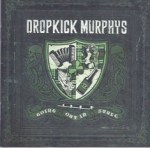
Going Out In Style cover

Dropkick Murphys - Going Out In Style

Don’t let the Dropkick Murphys fool you. Though they named their latest album Going Out In Style, they have no plan to disband anytime soon. They’re an institution now, so much so that their Wikipedia page needs a chart to record the members who have come and gone over the years, and they know exactly how to please their fans with every new album. (It helps that they wait a few years between each release, so there’s never a glut of Murphys music.)

That’s not to say that the Dropkick Murphys sound exactly the same from year to year. Interestingly, Going Out In Style is possibly the Irish punk band’s hardest album yet, but the standard punk signifiers are almost missing. Bagpipes and flutes, which used to appear sporadically for flavor, are now as prominent as the guitars, and a new listener could easily interpret this as an especially raucous Irish band.

Despite this change, the band’s strength is still in how naturally they connect Irish and punk culture. The wild party in Going Out In Style’s title track is a punker’s dream, but the specifics draw from hard-drinking Irish culture. “Sunday Hardcore Matinee” is about going to concerts as a kid, but describes punk shows as a character-building experience that their community-oriented fanbase will embrace. And of course, the Murphys’ rocking renditions of traditional songs (here “Peg of My Heart” and “The Irish Rover”) still sound like they should have been the definitive versions of the songs all along.

Even more than the Irish elements, the thing that really sets the Dropkick Murphys apart from other punk bands is their perspective as mature adults. It’s a traditionally youthful genre, but they manage to sound perfectly natural looking back at a hard-fought life (“Cruel”) or giving life lessons to those around them (“Deeds Not Words”). This element features even more strongly than normal here, with Going Out In Style being billed as a tribute to a (fictional) 78-year-old veteran and longshoreman named Connie Larkin.

In short, the Dropkick Murphys have once again released one of the best legitimate punk albums of the year, while also writing songs that will appeal to a lot of people who would normally even never give punk music a chance.

Grade: A-