Archive for 2011

Interactive Fiction Competition: Fan Interference, Cana According To Micah, and Last Day of Summer

The results are in for the 2011 IFComp. Below the fold, I have my final three reviews for games that I played. But first, a few comments on the competition as a whole:

  • I played 11 of the 38 games, and chose them randomly so there would be no selection bias when I submitted my votes. Of these 11, I only played 2 games in the top third and 3 in the bottom. Apparently, I ended up with a lot of the average games.
  • I suspect that I was grading slightly too kindly, and that seems confirmed now that I see how many high-rated games I missed. I am staying consistent with my scoring for the reviews here, but will probably be slightly harsher next year. My normal standard for giving something a B is “would I recommend this?”, which works well for books and CDs, but may be a little too low a bar for a free half-hour game.
  • Though my scores may have been a little too generous, I see that 9 of my reviews were pretty close to the universal consensus, but I liked 2 of them much better than most people. I stand by those, though: Blind was a surprisingly immersive and tense experience, and The Guardian was a strange but successful experiment in “interactive” storytelling. It’s possible that my years away from the IF scene made those seem more creative to me than they actually were, but that’s the only possible argument I can come up with.
  • I’ll definitely be playing again next year. It was fun, and I was pleasantly surprised to see that about half of the games are now designed to be completed in well under the 2-hour time limit. That will make it easier for me to commit to.

My previous reviews can be found here, here, here, and here. Now, on to three puzzle-based games: Fan Interference, Cana According To Micah, and Last Day of Summer.

Continue reading

EMA – Past Life Martyred Saints (Music Review)

Past Life Martyred Saints cover

EMA - Past Life Martyred Saints

EMA’s music exists in a territory somewhere between songs and performance pieces. The music is generally repetitive grinding or droning, creating a shapeless platform for her lost-sounding voice and frequent non-sequiturs, and the recordings lose quite a bit by not being able to show her dream-like but charismatic performance. Despite that, though, the tracks work well as individual songs, with meaning and cohesion that distances them from most of the lo-fi artsy experiments that it could be compared to. It’s rare for music like this to win me over, but her release Past Life Martyred Saints managed to do it.

An edgy energy flows through the performance. Usually it’s in the amusical instrumentation or angstful lyrics, but it feels perfectly natural on the occasions when an angry noise breaks through the calm surface. These fit naturally into a complex persona that makes the occasional vague, boring stretch forgivable. Those stretches do exist, unfortunately, but they don’t define the album.

EMA is still young, and still clearly recalls the teen angst she sings about: The brutal “Butterfly Knife” is an unapologetic story of self-mutilation (“You were a goth in high school/You cut and fucked your arms up… 20 kisses with a butterfly knife”), and “Marked” portrays her as a hollow soul (“My arms they are a see-through plastic”) craving dangerous validation (“I wish that every time he touched me left a mark”). In some ways, Past Life Martyred Saints feels a little like a college art thesis that managed to take on a life of its own. It has that exuberant but sometimes-unfinished quality that can be embarrassing ten years later, and hopefully the success she found here won’t stop her from the experimentation and development that should still be in front of her.

Past Life Martyred Saints covers everything from Stephen Foster references to off-key acapella. It is bookended by two songs over six minutes long: “Grey Ship” and “Red Star”. The former sets the tone by wandering between breathy folk and electronic drone, while the latter closes the album with a more traditional song structure. The triumphant conclusion finds her with the mature conviction to leave a man who’s no good for her. Whether or not those two songs are meant to thematically define the album, there’s no doubt that it covers a lot of ground and hints at further development in the future. EMA is an artist to watch.

Grade: B


Interactive Fiction Competition: It And The Guardian

(Though the IFComp ends today, I’m still catching up on my reviews. Here are my impressions of It and The Guardian, with a few more to follow later this week.)

Despite the name “interactive fiction”, most works are first and foremost puzzle-based games. Does this limit its literary potential? About a decade back, there was a movement to create “puzzleless IF” that would let the characters and plot come to the forefront. I remember those attempts as unsuccessful, though; interacting through a text parser naturally leads to situations that need to be figured out, and without a focus on puzzles, it was easier to notice the ways that the computer system didn’t completely model reality.

Coming back after a few years away from IF, I’m pleasantly surprised with how far a plot-based focus and puzzleless approaches have come along. Some of the games that I already looked at (The Play and Keepsake) are about living through a simple story, with the only puzzle being the metagame of figuring out how the story can be changed on subsequent playthroughs. Here, I look at two more works that certainly don’t adhere to a pure puzzleless approach, but keep the puzzles very simple in order to focus on their story.

Continue reading

Nick 13 – Nick 13 (Music Review)

Nick 13 cover

Nick 13 - Nick 13

With his self-titled solo debut, Nick 13 joins the growing ranks of punk singers gone country. What makes this case unique is just how country it is. Most projects like this still let the punk roots show through and seem too rough to traditional country audiences. This is pure mellow music whose riffs and rhythm guitar strongly evoke open western vistas. Sparse soundscapes support his distinctive voice, with Nick 13 singing over a simple melody and the band contributing flourishes between his lines.

Of course, his band Tiger Army was always a little unusual in this regard. Their psychobilly-tinged rock was comparatively mellow and introspective, with Nick 13’s mellow, squeaky-clean voice sounding a little too innocent for their chosen scene. Despite their popularity, Tiger Army’s style never felt right to me. Even here, Nick 13’s voice sounds so soft that it’s easy to imagine the typical Western characters dismissing him as too soft and effeminate. He’d be the guy on the dude ranch that the grizzled ranchers joke about while sitting around the campfire. By the third act of the story, though, the sincerity and depth of this ex-city slicker would win them over.

The subject matter is traditional, with wandering, love, and regrets about vaguely-defined sins taking the forefront. A couple times, such as “Cupid’s Victim”, Nick 13 bases the lyrics on metaphors that would seem more appropriate to Tiger Army than a simple country song, but that’s the only (slight) hint that he isn’t native to this genre. And really, most modern country artists are defying tradition more than that.

If anything, Nick 13 is too faithful to the laid-back style he is using here. The songs are consistent and enjoyable, but there are no radio-ready singles here. Only the upbeat “Gambler’s Life” even attempts a catchy refrain or memorable beat, but it still seems understated and more at home on the album than as a single. It’s safe to say that he would consider this a feature, not a bug, and is not likely to make any standalone hits even if he releases more albums like this. It’s hard to argue with that, though: The ten songs found here have absolutely no missteps, and Nick 13 already sounds perfectly at home in this new band. There is enough musical and lyrical variety to keep this from being repetitive. If it is arguably all “filler”, it’s good filler.

Few punk singers have embarrassed themselves when dabbling in country, but they rarely sound completely natural either. At best, those works can be accepted as a progression after years of experience, but the punk history still informs the new work. Here, though, Nick 13 steps into his country western sound like it’s a second skin. In many ways, it seems that he has finally found his perfect niche. If Tiger Army ended to allow for more releases like this, I wouldn’t be disappointed at all.

Grade: B

Interactive Fiction Competition: Operation Extraction and The Play

Every year, the IFComp features a few web-based games. With the state of web design these days, these can easily include status screens and other formatting that compares nicely to the state of the art in old-school text adventures. However, they generally don’t feature any text input from the player. Text parsing is complicated, and if the designer wanted it, they would probably have used one of the established interactive fiction development systems instead of their own web application. This means that the web-based games may feel very different than the other works in the competition, but in some ways they are very like classic Choose Your Own Adventures.

That’s not to say that a CYOA story has to be bad. There are interesting narrative possibilities that the classic children’s books barely touched on, and telling them through a computer creates a lot of potential that books couldn’t offer. This review examines two of this year’s web-based entries, Operation Extraction and The Play.

Continue reading

Wanda Jackson – The Party Ain’t Over (Music Review)

The Party Ain't Over cover

Wanda Jackson - The Party Ain't Over

When Jack White engineered a comeback album for Loretta Lynn, the result was stunning. Van Lear Rose’s collection of both covers and originals introduced Lynn to a new generation, and presented her as a still-talented and interesting woman. Now White is trying again with Wanda Jackson’s The Party Ain’t Over, but with less success.

As one of the first rockabilly singers, and still one of the few notable female ones, Jackson deserves this recognition as much as Lynn. However, she hasn’t aged quite as well. In some ways, a direct comparison to Van Lear Rose is unfair, since Jackson’s harder style favors youth, and original songs were never as central to her persona. However, it’s still the natural approach. Either way, this collection of competently-performed covers can’t avoid being disappointing.

She still has a distinctive growl on songs such as the “Shakin’ All Over” and “Nervous Breakdown”, but little range or energy. White tries to compensate with a band of talented young rock musicians, but there is only so much they can do. This is supposed to be Jackson’s album, and even though the music occasionally threatens to drown her out, she stays at the center. They never aim to be more than a good cover band.

Of the more rocking songs, “Thunder On The Mountain” is by far the best. This five-year-old Dylan song has gone almost uncovered to date, and it takes some serious instrumental scaling up and lyrical paring down to bring it in line with Jackson’s style. It’s the one song here that feels transformed into something new, and while it still would have benefitted from a different vocalist, it realizes the vision that White must have had when he decided to record albums with his influences.

Jackson is at her best with slower, sultrier songs, such as “Teach Me Tonight” and a surprising performance of Amy Winehouse’s “You Know I’m No Good”. She brings a world-weary perspective and experienced sultriness to these works, turning her age to a strength.

The main problem with The Party Ain’t Over may be that it sets its aims too low. It rarely tries to do more than pay tribute to classic songs, and that leaves no room for a tribute to Jackson. Without exception, these songs can easily be judged to be worse than the originals, and worse than Jackson could have done in her prime. Her personality barely comes through, with “Dust On The Bible” being the only choice that sounds like it came from Jackson’s heart. Winehouse’s “little carpet burns”, the gimmicky “Rum And Coca-Cola”, and the overreaching energy just don’t feel right for Jackson today. White succeeded with Lynn’s Van Lear Rose by making it into an honest snapshot of its subject, but this new work buries Jackson under all the glitz and fancy production. It’s hard to tell whether this was a miscalculation or the only thing that would work for her, but either way, it doesn’t do justice to this rock-n-roll icon.

Grade: C

The Vaccines – What Did You Expect From The Vaccines? (Music Review)

What Did You Expect From The Vaccines? cover

The Vaccines - What Did You Expect From The Vaccines?

The Vaccines have a sound equally influenced by 70’s punk and 80’s synth, with lyrics that sometimes dip into the sleazy, dangerous territory of The Raveonettes. These elements meld surprisingly well on their debut release What Did You Expect From The Vaccines? The punk elements keep the slower songs straightforward and emotional, without dipping into any boring or navel-gazing territory, and the other elements ensure that the harder songs are clear and well-produced enough to be accepted by a mainstream audience.

“Wreckin’ Bar (Ra Ra Ra)” and “Norgaard” are Ramones-influenced gems, which barely take three minutes when played back to back. These are the rare songs that can remain fun even when they stay stuck in your head for days. The bulk of the songs are in a slower style, with sparse arrangements around singer Justin Young’s deep, smooth voice. In songs like “Wetsuit” and “Post Break-Up Sex”, he provides a youthful approximation of soulfulness. while slightly more energetic ones like “Blow It Up” tinge the clean production with a garage influence. Somewhere in between the band’s extremes, the mid-tempo “If You Wanna” provides a bouncy beat and timeless sound, with a radio-ready message of break-up pain. (“I don’t wanna see you with another guy, but the fact is that I may. That’s what all the friends I do not like as much as you say.”)

This album has some of the best pop treasures of the year, but even at its short half hour runtime, it seems like the band have run through all their tricks by the end. It’s not immediately obvious how they will manage to follow this up without either becoming boring or abandoning their simple elegance. Even if The Vaccines’ career ends up being as fleeting as the youth and the lusts they portray, though, at least this album will preserve them.

Grade: B+

iZombie (Comic Review)

Cover to iZombie #2

iZombie

(This is a review of issues 1-18 of the ongoing series.)

You can learn a lot about the Vertigo series iZombie from the title. Originally solicited as “I, Zombie”, a name referencing Asimov’s classic I, Robot as well as the Vertigo property I, Vampire, it was changed to iZombie at the last minute. This name is either a nonsensical attempt to sound like an Apple product, or intended to imply that this is a new brand of cool, slick, popular zombies. Either interpretation would fit the series.

The main draw of iZombie is artist Michael Allred. His art is fun and breezy, with a pop sensibility can turn grotesque monsters into trendy versions of themselves that deserve that Apple-style “i” prefix. However, in most people’s minds his art is directly associated with his crazy, surreal writing in the Madman comic. iZombie is written by Chris Roberson instead, and Allred’s art suffers without that creative spark in the story.

Gwen, the zombie lead, is a recently-deceased woman who retains her personality andInternal art from iZombie humanity, but will lose it if she doesn’t eat at least one brain a month. So she works in a cemetery that specializes in natural burials to gain access to the still-fresh brains of people she won’t need to kill. The catch is that eating a brain gives her the memories of that person, and she feels obligated to help them complete their unfinished business. The comic interweaves several plots involving the supernatural folk living in her area. Among others, Gwen hangs out with a ghost stuck in a 1960’s mindset and a wereterrier (like a werewolf, but unthreatening), and a sorority of vampires outside the town run a paintball business to attract their victims.
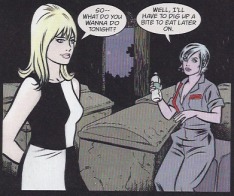
Yes, this series features a wereterrier and paintball. There is also a government task force called the “Dead Presidents”, whose name should be taken literally. Moreover, after Gwen meets cute with a monster hunter (who doesn’t notice that Gwen isn’t a normal human), he surprises her on their first date with a miniature golf outing. Not only does Gwen take this strange date location in stride, but she isn’t scared off when he gives a speech about the important role mini-golf played in his relationship with his mother. There are echoes of this a few issues later when Amon, the mummy character, announces that Skee Ball is the “passion” of his millenia-old life.

Mini-Golf!In short, this is a series in love with its own cleverness, where many of the interests that drive the characters are geeky pop culture elements. This could work, especially given the atmosphere created by Allred’s art, but it would be more effective if the ideas were more original than friendly werewolves. At the very least, the story needs to be less driven by random coincidences and characters who don’t act at all like believable people.

A good microcosm for the series as a whole is issue 6, which tells the backstory of wereterrier Spot. He’s a geek who loves comics and role-playing, but can’t talk to girls, and seems meant for the readers to identify with him. How did he meet up with Gwen’s group? Well, he kept staring awkwardly at them in a diner until she invited him to join them. Not only was that interaction completely unbelievable, but it doesn’t explain how these supernatural beings found each other. It’s difficult to accept that normal people don’t know about monsters when this group keeps bumping into strange creatures around every corner. In that same issue, Spot’s grandfather dies, and the narration goes out of the way to explain how Spot hadn’t talked to him in years and never thought to worry about the old man’s age or health. It’s not a problem, though: The grandfather’s soul becomes trapped in a chimpanzee’s body, and once again a supernatural creature accidentally joins the group without alerting normal people.

The most effective parts of the story are the mysteries that unfold very slowly, such as Gwen’s forgotten past, how it may relate to the mummy Amon, and whether a mad scientist is trying to raise a Lovecraftian horror. New pieces of information are doled out regularly, though they occasionally come up thanks to more coincidences (especially with people from Gwen’s past). In fact, the comic is usually juggling four or five plots at once. Roberson balances them very well, and in the right situation, it would be effective. Here, though, since half of the plots tend to be uninteresting, it just makes the story feel like it’s progressing too slowly.

iZombie has the right art and attitude to make it a lighthearted romp through monster cliches, but it falls short in the implementation. Without more original ideas and better plot devices, all those clever pop culture references just feel like cynical ploys from someone who doesn’t actually get them himself.

Grade: C-


Fucked Up – David Comes To Life (Music Review)

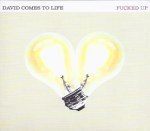
David Comes To Life cover

Fucked Up - David Comes To Life

It seems that there’s always one band to take up mantle as the potential savior of punk rock. Of course, they rarely seem to impact as much as expected: Where are all the bands inspired by The Refused or The New Bomb Turks? Regardless of their future legacy, though, Fucked Up has stepped into this role with the perfect approach for today’s music scene. From the radio-unfriendly name to the literate lyrics, this is legitimate punk for hipsters. The style works perfectly for people who might not normally listen to such hard music, as well: Vocalist Pink Eye just shouts the words in his throaty voice with a constant high energy level that could be almost a parody of punk. It can sound like noise at first, but after reading through the lyrics once, it sticks in the mind easily and the listener is inducted into the secret club of those who understand Fucked Up.

The band has a flair for the dramatic, and their experiments push the boundaries of what one would expect from their straightforward punk sound. Even knowing this, I don’t think anyone expected their 2011 release to be a rock opera. Over the course of 78 minutes, their character David falls in love, falls out of love, despairs, rails against the very concept of love, and then finally learns to open himself and accept pain as part of living life fully. David Comes To Life is possibly the most ambitious album of the year.

Most rock operas are confusing, showing the artistic overreach of classic and prog rock bands. This happens at times here, because Fucked Up is certainly capable of following their muse into strange territory. However, they are also grounded by a solid punk foundation, so quite a bit of the story is based on simple descriptions of emotions and events. The interplay between these two aspects of the band gives David an unpredictable feel, with every line like “He’s a ship on the sea, setting sail to perfidy” balanced by a catchy, heartfelt declaration like “Maybe it was my fault and I deserve to be upset, maybe the price of being wrong is a lifetime of regret.”

The first half of the album focuses especially on the literal story of a relationship and its aftermath. It’s so centered on the emotional rewards and costs that the plot specifics are barely given; The characters meet with a simple “hello, my name is David, your name is Veronica, let’s be together, let’s fall in love”, and the troubles begin two songs later with a perfunctory “right on time, here’s the other shoe”. It’s not a satisfying story, but the emotions, good and bad, come through with a clarity that few concept albums have ever conveyed.

As the story continues, it becomes more abstract and even metafictional. David’s anger leads to him directly confronting the narrator of the story, and the band seems to consider their own culpability in creating unhappy characters, but not before literally defeating David in battle. David is accused of murdering Veronica by people who sometimes seem completely literal, but other times imply that the actual crime was one of forgetfulness. Being only a character in a story, Veronica can’t survive if David blocks out her memory. These conceits are still peppered with a believable portrayal of emotions, though, and while I’d be hard-pressed to explain the details of the plot, David’s eventual healing and maturity feels like it was legitimately earned.

David Comes To Life is occasionally guilty of the ambitious failures that plague all rock operas, but it’s an impressive work overall. Fucked Up certainly put everything they could into it, too, with their lyrically dense songs filling up a CD to capacity. (As if that’s not enough, the liner notes include two additional poems, one providing an in-story introduction to go with the opening instrumental, and the other a tongue-in-cheek greeting to the fans.) However, it does fall short of the high bar set by the band’s last full-length, The Chemistry of Common Life. The focus on story and lyrics means that, despite the quantity, there is a lot less musical variety than an album of standalone tracks would have. And given that fans expect a high level of meaning out of all Fucked Up songs, the ongoing story is in some ways less dense in meaning than Chemistry was. Here, several songs might run together to say a single thing, rather than providing something new every few minutes.

There is no reason to complain too much about the flaws in this album, though. Fucked Up continues its reign as the Great Hope of Punk, giving their all for a work whose ambition only slightly outpaces its accomplishments.

Grade: A-


Webcomics Roundup – On Broadcasting

A few weeks ago, Warren Ellis posted his thoughts on the current state of webcomics. In short, he drew a line between “webcomics”, which are freely available, and “digital comics”, which people must buy through a service like Comixology. He regrets, but understands, the fact that attention seems to have shifted away from webcomics in recent years, as people realize that selling them up front is still the best way to make money. The problem is that only webcomics have the ability to “broadcast” themselves. As soon as a webcomic is updated, it’s “surrounded by an expanding sphere of URLs and shortcodes, of RTs and Likes and +1s” that you can’t get from the other side of a pay-wall. The implication is that webcomics offer a free, no-pressure space for artists to develop masterpieces, but that the most skilled people are going to need to migrate over to the digital comics side in order to survive.

My thoughts about this are below the fold.

Continue reading