
Spider-Man’s recent direction is still controversial in a lot of people’s minds: 2007’s “One More Day” storyline, which arbitrarily undid years’ worth of stories, was very poorly done. However, the intention of that disappointing event was to undo the damage done by all the other poorly-planned changes Marvel had sent Spider-Man through. In that respect, Marvel finally made the right choice: “Brand New Day” kicked off in 2008, with thrice-monthly issues and a small cabal of writers dedicated to stories about Spider-Man’s responsibility and Peter Parker’s friends. It was a stunning success, and it felt like Spider-Man again.
The “Brand New Day” status quo shifted to “Big Time” last November, though it wasn’t nearly as significant a change. Dan Slott, part of the team in “Brand New Day”, became the chief writer, and Amazing Spider-Man switched to two issues per month. Within the comic, “Big Time” represented the idea that maybe things can go right for Peter sometimes. He gets a fun new girlfriend, a job that uses his science skills, and once again finds respect from the hero community. It’s a really nice change of pace from most modern comics, in which the superhero is repeatedly ground down to show the strength of his resolve and the danger of his enemies.
This is a review of issues #648-#665 of Amazing Spider-Man. I’m not sure if Marvel considers the “Big Time” era over now, but the next issue begins the major “Spider Island” event, followed by the launch of a new Spidey title, so it seems like the right place to examine this run.
Skimming through these issues again to write this review was surprisingly fun, as Slott’s deft touch and master plan are more obvious when reading the stories for a second time. His strengths lie in the way he can balance his love for the characters with the need for a good story, as well as spacing a longer story throughout interesting single issues. The comics touch on every era of Spider-Man’s history, but they manage to move the plot forward without just being safe retread of past hits. Doctor Octopus is changing into something more desperate and sinister. Jonah Jameson continues with some of his first real character development in history. And Peter actually loses his “spider-sense”, leading to twists in the challenges he faces and the ways he has to fight. This feels natural, unlike the costume changes and tacked-on gimmicks that Marvel used to try out on Spider-Man. (Admittedly, Peter does make a few new costumes with the resources his new job gives him. These provide new abilities that make up for his loss of spider-sense. In the short run, it’s a nice change. In the long run, though, it does feel arbitrary for Peter to keep inventing ways out of his current problem. This spider-sense change is an enjoyable diversion, but I hope it’s a temporary one.)
Near the end of this run, Spider-Man’s defeats (for now) Mr. Negative, one of the new villains from the “Brand New Day” era. However, “new” is a relative term when a comic is coming out two to three times a month: It’s actually been more than 100 issues since Mr. Negative was introduced in 2008, and having his story planned and executed over such a long timeframe is an impressive feat. Very few writers ever get to stick with one character long enough to pull off a trick like that.
While it is good to see the hero win throughout “Big Time”, don’t expect it to come without struggle. In particular, one long-time supporting character dies in this run. Rather than feeling like a grab for attention, this is actually moving. The tribute issue that follows, with extended silent scenes demonstrating the holes the death leaves in others’ lives, was one of the best single comics of the year.

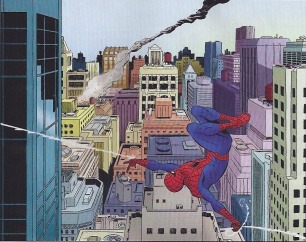
On many of the later issues, Slott is joined by writer Fred Van Lente, who takes care of the actual dialog. This is the perfect combination: Slott does a great job handling the plots, but Van Lente is better at the quintessential Spider-Man dialog (both snappy and dramatic without ever feeling overdone). The art is a little less even, unfortunately. No one artist can keep up with a twice-monthly schedule, so the comic rotated through several. None are bad, and some are very good, but as you can see above, the styles are not consistent from one to the next.
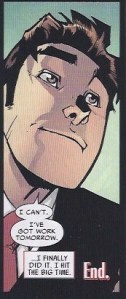 In a recent review, I called Batman Incorporated “exactly what a superhero comic should be”. At the time, I was still so impressed by that comic’s early issues that I hadn’t really considered that the later ones were harder to follow and only decent in quality. I’d like to correct that statement: Dan Slott’s run on Amazing Spider-Man is, in fact, exactly what a superhero comic should be. Fun, usually uplifting issues that focus on both the hero and the people around him, and that make use of a rich backstory without getting bogged down in it. It may still be controversial, but I’m confident that we are witnessing one of the classic eras of Spider-Man comics.
Grade: A-
 Today marks the big turning point for DC Comics. Instead of their usual fifteen to twenty new comics, they only released two: Flashpoint #5 completes the event that ends their current universe and Justice League #1 kicks off the new era. I’m going to review Flashpoint (the entire event) today, and look at the opening to Justice League tomorrow (update: here it is).
 The major comic news of the past month has been
  Terry Moore is one of the big names among self-published cartoonists, having worked on Strangers In Paradise since the early 1990’s. But one drawback to writing, illustrating, and publishing your own comic is that you spend all your time focusing on one. Perhaps for that reason, Moore ended Strangers In Paradise in 2007 to begin a new series, Echo. Echo just finished its run as a single 30-issue story, and a new series will be taking its place soon. This is probably the right strategy to pursue in today’s comic market. At the very least, it convinced me to try out his work.
 Note: So far, I’ve only reviewed comic series after they concluded. I’d to occasionally examine ones that are still ongoing, as well. As issue #24 of The Unwritten was just released, it seems like a good time. This is the point where most Vertigo titles are cancelled, so it’s now safe to say that this series should have have a long life ahead of it. In this case, it also happens to be the point where author Mike Carey says the first act is concluded. In a happy coincidence, as I was writing this review, I got word that volume 2 of this series had been nominated for a Hugo award.
 Cult of the New